
Research Focus: The formation of ice in clouds
What environmental challenge does your research tackle?
I look at tiny “ice-nucleating particles”. These form ice in clouds and can turn clouds from fluffier to wispier. I do this
because fluffier clouds reflect more sunlight that would otherwise heat the Earth. The amount of light reflected will
change in our future, hotter climate, but we don’t know how much.
What is one thing you want everyone to know about your project?
Water in clouds doesn’t freeze at 0 °C – in fact cloud drops can “supercool” to temperatures as low as -35 °C, colder than your freezer! However, they can freeze at temperatures warmer than -35 °C if they meet an ice-nucleating particle: these are particles like dust, sea spray or biological particles that are carried by the air.
What is the strangest or most surprising thing you have encountered during your fieldwork?
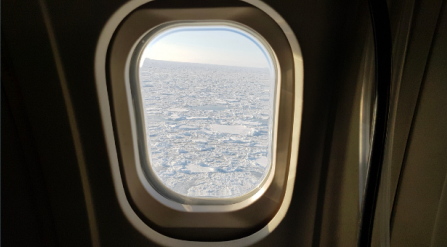
I’ve flown in a jet plane only 15m over the Arctic Ocean to measure these particles. When we were over water, the spray from the waves was almost reaching the plane!