
Project Description:
Contrails are the clouds which form behind aircraft as they fly through regions of the atmosphere when certain temperature and water content conditions are
fulfilled. These clouds have a substantial warming effect on the planet as they serve as blankets to keep the Earth warm. Understanding exactly how contrails
form is key to moving towards more sustainable air travel.
To date, most research into contrail formation has focused on the effect of soot emitted by the combustion processes in jet engines. However, we are moving
towards cleaner burning engines and increasing the use of sustainable aviation fuel, both of which serve to reduce the amount of soot emitted by jet engines.
As the concentrations of soot decrease, the relative importance of other aerosol types in contrail formation increases. These include volatile materials
produced by the jet engine, such as lubrication oil or unburnt jet fuel, as well as any ambient particles already present in the environment.
During this project, you will join the Ice Nucleation Group led by Ben Murray. Here you will be trained to work in a state-of-the-art aerosol laboratory as part
of a team investigating contrail formation in soot-poor environments (led by Jack Macklin). You will be trained on a wide range of aerosol equipment,
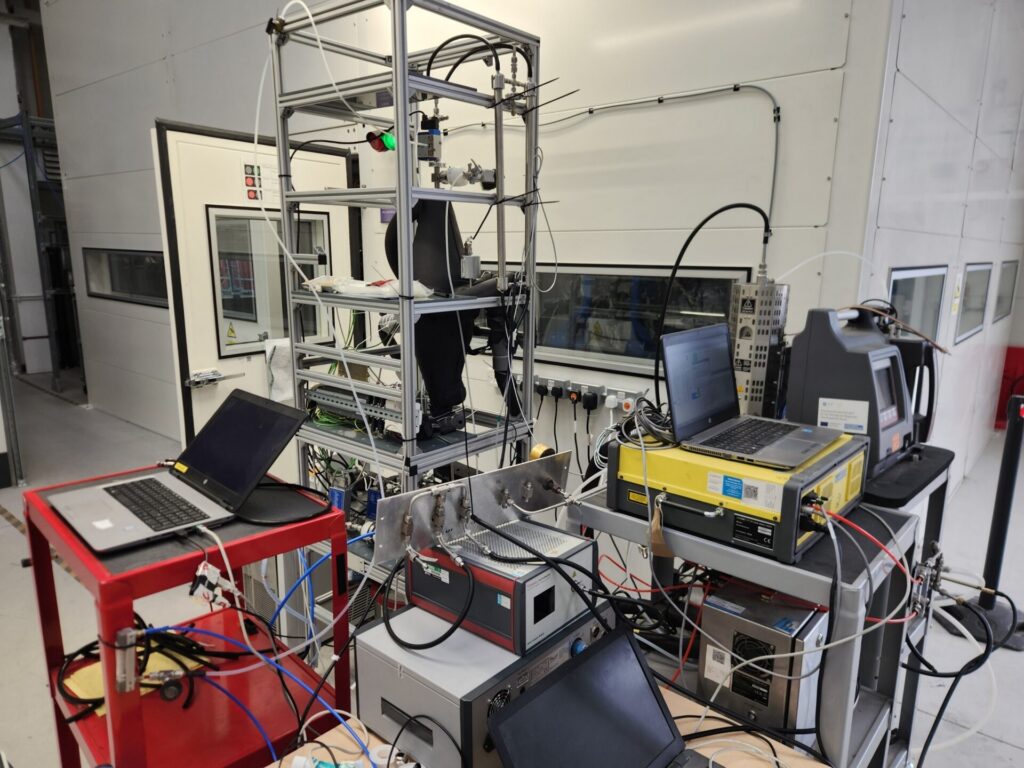
including the unique Portable Ice Nucleation Experiment (PINE). You will help to collect and analyse data on a variety of different aerosol types that we will
produce ourselves, including soot produced by a propane burner and jet engine lubrication oil.
You will have the opportunity to present our findings in the weekly Ice Nucleation Group meetings, which you will become an active member of. You will be
able to participate actively in a lively and friendly research team and directly contribute to the research culture and knowledge in the University.
At the start of the project, Jack, a postdoctoral research associate in the Ice Nucleation Group, will train you on a variety of aerosol instruments. These include
particle size and concentration measurement equipment such as SMPS, APS and CPC, aerosol size selection equipment, such as an AAC, and PINE. PINE is a
unique instrument used to study the ice forming abilities of different aerosol types by producing an artificial cloud that the Ice Nucleation group in Leeds
helped to develop.
You will also be taught to produce aerosol samples through a variety of techniques. These include combustion with a propane burner, suspension of dry
particles in a dust tower, and production of droplets with a nebuliser. Each of these methods produces different particle types which will all compete for water
vapour during the contrail formation process. You will be running experiments to determine the relative importance and role of each of these particle types
under different contrail formation conditions.
Throughout your project you will be closely integrated within the rest of the Ice Nucleation group, come to group meetings and be part of our enthusiastic
team. You’ll also have the opportunity to meet with our collaborators in Imperial College London and across Europe in online meetings. We’ll also teach you
how to use Python to analyse and visualise experimental data.
Pre-requisites: N/A
Supervisory Team: Jack Macklin & Benjamin Murray
Contact:
Jack Macklin: [email protected]
Benjamin Murray: [email protected]