
A petrological investigation of mafic explosive volcanic eruptions in southern Chile
Aims
This exciting project aims to understand how the accumulation of basaltic magmas beneath arc volcanoes leads to high intensity ignimbrite forming eruptions. Using petrological and geochemical methods it will examine the products of high-intensity eruptions from volcanoes in the Chilean southern volcanic zone, constraining the conditions that gave rise to these explosive events.
Background
Subduction zone magmatism is responsible for some of Earth’s most powerful volcanic eruptions and plays a critical role in long-term geochemical cycles. Arc volcanoes commonly produce eruptions that vary widely in magnitude and intensity, ranging from effusive lava flows to large, explosive ignimbrite-forming events. The tempo and intensity of such eruptions can be influenced by a combination of internal and external factors that affect magma supply and storage within crustal reservoirs. Gaining a better understanding of the chemical and physical processes operating within these magma systems—particularly prior to large explosive eruptions—is essential not only for assessing volcanic hazards but also for understanding the broader role of arc volcanism in Earth system processes.
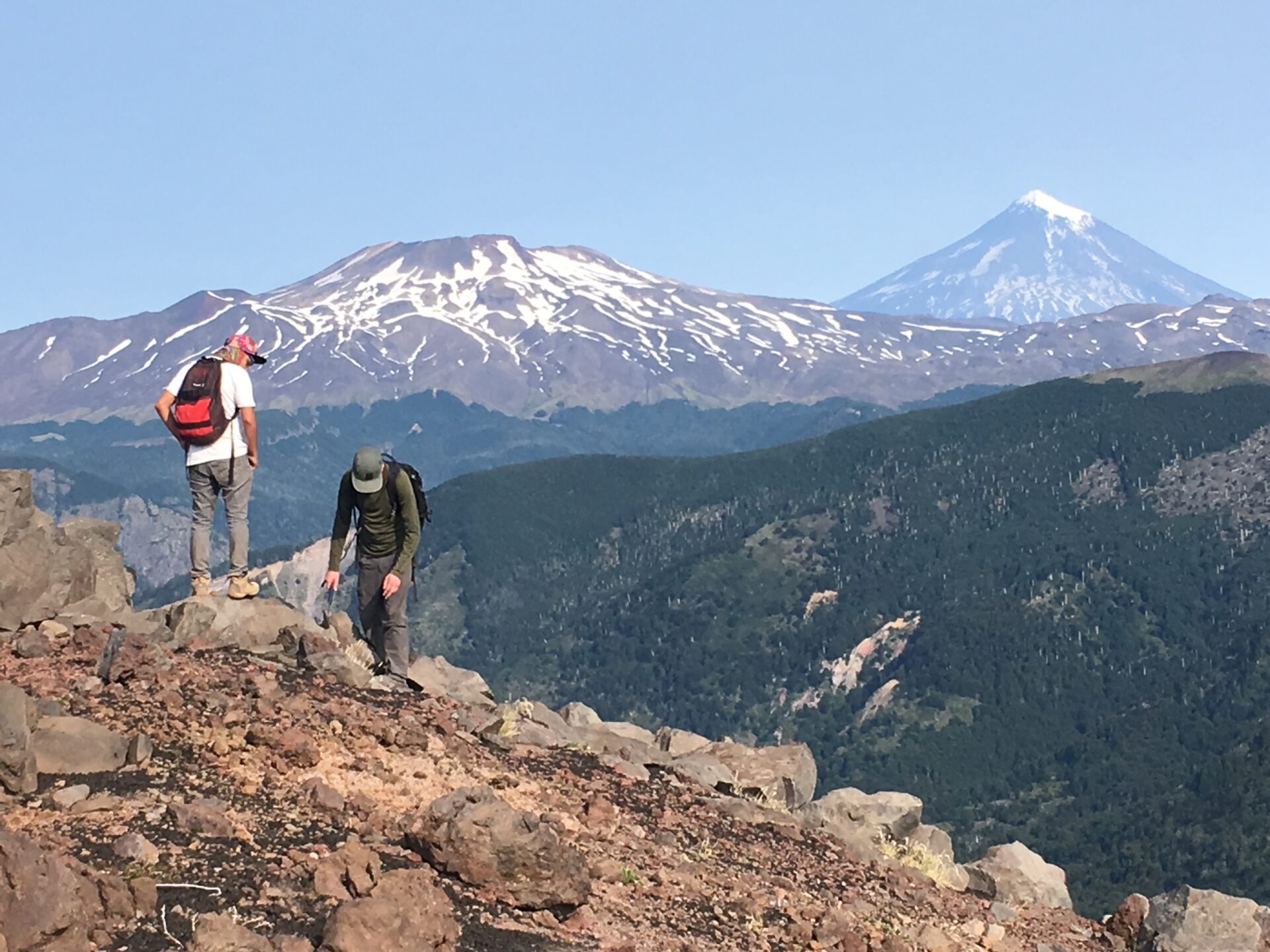
This project focuses on volcanism in the Southern Volcanic Zone (SVZ) of Chile, home to numerous highly active and long-lived arc volcanoes. While subduction is the primary driver of volcanism in this region, external factors such as tectonic (e.g., a major intra-arc fault system) and glacial (e.g., the retreat of the Patagonian Ice Sheet) activity are hypothesised to modulate magma ascent and eruption timing. Notably, some SVZ volcanoes—such as Villarrica and Llaima—have produced mafic ignimbrites, a deposit type typically associated with large silicic eruptions. If such eruptions were to occur today, they would pose significant hazards to the region, however, the processes that triggered these unusual events remain poorly understood. In some cases, these ignimbrites erupted shortly after deglaciation, suggesting a potential link between ice retreat and eruption timing.
Analytical approach
Initial work will involve an investigation of the pre-eruptive storage conditions of magmas involved in large ignimbrite-forming eruptions at Villarrica and Mocho-Choshuenco volcanoes (specifically, the Lican and Enco eruptions). This first phase of the project will utilise existing tephra and pumice samples housed at the University of Leeds. Subsequent fieldwork in Chile will aim to collect additional material, potentially expanding the study to include other centres such as Llaima (e.g., the Carcautin ignimbrite). The analytical approach will involve the preparation and microanalysis of crystal phases from erupted material to determine pre-eruptive conditions using mineral-based thermobarometry and to estimate magma reservoir formation timescales via intra-crystal diffusion chronometry. These data will be used to assess whether the assembly of melt reservoirs associated with ignimbrite-forming eruptions differs significantly from those feeding smaller or less explosive events.
Much of the analytical work will be conducted using facilities at Leeds, including the electron microprobe and scanning electron microscope. Depending on the results and the researcher’s interests, further analyses may involve applications to use specialised instruments such as the NERC Ion Microprobe Facility, for example, to investigate pre-eruptive volatile contents in melt inclusions. Over the course of the project, the researcher will gain expertise in petrological analytical techniques, geochemical data modelling, and field sampling in volcanic terrains.
Student profile
We are seeking a student with a background in geological or earth sciences and an interest in applying geochemical and petrological methods to investigate volcanic and magmatic processes. There is flexibility within this topic to tailor the work to the specific interests of the student as the project develops. Prior experience of sampling in volcanic terrains and/or geochemical microanalysis would be beneficial but is not essential.
Further reading
Boschetty, F.O., Ferguson, D.J., Cortés, J.A., Morgado, E., Ebmeier, S.K., Morgan, D.J., Romero, J.E. and Silva Parejas, C., 2022. Insights into magma storage beneath a frequently erupting arc volcano (Villarrica, Chile) from unsupervised machine learning analysis of mineral compositions. Geochemistry, Geophysics, Geosystems, 23(4), p.e2022GC010333.
Feignon, J.G., Cluzel, N., Schiavi, F., Moune, S., Roche, O., Clavero, J., Schiano, P. and Auxerre, M., 2022. High CO2 content in magmas of the explosive andesitic Enco eruption of Mocho-Choshuenco volcano (Chile). Bulletin of Volcanology, 84(4), p.40.
Rawson, H., Pyle, D.M., Mather, T.A., Smith, V.C., Fontijn, K., Lachowycz, S.M. and Naranjo, J.A., 2016. The magmatic and eruptive response of arc volcanoes to deglaciation: Insights from southern Chile. Geology, 44(4), pp.251-254.