
Can machine-learning weather models improve weather forecasts for Africa?
Motivation
Over more than the last 60 years, forecasting using numerical weather prediction (NWP) has provided a slow and steady “quiet revolution”, with progress in skill giving enormous socioeconomic benefits. This business-as-usual approach to forecasting is now being disrupted by machine-learning (ML), which is providing a fast-paced revolution, although the extent of the benefits from this are currently unclear.
NWP has brought greatest benefit in the mid-latitudes. On typical forecast time-scales of days, progress in the tropics has not been as great, due in part to the dominant role of convective storms in the tropics, which NWP struggles to represent: currently even state-of-the-art post-processed global NWP models struggle to beat climatology for a 1-day rainfall forecast for large parts of Africa.
There is therefore a huge opportunity to improve forecasting in the tropics using ML, or hybrids between NWP and ML. In particular, there is an urgent need to develop effective approaches to evaluate new ML tools alongside physical models, across timescales: not just for their average skill, but for user-relevant quantities, understanding how models capture the relevant physics, and how this relates to their reliability. This is particularly important for extremes, and unprecedented extremes, which with climate change are causing increasing harm.
Progress in Africa is vital, with only 40% of Africans having access to multi-hazard early warnings, and the UN’s “Early-warning for All” initiative aiming to deliver 100% coverage. The growing role of the private sector, with “big tech” producing ML global forecast models, and private companies selling forecasts, only increases the need for scientific evaluation of forecast tools to inform both their development and application.
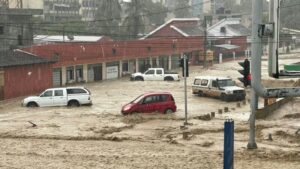
Flooding in Mozambique (Photo: Red Cross). Improved forecasts can enable early action.
Aims, Objectives and Impacts
The project will deliver the vital rigorous scientific evaluation of NWP and ML forecast models that is needed for users to benefit from the opportunities that ML provides. Critically this work will not only assess model’s skill, but develop scientific understanding of processes and model performance.
Using state-of-the-art ML & physical models, the project will:
- Evaluate forecast skill for focus regions in Africa, understanding skill in user-relevant weather variables (e.g., precipitation across different time scales, extreme precipitation, dry and humid heatwave indices). Many ML systems now produce ensemble-based metrics, so probabilistic verification will also be carried out, for example by investigating how the error growth is related to the development of bias and ensemble-spread.
- Analyse skill as a function of driving phenomena (e.g., the Madden Julian Oscillation, Kelvin Waves and African Easterly Waves), addressing error growth on different spatial scales.
- Address aspects of the model physics which we know to be important in the tropics, where both NWP and ML are expected to have limitations, such as organised convection and land-atmosphere interactions, assessing how models’ abilities to capture these phenomena (or not),and link this to their skill and reliability.
Throughout we will pay particular attention to predictability of extremes and unprecedented events, since these have the greatest impacts on the most people in Africa.
Extensive ongoing collaborations between Leeds and groups in Africa will support translation of project results, to real-world impacts.
Training and Environment
The student will join a large group at Leeds (more than 5 academics) working on tropical weather prediction in a variety of projects, many including ML, whose research work with the Global South (especially Africa) was recently recognised by the award of a Queen’s Anniversary Prize. There may be opportunities to travel to Africa, to develop collaborations there, although this is not essential.
Development and evaluation of ML forecast models is an important priority for the Met Office. The project is co-supervised by (Prince Met Office in Exeter) and Richard Keane (Met Office and Leeds, based in Leeds). Visits to the Met Office will facilitate wider collaborations with scientists there, working on forecast model development, application and evaluation, again facilitating widespread impact.
Student Background
The project will suit students from a wide variety of backgrounds (e.g. maths, physics, meteorology, environmental science, or computer science) who are keen to understand model performance and relate this to the meteorology to deliver scientific the understanding needed to inform applications.
Further reading
Keane et al., 2025, Met. Apps.
Vogel et al., 2018, Wea. Forecasting.