
YES-27-A-05: Cold-air pools in urbanised mountain regions – improving weather and climate prediction
Overview
Mountain–atmosphere interactions are central to weather and climate globally. They profoundly influence the atmosphere across a wide range of scales, generating atmospheric waves, modifying large-scale flows, and producing mesoscale and microscale circulations and turbulence.
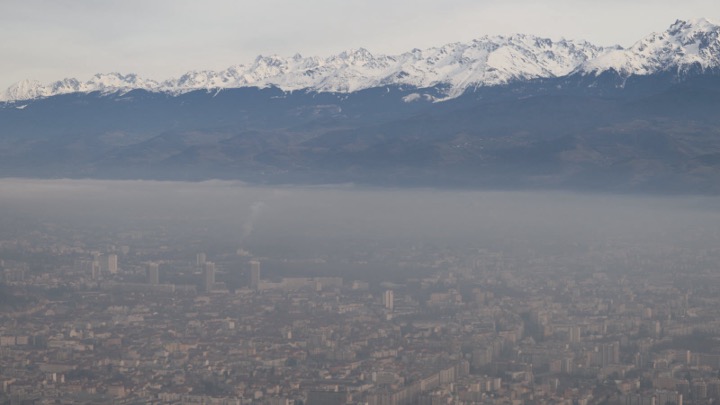
Mountains can also create extreme and highly variable weather environments. In particular, mountain basins and poorly drained valleys can trap cold air near the surface. These cold-air pools can lead to freezing temperatures, fog, road icing and the accumulation of air pollution, creating risks for agriculture, transport and human health.
The development of cold-air pools depends on terrain, large-scale atmospheric flow and land cover. While the role of large-scale flow is relatively well understood, the influence of land cover—particularly urbanisation—is less well characterised. Little is known about how urban circulations interact with valley and mountain winds to influence the formation, evolution and breakdown of cold-air pools.
This project will investigate these processes, focusing on urbanised Alpine valleys, while developing insights relevant to urban mountain and valley environments worldwide. It will suit candidates interested in atmospheric processes in complex terrain and in developing improved weather and climate prediction through the integration of observations, numerical modelling and data-driven approaches.
Research Project
The aim of this project is to understand how urban areas interact with cold-air pooling in mountainous terrain, develop models of these interactions, and investigate their environmental impacts and potential mitigation options.
The successful applicant will use the Met Office Unified Model (MetUM) together with the MORUSES urban-canopy model to investigate urban–atmosphere interactions in complex terrain. The research will focus primarily on urbanised Alpine valleys, using both idealised and realistic simulations, and will evaluate model results against observations from the TEAMx programme.
The project will investigate how cold-air pooling varies with urban characteristics, terrain scales and large-scale atmospheric flow. Numerical experiments will systematically perturb key controls on cold-air pooling, particularly urban parameters, and evaluate their effects using appropriate cold-air-pooling metrics.
The project will also provide an opportunity to exploit the rapidly increasing volume and diversity of observations from urban areas, including citizen-science and other non-traditional observations. These datasets have considerable potential to improve our understanding and modelling of fine-scale urban weather. Depending on the direction of the project, machine learning (ML) and artificial intelligence (AI) approaches may be used to identify relationships between urban characteristics, atmospheric conditions and cold-air pooling, and to develop new diagnostic or predictive approaches.
The combination of physical understanding, numerical modelling, emerging observations and data-driven methods is particularly relevant to the future development of UK weather prediction and to the work of the Met Office.
The project is aligned with TEAMx (Multi-scale transport and exchange processes in the atmosphere over mountains – programme and experiment; http://teamx-programme.org), an international initiative combining intensive observations and modelling of atmospheric processes over mountains. There will be opportunities to engage with the TEAMx research community and to travel to the European Alps as part of the programme.
The project is also aligned with the National Centre for Atmospheric Science (NCAS) Weather Science Programme, with the student becoming part of the wider NCAS research community.
The Met Office is a project partner. The successful applicant will work with the Met Office research team and undertake visits to the Met Office during the project.
Candidate Requirements
Applicants should hold a degree in mathematical, physical, environmental, atmospheric, or a closely related science.
Experience with scientific programming, numerical modelling or data-driven analysis would be advantageous.
Further Information and Applications
The unique project code for this project is: YES-27-A-05.
For further information, please contact Dr Charles Chemel ([email protected]).
Details of the application process can be found at: https://yes-dtn.ac.uk/how-to-apply-2/.