
Do Antarctic bioaerosols influence clouds and climate in the Southern Ocean?
Background and motivation
Discrepancies between global climate model simulations and observations of surface radiation and sea surface temperature are larger over the Southern Ocean than anywhere else in the world, making this region a major source of uncertainty in predicting global climate (Lauer et al., 2018). One important reason for this is the poor representation of aerosol-cloud interactions and mixed-phase clouds (containing both water and ice). A key factor in these interactions are ice-nucleating particles (INPs), a rare aerosol that triggers the freezing of supercooled cloud droplets, substantially influencing cloud lifetime and radiative properties (Murray et al., 2021). Remote marine environments such as the Southern Ocean are thought to be dominated by INPs from sources such as sea-spray aerosols and blowing snow that have low ice-nucleating activity. However, INPs entering the region from long range sources (e.g. desert dust) or the Antarctic continent could have a huge impact. Biological INPs have been found to be very efficient at freezing water and represent an INP source that is unaccounted for in aerosol models.
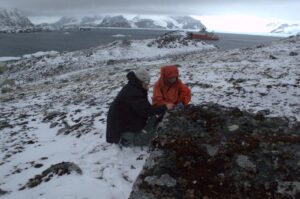
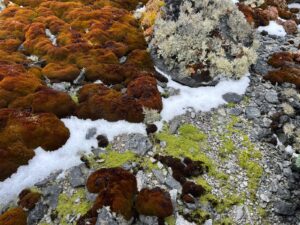
Although most of Antarctica is covered by ice, its exposed areas are rich in mosses and lichens. Compared to vascular plants, bryophytes dominate the Antarctic flora (Câmara et al., 2021). On Alexander Island off the Antarctic Peninsula, up to 47% of moss species produce sporophytes, each capable of releasing thousands of spores that can be dispersed over long distances.
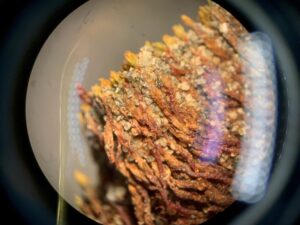
We recently discovered that several Antarctic moss and lichen samples, even decades old, show high ice-nucleating activity. If their spores or fragments can be lifted into the atmosphere, they could exhibit a huge influence on Southern Ocean clouds even in relatively low concentrations, compared to much more abundant but far less ice-active sea-spray aerosols.
Your project, in collaboration with the British Antarctic Survey, will investigate Antarctic mosses and lichens as potential INP sources. You will assess how efficiently they produce INPs, whether these can be aerosolised and transported, and what their potential impact could be on clouds and climate in the Southern Ocean. These findings may be particularly important in a warming climate that could see increased cryptogam coverage in Antarctica.
Project objectives
- Work with partners at British Antarctic Survey (BAS) to identify Antarctic mosses and lichens from samples recently collected from the Southern Ocean Clouds (SOC) project, and from the Antarctic herbarium collection.
- Measure their ice-nucleating activity using state-of-the-art freezing assays and novel microfluidic technologies developed at Leeds.
- Isolate and test their different structures (spores, tissues, filaments) to identify the source of ice-nucleating activity.
- Use aerosol chamber facilities with state-of-the-art online monitoring instruments to test how mosses and lichens release spores or fragments into the air and determine their sizes and atmospheric lifetime.
- Compare laboratory findings with aerosol samples collected during the SOC project to assess whether mosses and lichens contributed to INP signals.
- Employ aerosol dispersion modelling to explore how Antarctic bioaerosols may be transported over the Southern Ocean and whether they can compete with sea-spray or long-range transported dust.
- Investigate future scenarios in which a warming climate may increase Antarctic greening.
- Potentially carry out polar field work at a research station or on board the RRS Sir David Attenborough, for example as part of the CASS scheme.
Training
You will join the Ice Nucleation Group at the University of Leeds, and work closely with project partners at British Antarctic Survey (BAS). You will be trained in the use of state-of-the-art ice nucleation and aerosol sampling technologies, novel microfluidic biological assays, and aerosol modelling to help improve our understanding of INPs in remote regions and their influence on clouds. Research areas will include atmospheric and aerosol science, bioanalytical chemistry, modelling, and aspects of design and engineering. Training will be bolstered with a secondment to the British Antarctic Survey to directly work with polar scientists, and there will be opportunities to attend polar science and bioaerosol science summer schools. There might be a potential to participate in a scientific cruise to Antarctica to perform studies in the field, though the project will not be dependent on the collection of new field data. You will also develop highly transferable skills in science communication, data analysis, programming, interdisciplinary collaboration, and planning.
Further reading
Câmara et al., Antarctic bryophyte research — current state and future directions, Bry. Div. Evo., 43, 221, https://doi.org/10.11646/bde.43.1.16, 2021.
van den Heuvel, Tarn et al., Investigating potential sources of Ice Nucleating Particles around the Antarctic peninsula, EGU General Assembly 2024, Vienna, Austria, 14–19 Apr 2024, EGU24-16088, https://doi.org/10.5194/egusphere-egu24-16088, 2024.
Lauer et al., Process-level improvements in CMIP5 models and their impact on tropical variability, the Southern Ocean, and monsoons, Earth Syst. Dynam., 9, 33, https://doi.org/10.5194/esd-9-33-2018, 2018.
Murray et al., Opinion: Cloud-phase climate feedback and the importance of ice-nucleating particles, Atmos. Chem. Phys., 21, 665, https://doi.org/10.5194/acp-21-665-2021, 2021.