
YES-27-D-09: Linking earthquake mechanics to fault property evolution in space and time using field observations and novel experiments
In this exciting project you will investigate the physical processes that dictate earthquake recurrence. You will link field observations at different scales with experimentally determined changes in fault properties to explore the evolution of fault zones in time and space. Results will be important for our fundamental understanding of earthquakes and future earthquake hazard assessment.
Motivation and background
This project tackles the problem that we do not fully understand how and why earthquakes start, propagate, and stop. The physical processes that control earthquake occurrence and character are likely governed by the spatial and temporal evolution of fault surfaces and fault damage zones. These processes operate at scales from the atomic to kilometre(s).
Slip in earthquakes is observed to correlate with fault properties. Earthquakes are suggested to initiate at high stress regions near km-scale fault complexities, and surface features such as asperities can accommodate high slip. Much work has been done to investigate how properties such as fault surface roughness may control earthquake behaviour, but these properties have never been directly linked to observations of deformation and fluid related changes in the fault rocks and fault surfaces themselves.
This interdisciplinary project will take advantage of recent advances in observational capability and will use novel applications of analytical and experimental techniques in both geoscience and tribology (the study of interacting surfaces in relative motion).
Hypothesis and Objectives
We will hypothesize that there is a quantitative link between paleostress and fault surface properties that suggests features such as roughness, chemistry, and structural complexity control the distribution of slip in earthquakes.
The project objectives are to:
- Use tribology experiments to investigate the link between fault friction and surface roughness, in the presence of fluids.
- Make detailed observations on exceptionally well exposed faults and their surrounded deformed zone (fault surfaces, damage zones, gouges).
- Observe how microstructural observations of mineral stress concentrations are related to surface properties to understand the 3D spatial distribution of fault strength.
- Scale up the experimental results by characterising and mapping the same structures across a fault surface.
- Link microstructural observations to metre-kilometre scale fault complexity and slip rate variation to develop a framework for the dynamics of earthquakes through time and space.
You will have the opportunity to conduct field work in the Apennines, central Italy, where we have extensive field experience, initial data, and known field sites. There is potential for fieldwork in other regions, such as western Turkey.
Experimental work will be conducted at the Institute of Functional Surfaces (Leeds), using novel fluid-present tribology experiments to investigate the influence of fluid chemistry and rock properties (e.g. porosity, surface structure) on fault friction and stick slip behaviour, and their link to microstructural development.
Student profile and research environment
You should have a strong interest in active tectonics, a desire to undertake laboratory and fieldwork overseas, and a strong background in a quantitative science (earth sciences, geophysics, geology, physics, and natural sciences). Willingness and excitement for taking up the challenge to work at the boundary of geophysics, mechanics and microstructural analysis utilizing a combination of technique (field analysis, in-depth microstructural analysis, experiments and/or numerical modelling) is a prerequisite. This is a multidisciplinary project, but we welcome students with enthusiasm for any relevant field as the project is flexible based on your interests.
You will be part of a vibrant COMET (Centre for the Observation and Modelling of Earthquakes and Tectonics) community, as well as various research clusters in Engineering and Earth Sciences at Leeds.
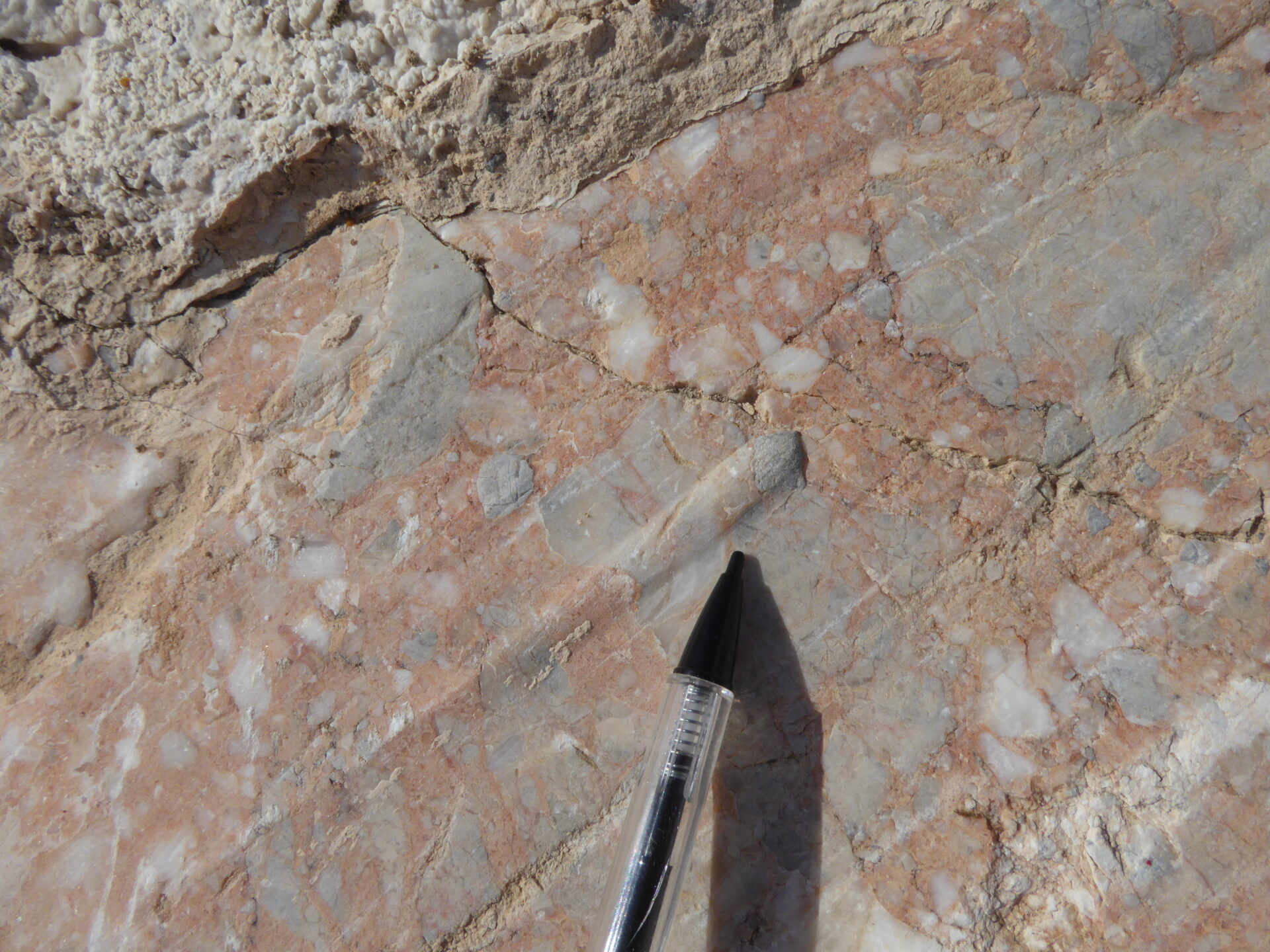
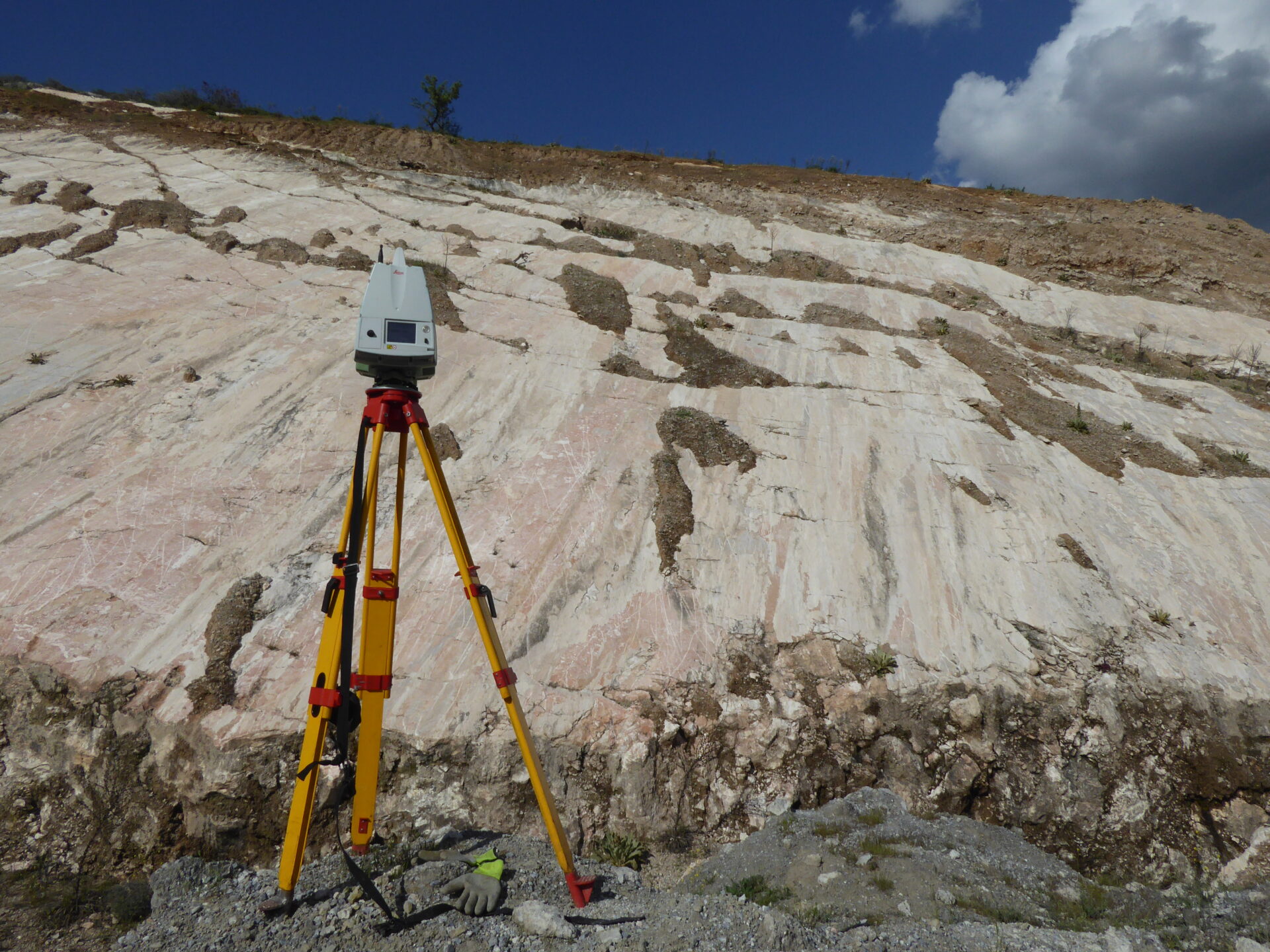
Figure 1: (Left panel) Surface roughness at the centimetre scale, with visible fault breccia. (Right panel) Surface roughness at the 1 – 10 m scale, Terrestrial Laser Scanner in foreground. Both photos are from the Rahmiye fault in western Turkey.
References
Allam, A. A., Kroll, K. A., Milliner, C. W. D., & Richards-Diner, K. B. (2019). Effects of fault roughness on coseismic slip and earthquake locations. Journal of Geophysical Research: Solid Earth, 124, 11,336 – 11,349. https://doi.org/10.1029/ 2018JB016216
Armitage, J. L., Ghanbarzadeh, A., Bryant, M. G., & Neville, A. (2022). Investigating the influence of friction and material wear on triboelectric charge transfer in metal–polymer contacts. Tribology Letters, 70(2), 46.
Brodsky, EA; Kirkpatrick, JD; and Candela, T (2016). Constraints from fault roughness on the scale-dependent strength of rocks. Geology 44, 19-22, doi:10.1130/G37206.1
Collettini, C; Carpenter, BM; Vitti, C; et al (2014). Fault structure and slip localisation in carbonate-bearing normal faults: An example from the Northern Apennines of Italy. Journal of Structural Geology v 67, 154-166.
Cowie, PA; Phillips, RJ; Roberts, GP; McCaffrey, K; Zijerveld, LJJ; Gregory, LC; Faure Walker, J; Wedmore, LNJ; Dunai, TJ; Binnie, SA; Freeman, SPHT; Wilcken, K; Shanks, RP; Huismans, RS; Papanikolaou, I; Michetti, AM; and Wilkinson, M (2017). Orogen-scale uplift I nthe central Italian Apennines drives episodic behaviour of earthquake faults. Scientific Reports 7:44858, doi: 10.1038/srep44858.
Davidesko, G; Sagy, A; and Hatzor, YH (2014). Evolution of slip surface roughness through shear. Geophysical Research Letters 41, 1492–1498, doi:10.1002/2013GL058913.
Delle Piane, C., Piazolo, S., Timms, N. E., Luzin, V., Saunders, M., Bourdet, J., … & Verrall, M. (2018). Generation of amorphous carbon and crystallographic texture during low-temperature subseismic slip in calcite fault gouge. Geology, 46(2), 163-166.
Dunham, EM; D Belanger, L Cong; and JE Kozdon (2011). Earthquake ruptures with strongly rate-weakening friction and off-fault plasticity, part 2: Nonplanar faults.” Bulletin of the Seismological Society of America 101 (5), pp 2296–2307, doi: 10.1785/0120100076
Marone, C (1998). The effect of loading rate on static friction and the rate of fault healing during the earthquake cycle. Nature 391, pp 69-72.
Piazolo S; La Fontaine A; Trimby P; Harley S; Yang L; Armstrong R; Cairney JM (2016) Deformation-induced trace element redistribution in zircon revealed using atom probe tomography, Nature Communications, 7, . doi: 10.1038/ncomms10490
Piazolo S; Montagnat M; Grennerat F; Moulinec H; Wheeler J (2015) Effect of local stress heterogeneities on dislocation fields: Examples from transient creep in polycrystalline ice, Acta Materialia, 90, pp.303-309. doi: 10.1016/j.actamat.2015.02.046
Piazolo, S., & Langone, A. (2026). Zircon deformation features reveal sequence of transient high stress, tension and shearing during seismic faulting: A case study from the Ivrea-Verbano Zone, Italy. Earth and Planetary Science Letters, 679, 119858.
Rice, JR (2006). Heating and weakening of faults during earthquake slip. Journal of Geophysical Research 111; B05311, doi:10.1029/2005JB004006.
Weldon, R; Scharer, K; Fumal, T; and Biasi, G (2004). Wrightwood and the earthquake cycle: what a long recurrence record tells us about how faults work. GSA Today 14 (9), pp 4-10.