
How much do agricultural sources actually contribute to UK nitrogen oxide emissions?: Implications for future air quality and climate
Project summary
Nitrogen oxides (NOx = NO + NO2) are both a direct air pollutant and play a central role in the atmospheric chemistry controlling the removal of emitted gases and the production of secondary pollutants. Understanding NOx emissions both now and into the future is therefore essential if we are to tackle environmental challenges such as air pollution, climate and acid deposition. In many parts of the globe dramatic reductions in NOx emissions from road transport is resulting in current and projected NOx source profiles being unrecognisable from those of 20 years ago. Although something to be celebrated, this has resulted in a large and growing uncertainty in projections of future atmospheric change because the data on which current and future atmospheric emissions inventories and policy projections are based are no longer relevant. Several recent studies have suggested that heavily fertilised agricultural soils could now be a major source of NOx in many highly populated regions. If correct, the fact that these sources are vastly underestimated in current emissions inventories represents a critical flaw in atmospheric projections and a major omission from the current environmental policy agenda. This flaw is only going to grow as combustion sources of NOx continue to decrease, and therefore real-world observations that can constrain current NOx sources and support updates to current and future emission inventories are urgently needed. This PhD project will use cutting-edge analytical tools to investigate the biogeochemical drivers of soil NOx production and assess the soil NOx contribution to ambient NOx levels at multiple sites in the UK.
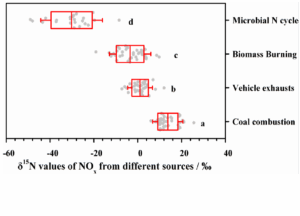
Soil NOx emissions vary spatially and temporally by orders of magnitude, making direct emission rate measurements difficult to extrapolate to scales needed for inventories or testing model estimates. The majority of observational constraints on soil NOx contributions come from nitrogen isotopic signatures (δ15N-NOx), as biologically produced NOx shows a significant 15N depletion compared to combustion NOx (Fig.1). Unfortunately, the analytical methods currently used to measure δ15N-NOx require significant assumptions; suffer from potentially large sampling biases and have poor time resolution (typically days to weeks). This project will develop and deploy a novel laser-induced-fluorescence (LIF) instrument to directly measure atmospheric δ15N-NOx in real-time and use this to lay the foundations for significantly reducing a major uncertainty in predictions of future atmospheric change during the most radical change in NOx emissions since the industrial revolution. This will be achieved through the following key objectives:
- Support the development and characterisation of the new LIF system for δ15N-NOx
- Deploy the new instrument in experiments with collaborators at the University of Warwick Crop Centre to characterise the nature and isotopic signatures of soil reactive nitrogen emissions under a range of agricultural practices.
- Measure the isotopic signatures of key combustion NOx sources
- Use these source signatures to develop a new method for assessing the soil NOx contribution to ambient NOx levels.
As part of a funded NERC project, this PhD project will address an important knowledge gap in our understanding of atmospheric chemistry and thus directly improve our ability to design effective environmental policies.
Introduction
Atmospheric nitrogen oxide (NOx = NO + NO2) emissions are a primary focus for national and international environmental policy due to their direct impact on human health, their control of the global oxidation capacity and their contribution to acid deposition. The atmosphere’s oxidation capacity determines the chemical removal of emitted gases (e.g. the climate gas methane) and the production of secondary pollutants such as ozone and particulate matter. Accurately estimating NOx emissions both now and into the future is therefore essential to the development of effective policies and mitigation strategies to tackle environmental challenges including air pollution and climate change.
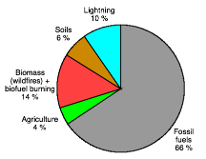
Global emissions of NOx are dominated by the anthropogenic burning of fossil fuels, with smaller natural sources including lightning and soil bacterial processes. Figure 2 shows the current estimate of global NOx source contributions as published in the Intergovernmental Panel on Climate Change AR4 report, with soils and agriculture accounting for around 10% of the globally estimated emissions, with this contribution estimated to be much lower in regions with high anthropogenic emissions. However, several recent studies suggest these soil NOx numbers could be significant underestimates, especially for fertilised agricultural soils. Using models and observations of NOx concentration, Almaraz et al. [2018] showed that soils could contribute up to 51% of the total NOx source in the state of California, compared with a negligible contribution in the state’s emission inventory. This gross underestimate was further supported by aircraft observations of NOx emission fluxes over agricultural land in California’s Central Valley [Zhu et al. 2023]. Annual average observations of nitrate isotopes in rainwater were used by Song et al. [2021] to estimate that non-combustion NOx sources account for 56%, 54% and 53% of NOx emissions in East Asia, Europe and North America, respectively. If correct, the fact that these soil NOx sources are vastly underestimated in current inventories and models represents a critical flaw in atmospheric projections of climate and air pollution, and a major omission from the current environmental policy agenda.
Project aims: Using isotopes to fingerprint and quantify NOx sources
Previous work has used the negative δ15N-NOx from soil biological processes to infer NOx source contributions. However, the range of soil δ15N-NOx reported in the literature is large, due to a combination of real variability and large biases in current analytical methods [Fibiger & Hastings, 2016]. Working with project collaborators we have demonstrated a method for the accurate real-time measurement of δ15N-NOx using laser-induced fluorescence (Fig. 3). This novel method has several significant advantages over previous techniques, and will enable the accurate characterisation of the isotopic signatures of individual sources and quantify their variability.
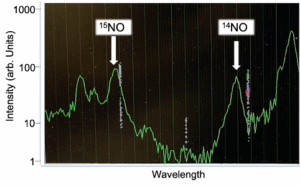
Figure 3: LIF-NO scan in an enhanced 15NO gas standard showing spectroscopic features of both the 14NO and 15NO isotopologues.
The University of York (UoY) laser-induced fluorescence instrument for NO detection (NO-LIF) is based on a detection system recently developed by collaborators at the US National Oceanic Atmospheric Administration [Rollins et al. 2020]. The instrument itself is based around a custom-built fibre laser system, that capitalises on recent advances in telecommunications laser technology. This laser system enables the generation of 215 nm laser light which is used to excite NO molecules into an excited vibronic transition, from where they subsequently relax and we detect the resulting red shifted fluorescence from ∼ 255 – 267 nm. The ability of the laser to rapidly scan its wavelength also opens up the possibility for the detection of different NO isotopologues. The abundance of stable isotopes in a chemical species depends not only on the natural abundance of isotopes available, but also on the chemical and physical processes that created that species. Therefore, measuring isotopic ratios can yield invaluable information regarding the sources and (bio)geochemical cycling of the species beyond what concentration measurements alone can provide. Nitrogen has two stable isotopes (14N and 15N) and oxygen has three (16O, 17O and 18O). Measurements of the isotopic abundance of the different isotopologues of NOx species can aid in understanding emissions sources and chemical transformations that contribute to nitrogen deposition. Thus, an instrument that can make time-resolved measurements of these different NOx isotopologues will enable unprecedented new information on atmospheric reactive nitrogen sources and chemistry.
This project will develop and characterise this exciting new analytical method into an instrument capable of the detection of NOx isotopes in the field. The instrument will then be used to accurately determine the isotopic signatures of key NOx sources, with a particular focus on soil NOx emissions. Working with project collaborators at the University of Warwick, the project will quantify agricultural soil NOx emissions and their isotopic composition under a range of farming practices, as well as key anthropogenic emission sources. These source signature data will then be used to develop a statistical method capable of attributing ambient NOx to the various source types. Ultimately, this work will demonstrate a novel method capable of quantifying NOx source contributions in different locations, with the ultimate aim of reducing the current large uncertainty in soil NOx contributions and informing revisions of international NOx emissions inventories and thus environmental policy.
Skills
The combination of instrument development, data analysis and statistical modelling in this PhD project will provide the successful candidate with a wide range of skills and experiences, and will be suitable for candidates with excellent practical / physical laboratory skills as well as a background in the physical sciences (e.g. Chemistry, Physics). The candidate will be enthusiastic about hands-on lab work, and show interest in environmental and/or public health issues. Computer programming experience, for both instrument control and data analysis, will be advantageous but significant training will be provided as part of the project (see Training section below). The Wolfson Atmospheric Chemistry Laboratories are a world class research centre, with significant technical support and resources for instrument development and data analysis. We appreciate that this PhD project encompasses several different science and technology areas, and we don’t expect applicants to have experience in many of these fields. The project is very well supported with experienced scientists and training in the new techniques and disciplines is all part of the PhD. The project has a number of collaborators and partners, including biogeochemists at the University of Warwick, emissions experts at Ricardo and air quality policy experts at Defra.
Training
The student will work under the supervision of Dr Pete Edwards, Dr Gordon Novak and Prof David Carslaw, and will be based at the Department of Chemistry’s Wolfson Atmospheric Chemistry Laboratory at the University of York. The Wolfson Atmospheric Chemistry Laboratories are home to more than 65 researchers with interests in all aspects of atmospheric chemistry, from stratospheric ozone, through to urban pollution, personal exposure and health. The laboratories comprise more than 1200 m3 of modern offices and labs, supporting an exceptional environment for research with state-of-the-art facilities and expertise across a range of different disciplines. The student will receive training on the new NO-LIF instrument as well as techniques used to calibrate and characterise the instrument. Training will also be given on the computational skills needed to collect and analyse the data from the instrument. The University of York and the wider NERC YES-DLA provide comprehensive training programmes for PhD students with a range of courses on both hard (e.g. data carpentry) and soft (e.g. presentation) skills. The student will also have access to training provided by the UK National Centre for Atmospheric Science such as the Introduction to Atmospheric Science course and Atmospheric Measurement Summer School on the Isle of Arran, and the Scientific Computing Course. The student will have the opportunity to present their work to the scientific community at national and international meetings and conferences, and will also be encouraged to take part in outreach events in order to disseminate the research beyond the immediate scientific community (e.g. to policymakers and the general public).
References
Almaraz, M. et al.: Agriculture is a major source of NOx pollution in California. Sci. Adv.4 (2018).