
The heat is on! Monitoring shallow geothermal operations with geophysical intelligence
Heating accounts for around half of global energy demand, with 75% of that supplied by fossil fuels. In the UK, heating buildings is responsible for ~20% of carbon emissions. Compared with the challenge of decarbonising heating, greening the supply of electricity has been relatively straightforward since the interventions required have not significantly impacted people’s lives. By contrast, we need innovative solutions to heating to minimise the degree of retrofitting needed to decarbonise heating systems in every UK building.
Geothermal energy is attractive for decarbonising heating/cooling systems in the urban environment. Many urban centres are underlain by potential geothermal reservoirs, offering storage and extraction options for excess heat and providing significant reductions in carbon demand. Nevertheless, the UK has been slow to explore geothermal heating solutions, owing to i) lack of knowledge about the geological and hydrological complexities of geothermal reservoirs, and ii) stakeholder concerns about the long-term sustainability, and thus cost-effectiveness, of geothermal heating. Any potential geothermal reservoir therefore requires extensive characterisation prior to development, and monitoring during usage to ensure sustainable management. Geophysical methods can be powerful in this regard, particularly when supported with artificial intelligence (AI) to link usage metrics to subsurface heat processes. Indeed, a practical means of monitoring the thermal evolution of the subsurface will be an essential component in the governance of a geothermal system.
Building on existing experience with geophysical approaches, including seismic and electrical methods, you will be free to explore technologies that could be beneficial for understanding geothermal heating systems. You could monitor subsurface temperature by assessing the time-lapse behaviour of borehole resistivity responses or build seismic velocity models from nodal seismometers or novel fibre-optic distributed acoustic sensing (Figure 1). You would be supported in exploring and developing AI tools to link insight from geophysical analyses to energy usage metrics at geothermal test sites.
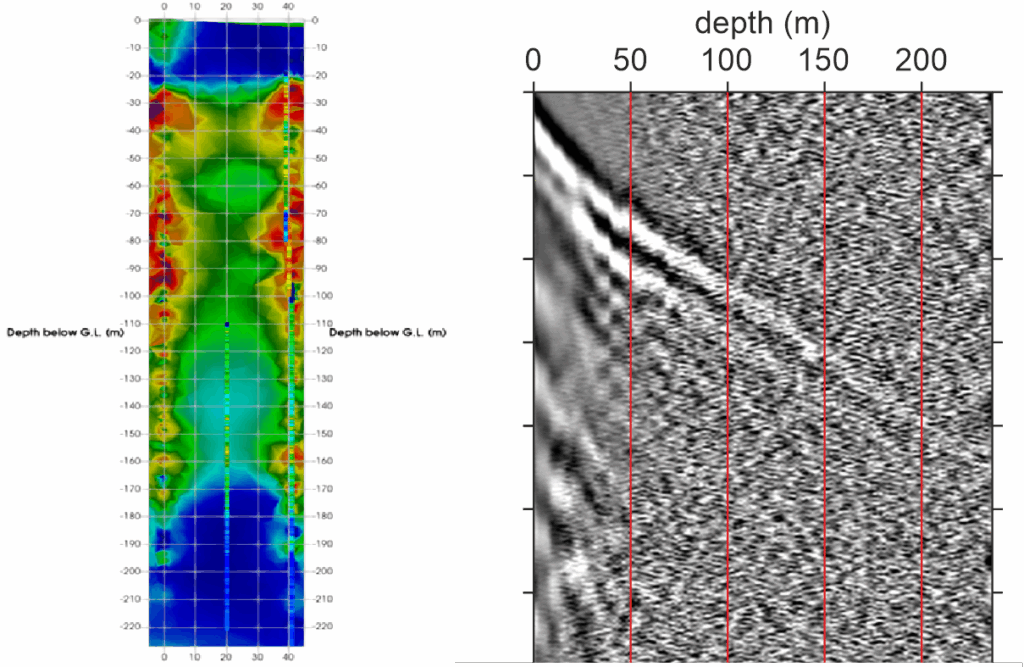
Figure 1. Example geophysical data from geothermal test sites: left – crosshole resistivity data; right – a fibre-optic seismic profile
In terms of site selection, the University of Leeds and the British Geological Survey (BGS) are uniquely placed to offer access to Living Labs – that is to say, genuine geothermal infrastructure that also serves as an experimental facility. The University of Leeds and BGS both have instrumented geothermal boreholes on their respective campuses, with systems including fibre optic distributed acoustic and temperature sensing and PRIME resistivity servers. Leeds expects that its boreholes will support geothermal heating and cooling operations within the next two years, while the system at BGS is already operational (Figure 2). Both systems will provide data from energy meters which, via AI, could be used to link usage statistics to subsurface thermal processes. With both sites easily accessible, you could also undertake your own geophysical surveys to provide further insight for your project. The project should also provide capacities for extended research visits with BGS colleagues.
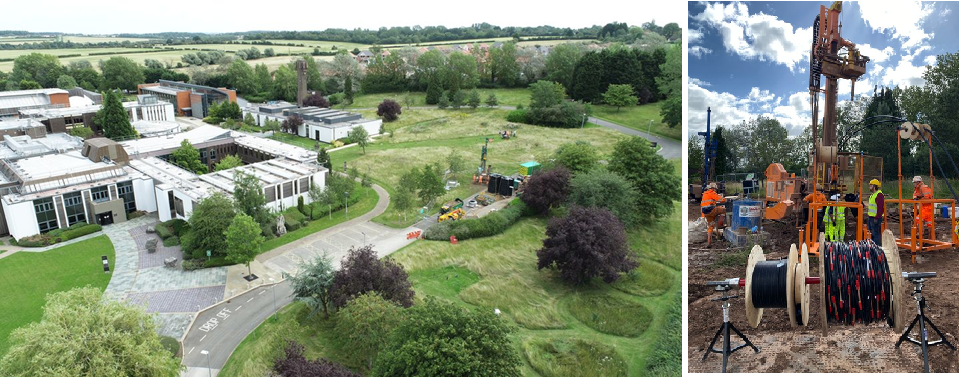
Figure 2. A view of BGS’s Keyworth geothermal living lab, during installation and instrumentation of boreholes.
In addition to unique field data, working with Leeds and BGS provides direct access to a broad network of research connections. Members of this research team are part of Leeds Geosolutions, a cross-disciplinary centre exploring geoscientific and societal aspects of the energy transition. They also undertake research on the NERC-funded SmartRes project, also involving Imperial College London and the University of Manchester, which aims to address the barriers to the broader uptake of UK geothermal energy – very much aligned with the ambitions of this proposal.
As a PhD student in the YES Doctoral Training Network, you will benefit from a training environment that offers diverse schemes to boost your skills beyond technical expertise. Such schemes include academic writing to help you prepare the submission of research articles, and presentation skills to give you confidence in disseminating your work to international conference audiences. During your studies, you will be based in the Institute of Applied Geoscience (IAG) of Leeds’ School of Earth, Environment and Sustainability, and will engage with researchers in Civil Engineering and CEMAC. With an active PhD research community, you will find a vibrant network of peer support. Furthermore, through Geosolutions you will meet researchers developing the policy solutions to implement geothermal technology for societal benefit: this represents a unique multi-disciplinary grouping that is unique for a UK research centre.
For your own background, you should be experienced with geophysics, artificial intelligence, or a related quantitative discipline (e.g., physics, mathematics, engineering, computing). You should have a passion for translating theory into practical applications, with industrial and societal relevance. You will be guided in bringing your own ideas to your data analysis. Fieldwork is optional during this project: you may develop your own field approaches, or alternatively work with archive data. We welcome applications from anyone with relevant academic or industrial experience.