
The inner workings of the earthquake cycle: New insight from integrating Quaternary fault activity, microstructures, and geophysics
Summary
Fault activity is now known to be highly dynamic, with observable spatial and temporal variability in earthquake recurrence and the style of fault slip. This exciting project explores the underlying physical processes that lie at the core of dynamic fault behaviour by probing the rock and Quaternary records of fault slip. In this multi-disciplinary project, you will integrate knowledge obtained from quantitative microstructural work, Quaternary fault studies, and high resolution laser scanning (LiDAR) to gain an in-depth understanding of the physical processes acting on a fault and/or fault zone. Results will be far reaching in fundamental science with direct implications for applied science in terms of earthquake hazard evaluation and forecasting.
Motivation
This project will combine field work, lab work, and computer modelling to investigate the behaviour of faults over different time scales. Earthquakes are a devastating hazard that cause long-lasting impacts on exposed communities. Improving our ability to anticipate how faults behave through time can help to mitigate this hazard when incorporated into earthquake forecasts and carefully communicated to the communities at risk. However, there are significant barriers to providing accurate long- and short-term earthquake forecasts because we do not understand some of the basic physical behaviours exhibited by faults, particularly in the patterns of earthquake recurrence on different timescales.
Project aims and objectives
This project will address questions on why some faults appear to accommodate different slip modes and others do not, how different slip processes are represented in the rock record, and why faults cycle between different modes. The research is novel in its cross-disciplinary nature integrating earthquake cycle analysis on real rocks including information on the time-averaged fault activity using isotopic age dating on exposed fault surfaces, patterns of fault surface roughness, and their link to microstructures from natural and experimental fault rocks. The University of Leeds presents the opportunity to integrate different fields, and strong personal links to collaborators at other universities (Dr Bora Uzel, Dokuz Eylul University, Turkey and Prof Ken McCaffrey, Durham University) strengthen this project.
You will collect a set of fault breccia samples “caught in the act” from active fault zones in several potential field areas. One area of focus will be from the Apennines in central Italy, which in 2016 experienced a devastating earthquake sequence that began with an Mw 6.2 resulting in nearly 300 deaths and relocation of tens of thousands of people (Walters et al., 2018). This region hosts normal faults that are at varying stages of maturity that have been shown to demonstrate slip rate variability (Cowie et al., 2017). You will also investigate normal faults in southwest Turkey, and other potential regions depending on your interest and progress. The seismic activity and average Quaternary slip has already been investigated on target faults in Central Italy and Turkey, and the locations of ideal field sites are already known. You will have the unique opportunity to combine knowledge gained through microscopic studies with mesoscale features on these faults, using terrestrial laser scanning datasets detailing the metre-scale fault surface, in collaboration with co-supervisor Prof Ken McCaffrey, from Durham University. These faults provide the opportunity to investigate structures from the outcrop to the nanoscale, allowing for a process-oriented analysis of fault rock structure. Finally, observations of the fault rocks will be paired with cosmogenic isotope analyses from the same faults, to reveal the multi-earthquake cycle (i.e. thousand year) behaviour of each fault.
Impact
The research topic has immediate relevance to improving our understanding of the links between faulting and nature of seismic hazard on different timescales. There will be ample opportunities to deliver the results of the project at international conferences in addition to UK meetings. Through in-country collaborators, there will be the opportunity to communicate the earthquake hazard to local authorities and civil protection authorities.
Student profile
You should have a strong interest in active tectonics, a desire to undertake laboratory and fieldwork overseas, and a strong background in a quantitative science (earth sciences, geophysics, geology, physics, and natural sciences). Willingness and excitement for taking up the challenge to work at the boundary of geophysics, mechanics and microstructural analysis utilizing a combination of technique (field analysis, in-depth microstructural analysis, experiments and/or numerical modelling) is a prerequisite. This is a multidisciplinary project but we welcome students with enthusiasm for any relevant field as the project is flexible based on your interests.
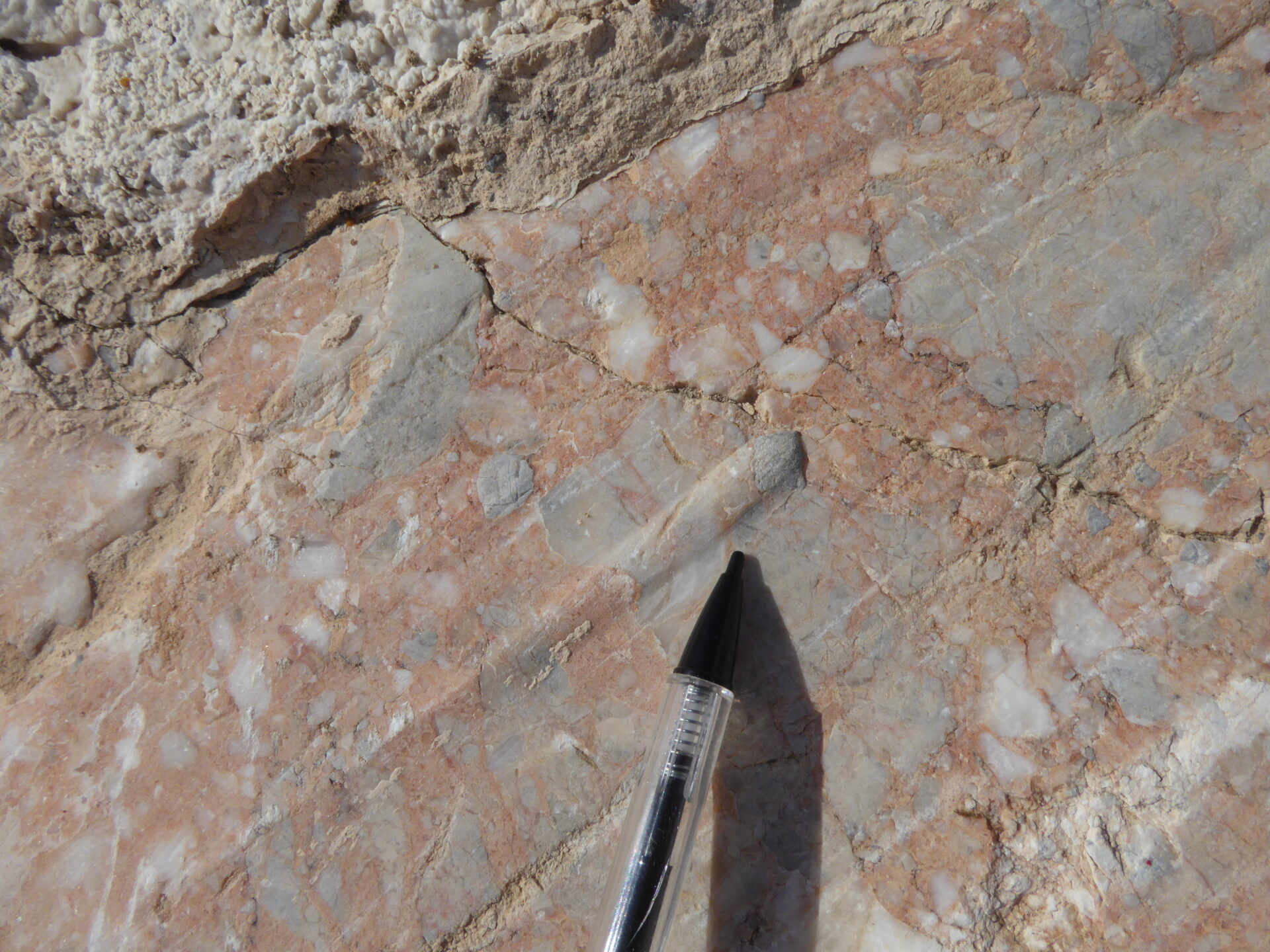
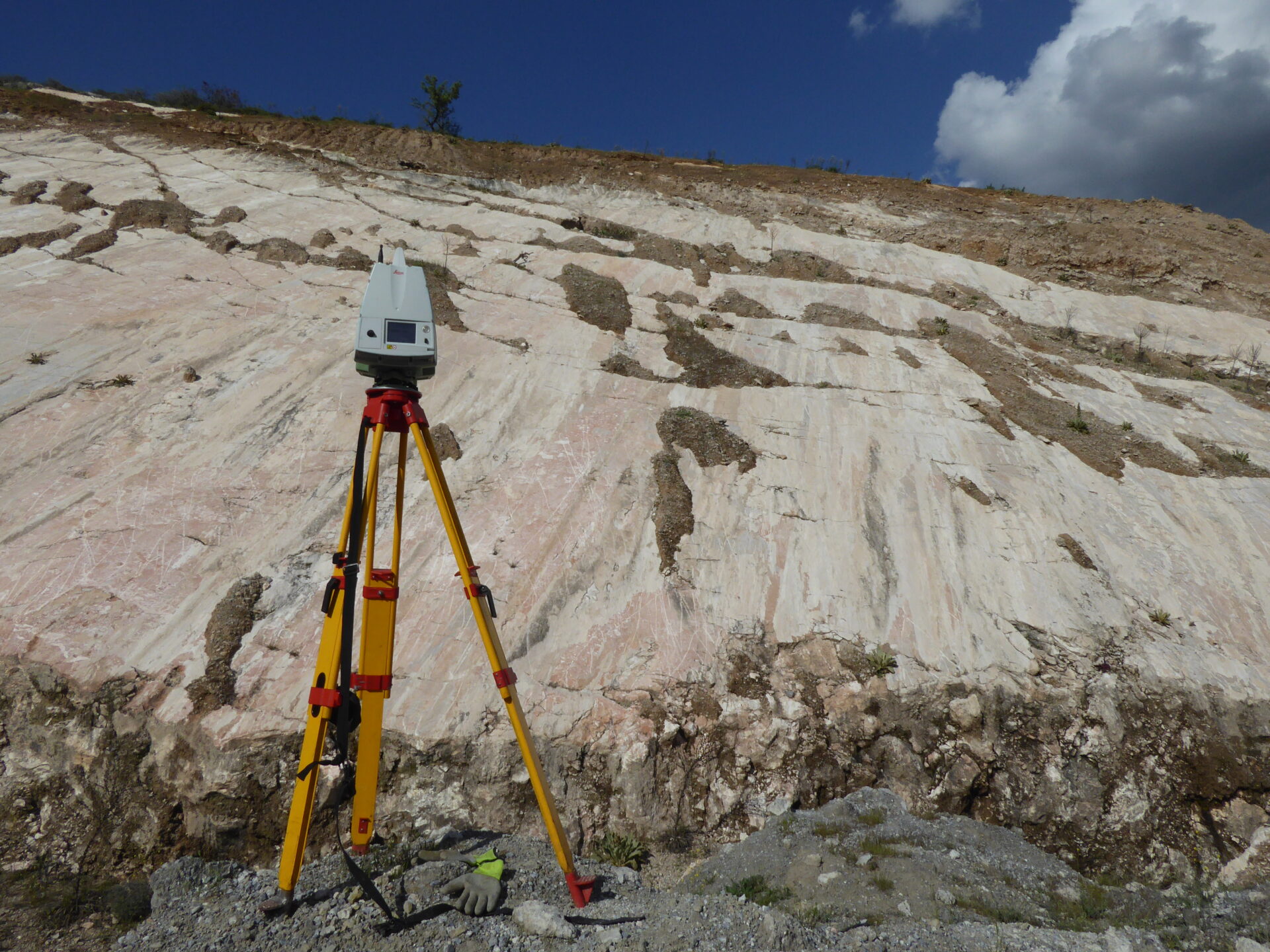
Figure 1: (Left panel) Surface roughness at the centimetre scale, with visible fault breccia. (Right panel) Surface roughness at the 1 – 10 m scale, Terrestrial Laser Scanner in foreground. Both photos are from the Rahmiye fault in western Turkey.
References
Brodsky, EA; Kirkpatrick, JD; and Candela, T (2016). Constraints from fault roughness on the scale-dependent strength of rocks. Geology 44, 19-22, doi:10.1130/G37206.1
Collettini, C; Carpenter, BM; Vitti, C; et al (2014). Fault structure and slip localisation in carbonate-bearing normal faults: An example from the Northern Apennines of Italy. Journal of Structural Geology v 67, 154-166.
Cowie, PA; Phillips, RJ; Roberts, GP; McCaffrey, K; Zijerveld, LJJ; Gregory, LC; Faure Walker, J; Wedmore, LNJ; Dunai, TJ; Binnie, SA; Freeman, SPHT; Wilcken, K; Shanks, RP; Huismans, RS; Papanikolaou, I; Michetti, AM; and Wilkinson, M (2017). Orogen-scale uplift I nthe central Italian Apennines drives episodic behaviour of earthquake faults. Scientific Reports 7:44858, doi: 10.1038/srep44858.
Davidesko, G; Sagy, A; and Hatzor, YH (2014). Evolution of slip surface roughness through shear. Geophysical Research Letters 41, 1492–1498, doi:10.1002/2013GL058913.
Delle Piane, C; Piazolo, S; Timms, NE; Luzin, V et al. (2017). Sub-seismic slip in nano calcite fault gouge generates amorphous carbon and crystallographic texture at low temperature. Geology 46, 163-166.
Dunham, EM; D Belanger, L Cong; and JE Kozdon (2011). Earthquake ruptures with strongly rate-weakening friction and off-fault plasticity, part 2: Nonplanar faults.” Bulletin of the Seismological Society of America 101 (5), pp 2296–2307, doi: 10.1785/0120100076
Marone, C (1998). The effect of loading rate on static friction and the rate of fault healing during the earthquake cycle. Nature 391, pp 69-72.
Piazolo S; La Fontaine A; Trimby P; Harley S; Yang L; Armstrong R; Cairney JM (2016) Deformation-induced trace element redistribution in zircon revealed using atom probe tomography, Nature Communications, 7, . doi: 10.1038/ncomms10490
Piazolo S; Montagnat M; Grennerat F; Moulinec H; Wheeler J (2015) Effect of local stress heterogeneities on dislocation fields: Examples from transient creep in polycrystalline ice, Acta Materialia, 90, pp.303-309. doi: 10.1016/j.actamat.2015.02.046
Rice, JR (2006). Heating and weakening of faults during earthquake slip. Journal of Geophysical Research 111; B05311, doi:10.1029/2005JB004006.
Weldon, R; Scharer, K; Fumal, T; and Biasi, G (2004). Wrightwood and the earthquake cycle: what a long recurrence record tells us about how faults work. GSA Today 14 (9), pp 4-10.