
YES-27-A-02: Tropical heat forecasting using AI
Background and Rationale
Heat extremes have become more intense and frequent in the past 50 years, across almost all tropical and sub-tropical land regions. Even if global warming is limited to 2°C, exposure to dangerous heat stress is projected to increase by 50–100% and, in tropical regions, total outdoor labour capacity is projected to be only 55% of today’s level (Buzan and Huber 2020).
Humid heat poses an even greater threat to health because high humidity reduces the effectiveness of sweating, reducing the body’s ability to thermoregulate. Humid heat is now a risk across much of the tropics and sub-tropics (Fig. 1). It is essential we adapt to climate change by accurately predicting heat extremes across timescales to provide effective warnings. Unlike for flooding and drought, there is currently no global early warning system for heat.
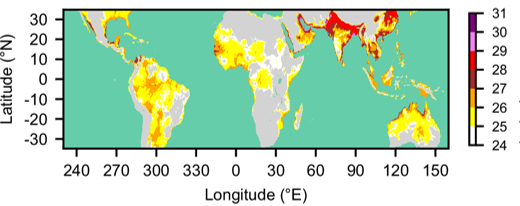
Fig. 1: Humid heatwave intensity, defined at the 95th percentile of daily mean wet bulb temperature (°C) on heatwave days. Grey regions have no events classified as a humid heatwave [taken from Jackson et al. 2025].
Despite an urgent need, there has been very little evaluation of heat forecasts in the tropics. This is the case across all timescales, from weather forecasts for the following day to seasonal forecasts for the next few months. Preliminary analysis shows that weather models often can’t capture the daily peak in heat or its spatial variability (Fig. 2).
Improved heat forecasts will lead to improved severe weather warnings for heat. Advance action could then be taken, such as planning the location and timing of outdoor work, protecting livestock, targeting interventions such as cool spaces and water access, ultimately saving lives.
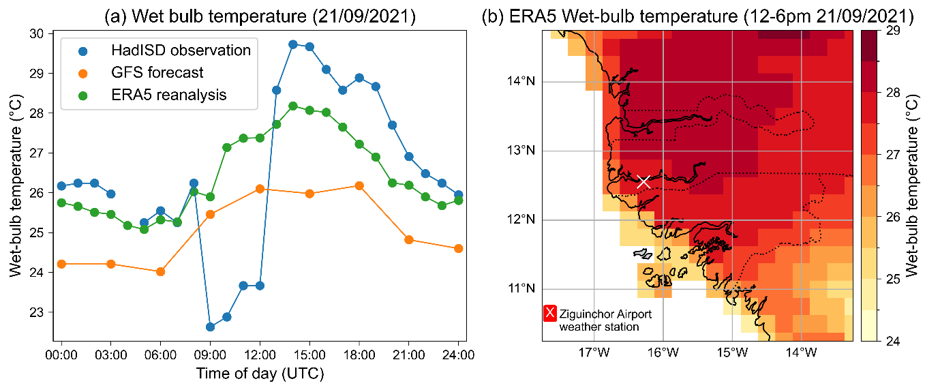
Fig. 2: (a) Weather station observations, weather model forecast and reanalysis at Ziguinchor Airport, Senegal. (b) humid heat in ECMWF weather model [plot by Lawrence Jackson].
With the introduction of AI-related methodologies there comes a new opportunity to improve tropical heat prediction. AI-based weather forecast models (e.g. GraphCast, Pangu-Weather, GenCast) can beat traditional weather forecast models on basic skill score measures for metrics such as mean sea level pressure. However, their spatial resolution is still fairly coarse (like Fig. 2b) and there is relatively little understanding of how these models perform for extreme heat events (Pasche et al. 2025).
AI can also be used to improve (or ‘post-process’) both AI-based and more traditional weather forecasts (Mardani et al. 2025, Trotta et al. 2024). In this PhD we will explore refinement of these generative approaches for heat extremes using observed heat behaviour from weather stations and satellite observations. The successful applicant will have access to many different projects within the department working on AI downscaling across weather and climate, for example the Cumulus project which employs AI downscaling for tropical rainfall.
Project objectives
The PhD project will:
- Identify the strengths and weaknesses of existing forecasts of tropical heat extremes
- Evaluate AI-based global models such as European Centre for Medium-Range Forecasts (ECMWF)’s AIFS, Google Deepmind’s WeatherNext (GraphCast and GenCast), and Met Office’s FastNet, and traditional Numerical Weather Prediction models from the Met Office and ECMWF.
- Evaluate high-resolution (convective-scale), regional weather models. They have a spatial resolution of 2-4km compared with 10-30km for the global models and are known to better represent features such as the land-sea breeze, topography, urban areas and inland water bodies. The Met Office will provide model forecast data over Africa and Southeast Asia.
- Develop statistical and AI-based methodologies to post-process weather forecasts to improve extreme heat predictions, including of daily temperature maxima and spatial variability.
- Use weather station observations and satellite observation of land surface temperatures for evaluation of forecasts and AI training.
Training opportunities
You will join a well-established research group, with a recent, strong track record in heat research and use of AI-methodologies for forecast improvement. You will gain skills in AI and machine-learning, data analysis and visualisation using Python, weather models and forecasting, and scientific writing. Dr Ben Booth is Met Office staff, but holds a joint position at University of Leeds, and will provide expertise in AI and weather models. There is the very high possibility of the Met Office CASE award, to be applied for once the project has recruited a student.
Key references
Barriopedro D, García-Herrera R, Ordóñez C, Miralles DG, Salcedo-Sanz S. 2023. Heat waves: Physical understanding and scientific challenges. Rev. Geophys., https://doi.org/10.1029/2022RG000780
Buzan JR and Huber M. 2020. Moist Heat Stress on a Hotter Earth. Annual Reviews, https://doi.org/10.1146/annurev-earth-053018-060100
Domeisen DIV, Eltahir EAB, Fischer EM. et al. 2023. Prediction and projection of heatwaves. Nat. Rev. Earth. Environ., https://doi.org/10.1038/s43017-022-00371-z
Hidayat AM, Birch CE, Jackson LS, Schwendike J, Sanchez C, Matthews AJ. 2026. Synoptic-to-interannual drivers of humid heat variability in equatorial Southeast Asia. npj Climate and Atmospheric Science, https://www.nature.com/articles/s41612-026-01451-3
Jackson LS, Birch CE, Chagnaud G, Marsham JH, Taylor CM. 2025. Daily rainfall variability controls humid heatwaves in the global tropics and subtropics. Nature Communications, https://www.nature.com/articles/s41467-025-58694-6
Mardani M., Brenowitz N., Cohen Y. et al. 2025. Residual corrective diffusion modeling for km-scale atmospheric downscaling. Commun. Earth Environ., https://doi.org/10.1038/s43247-025-02042-5
Pasche OC, Wider J, Zhang Z, Zscheischler J, Engelke S. 2025. Validating Deep Learning Weather Forecast Models on Recent High-Impact Extreme Events. Artif. Intell. Earth Syst., 4, e240033, https://doi.org/10.1175/AIES-D-24-0033.1
Trotta B. 2024. Improving blended probability forecasts with neural networks. Meteorological Applications, https://doi.org/10.1002/met.70021