
YES-27-A-15: Climate impacts longevity from high-altitude major volcanic eruptions
- Introduction
The scientific response to the August 1883 Krakatoa eruption was arguably the advent of modern environmental science, bringing together an initial cluster of atmospheric scientists in the Royal Meteorological Society, with experts from volcanology, and other geoscientists, for the inter-disciplinary Royal Society “Krakatoa committee”.The subsequent landmark report (Symons et al., 1888), included an optical phenomena synthesis (Russell and Archibald, 1888), which led to public awareness of global influences within the earth’s environment, the unusual sunsets seen extensively since autumn 1883 caused by a volcanic eruption on the other side of the world, several months earlier (e.g. Wexler, 1951; von Savigny et al., 2024). - The long-lived solar dimming from the August 1883 Krakatoa eruption
The years after historical major volcanic eruptions such as 1991 Pinatubo have a substantial natural surface cooling from solar dimming caused by volcanic sulphate aerosol in the stratosphere.A seminal paper from CSIRO scientist AJ Dyer (Dyer, 1974) set out a “present knowledge” on volcano climate impacts, at that time, including identifying a longer duration of the solar dimming effect for eruptions reaching the middle stratosphere, the effects extending to two or more years after.The different regime relates to the first direct measurement dataset of a volcanic solar dimming, the solar radiation measurement record from Montpellier after Krakatoa (Kimball, 1918; Wexler, 1951). A recent undergraduate dissertation project at the Univ. Leeds (Marshall, 2026) has digitized the Montpellier solar radiation anomaly dataset (Figure 1a), deriving a stratospheric aerosol optical depth (Figure 1b), each dataset providing alternative constraints for climate model predictions.
This PhD project will involve model experiments with the UK Earth System Model, to explore the climate influences from high-altitude major eruption case studies. The PhD is a co-operation with Met Office scientists, within the Leeds-Met Office academic partnership.
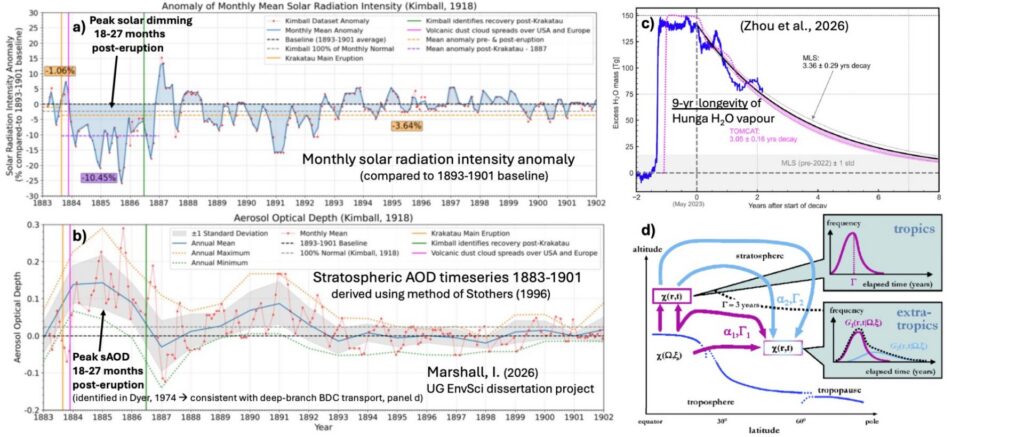
Figure 1: a), b) Montpellier solar radiation measurement dataset for 1883-1901 has two-year post-Krakatoa peak solar dimming, consistent with deep-branch transport pathway from high-altitude volcanic sulfur emission. c) The Hunga excess water vapour decay rate has e-folding timescale of 2.89-3.65 years, a longevity of ~9 years. d) schematic of stratospheric meridional transport pathways in deep branch (from Boenisch et al., 2009).
- PhD aligns with CMIP7 historical climate model experiments and 2025 Hunga impacts report.
For the historical integrations in CMIP climate model intercomparison activities (e.g. Eyring et al., 2016), volcanic impacts are represented from “volcanic forcing datasets”, to enact the solar dimming effect from best-estimate time-varying stratospheric aerosol optical properties (e.g. Sato et al., 1993; Joerimann et al., 2025). For the current CMIP7 activity (Van Vuuren et al., 2026), a new approach (Aubry et al., 2026) provides also a self-consistent historical volcanic forcing dataset based on eruption source parameters for each individual eruption, including the altitude of sulfur emission.
The January 2022 Hunga eruption was the most explosive volcanic event in the satellite era (Wright et al., 2022) and its shallow underwater setting caused emitted water vapour to remain in the stratosphere for 5-10 years (Millan et al., 2022; Zhuo et al., 2025). The potential for substantial impacts on polar ozone (Zhu et al., 2022; Wang et al., 2023), and the effects from the strong cooling of the stratosphere (e.g. Randel et al., 2024), motivated the 2025 Hunga impacts report (e.g. APARC, 2025), aligned to the 2026 WMO/UNEP Scientific Assessment of Ozone Depletion report.
Major volcanic eruptions such as Pinatubo cause prolonged increases to the stratospheric aerosol layer and subsequent heterogenous chemistry, on the surfaces of volcanic aerosol, and at high latitudes also on polar stratospheric clouds (PSCs). Both effects cause substantial changes to the ozone layer (e.g., Solomon, 1999; WMO, 2022). Recent new understandings include a volcaniic “vortex strengthening effect” (Kodera, 1994; Toohey et al., 2014), seen for both Hunga (Bednarz et al., 2025; 2026) and Pinatubo (Dalla Santa et al., 2019); and how emitted water vapour can increase PSCs and ozone depletion when volcanogenic water vapour reaches high latitudes (Heddell et al., 2026).
This PhD project will focus on high sulfur major eruption case studies, aligned to analysis of Hunga transport pathways (Toohey et al., 2025; Schoeberl et al., 2025; Zhou et al., 2026) that provides new constraints for the longer-duration timescales of deep-branch water vapour and aerosol transport, relevant for reliably predicting impacts high-altitude high-sulphur volcanic eruptions.
- Krakatoa eruption chronology and constraints for initial aerosol progressionVolcanological reconstructions of the Krakatoa eruption chronology (Francis and Self, 1983; Self, 1992) show how submarine tephra deposits, and observer recorded evidence, indicate the largest explosion occurred after plume collapse, the highest altitude emission occurring when hot pyroclastic flows reached ocean seawater.
The 1883 eruption is the most recent high-sulphur water co-emission case, with large amounts of water vapour thought to have been injected into the stratospheric from co-ignimbrite plume explosions from the ocean pyroclastic flow, alongside also high sulphur emission (Rampino and Self, 1982; Colombier et al., 2025).
In addition to the Montpellier solar dimming measurement constraints, the project could explore initial similarities with the Hunga eruption, with twilight duration measurements indicating an initial descent of the Krakatoa aerosol, strikingly similar to that observed after Hunga (see Figure 2).
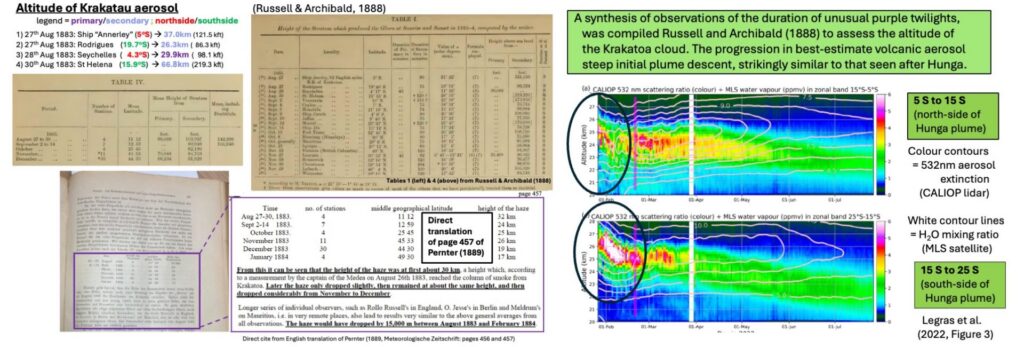
Figure 2: Observations from the optical phemonena synthesis (Russell and Archibald, 1888) of the Royal Society report on Krakatoa (Symons et al., 1888) show the Krakatoa aerosol descended from ~32km to ~25km (left-hand panels), strikingly similar to the initial water vapour forced descent after Hunga (right-hand panels).
- The PhD projectThis PhD project will involve simulations with the UK Earth System Model (Sellar et al., 2019, 2020), as adapted for interactive volcanic aerosol (Dhomse et al., 2014; Mann et al., 2015; Dhomse et al., 2020) to assess climate and polar ozone impacts from Krakatoa-like high-altitude major eruptions.
The PhD is a co-operation with Met Office scientists, within the Leeds-Met Office academic partnership, and could also align with other impacts from the long-lived stratospheric water vapour, for example polar stratospheric clouds. An alternative very high-altitude high-sulfur eruption case study (e.g. Taupo or Santorini) could also be another alternative for exploring within the PhD.
Similarly, the student will have the opportunity to make use of NCAR’s Community Earth System Model (CESM) which has been developed in Leeds University (e.g. Feng et al., 2013; Kovacs et al., 2016; Li et al., 2026) to investigate the impacts of volcanic eruptions on changes in stratospheric ozone, aerosol, radiations and dynamics etc) using a self-consistent whole atmospheric model.
For very large eruptions, impacts on food security, and another alternative route the PhD project could be to explore how the longevity compounds into more severe economic and hence societal impacts, for example when two successive growing seasons are affected.
- References
Aubry et al. (2026), “Stratospheric aerosol forcing for CMIP7 – Part 1: optical properties for pre-industrial, historical & scenario simulations”, Geo. Mod. Dev., 19, 3725–3756, https://doi.org/10.5194/gmd-19-3725-2026 .
Boenisch et al. (2009), “Quantifying transport into the lowermost stratosphere using simultaneous in-situ measurements of SF6 & CO2”, Atmos. Chem. Phys., 9, 5905–5919, https://doi.org/10.5194/acp-9-5905-2009 .
Colombier et al. (2025), “The role of submarine volcanism in atmospheric chemistry”, Earth & Planetary Sci. Lett., vol. 671, 119690, https://doi.org/10.1016/j.epsl.2025.119690 .
Dhomse et al. (2014), “Aerosol microphysics simulations of 1991 Pinatubo with the UM-UKCA composition-climate model”, Atmos. Chem. Phys., 14, 11221–246, https://doi.org/10.5194/acp-14-11221-2014 .
Dhomse et al. (2020), “Evaluating the simulated radiative forcings, aerosol properties, and stratospheric warmings from the 1963 Mt Agung, 1982 El Chichón, and 1991 Mt Pinatubo volcanic aerosol clouds”, Atmos. Chem. Phys., 20, 13627–13654, https://doi.org/10.5194/acp-20-13627-2020 .
Dyer (1974), “The effect of volcanic eruptions on global turbidity, and an attempt to detect long-term trends due to man”, Q. J. Roy. Met. Soc., 100, 563-571, https://doi.org/10.1002/qj.49710042606
Eyring et al. (2016), “Overview of the Coupled Model Intercomparison Project Phase 6 (CMIP6) experimental design and organization”, Geosci. Model Dev., 9, 1937–1958, https://doi.org/10.5194/gmd-9-1937-2016 .
Feng et al. (2013): “A global atmospheric model of meteoric iron”, J. Geophys. Res. Atmos., 118, 9456–9474, https://doi.org/10.1002/jgrd.50708 .
Heddell et al. (2026): “The impact of 2022 Hunga on the 2023 Antarctic ozone hole: effects in the core & edge regions of the polar vortex”, https://egusphere.copernicus.org/preprints/2026/egusphere-2026-3619/ .
Joerimann et al. (2025), “REtrieval Method for optical and physical Aerosol Properties in the stratosphere (REMAPv1)”, Geosci. Model Dev., 18, 6023–6041, https://doi.org/10.5194/gmd-18-6023-2025 .
Khaykin, Bourassa et al. (2025), “Atmospheric transport and evolution of Hunga water vapour and aerosols. In APARC, 2025: The Hunga Eruption Atmospheric Impacts Report [Yunqian Zhu, Graham Mann, Paul A. Newman, William Randel (Eds.)]. APARC report 11, WCRP Report No. 10/2025, https://doi.org/10.34734/FZJ-2025-05240. Kimball (1918): “Volcanic eruptions and solar radiation intensities”, Monthly Weather Review, vol. 46, no. 8, 355-356, https://doi.org/10.1175/1520-0493(1918)46<355:VEASRI>2.0.CO;2 .
Kodera, (1994): “Influence of volcanic eruptions on the troposphere through stratospheric dynamical processes in the Northern Hemisphere winter”, J. Geophys. Res., 99, D01273, https://doi.org/10.1029/93JD02731 .
Kovács et al. (2016): “D-region ion–neutral coupled chemistry within the Whole Atmosphere Community Climate Model (WACCM4), Geosci. Model Dev., 9, 3123–3136, https://doi.org/10.5194/gmd-9-3123-2016 .
Legras et al. (2022), “The evolution and dynamics of the Hunga Tonga–Hunga Ha’apai sulfate aerosol plume in the stratosphere”, Atmos. Chem. Phys., vol. 22, 14957–14970, https://doi.org/10.5194/acp-22-14957-2022 .
Li et al. (2026): The impact of rocket-emitted chlorine on stratospheric ozone, Atmos. Chem. Phys., 26, 3621–3635, https://doi.org/10.5194/acp-26-3621-2026 .
Mann et al. (2015), “Evolving particle size is the key to improved volcanic forcings”, Past Global Change, , vol. 23, no. 2, https://doi.org/10.22498/pages.23.2.52 .
Marshall, I. (2026), “Investigation into the impact of the Krakatau eruption on solar irradiance at the surface from historical datasets”, BSc Env Science UG research report, Univ. Leeds. 55 pp.
Millan et al. (2022), “The Hunga Tonga-Hunga Ha’apai Hydration of the stratosphere”, Geophys. Res. Lett., 49, e2022GL099381. https://doi.org/10.1029/2022GL099381 .
Pernter et al. (1889), “Der Krakatau-Ausbruch und seine Folge-Erscheinungen, 4. Die optischen Erscheinungen”, Meteorol. Zeitschrift, vol. 6, pp. 447-466.
Rampino and Self (1982), “Historic Eruptions of Tambora, Krakatau, and Agung, their stratospheric aerosols, and climatic impact”, Quaternary Res., vol. 18, 127-143. https://doi.org/10.1016/0033-5894(82)90065-5 .
Randel et al. (2024), “Long‐term temperature impacts of the Hunga volcanic eruption in the stratosphere and above”, Geophys. Res. Lett., 51, e2024GL111500, https://doi.org/10.1029/2024GL111500 .
Russell & Archibald (1888): “On the unusual optical phenomena of the atmosphere, 1883-6, including twilight effects, coronal appearances, sky haze, coloured suns, moons” In: “The eruption of Krakatoa and subsequent phenomena”, G. J. Symons (ed). Royal Society Krakatoa committee report,
Sato et al. (1993), “Stratospheric Aerosol Optical Depths, 1850-1990”, J. Geophys. Res., vol. 98, https://doi.org/10.1029/93JD02553 .
Schoeberl et al. (2025), “Stratospheric Injection Lifetimes”, J. Geophys. Res. Atmos., vol. 130, e2025JD043928. https://doi.org/10.1029/2025JD043928 .
Self (1992), “Krakatau Revisited: The course of events and interpretation of the 1883 eruption”, Geojournal, vol. 28 no. 2, 109-121 , https://www.jstor.org/stable/41145820 .
Self and Rampino (1981): “The 1883 eruption of Krakatau”, Nature, 294, 699-704, https://doi.org/10.1038/294699a0 .
Sellar et al. (2019): “UKESM1: Description and evaluation of the U.K. Earth System Model”, J. Adv. Mod. Earth Sys., vol. 11, 4513-4558, https://doi.org/10.1029/2019MS001739 .
Sellar et al. (2020): “Implementation of U.K. Earth System Models for CMIP6”, J. Adv. Mod. Earth Sys., vol. 12, e2019MS001946, https://doi.org/10.1029/2019MS001946 .
Solomon, S. (1999). Stratospheric ozone depletion: A review of concepts and history. Reviews of Geophysics, 37(3), 275–316. https://doi.org/10.1029/1999RG900008.
Symons et al. (1888), “The eruption of Krakatoa and subsequent phenomena”, G. J. Symons (ed). Report of the Krakatoa committee of the Royal Society, available online via Google (digitized Harvard Geol. Sci. library copy).
Toohey et al. (2014): “Impact of volcanic aerosol on NH stratospheric polar vortex: mechanisms & sensitivity to forcing structure”, Atmos. Chem. Phys., 14, 13063–13079, https://doi.org/10.5194/acp-14-13063-2014 .
Toohey et al. (2025), “Stratospheric residence time and the lifetime of volcanic stratospheric aerosols”, Atmos. Chem. Phys., 25, 3821–3839, https://doi.org/10.5194/acp-25-3821-2025 .
Van Vuuren et al. (2026), “The Scenario Model Intercomparison Project for CMIP7, “ScenarioMIP-CMIP7”, Geosci. Model Dev., 19, 2627–2656, https://doi.org/10.5194/gmd-19-2627-2026 .
Von Savigny et al. (2024): “Explaining the green volcanic sunsets after the 1883 eruption of Krakatoa”, Atmos. Chem. Phys., 24, 2415–2422, https://doi.org/10.5194/acp-24-2415-2024 .
Wang et al. (2023), “Stratospheric climate anomalies and ozone loss caused bythe Hunga Tonga-Hunga Ha’apai volcanic eruption”, J. Geophys. Res. Atmos., 128, e2023JD039480, https://doi.org/10.1029/2023JD039480 .
Wexler (1951), “Spread of the Krakatoa volcanic dust as related to the high-level circulation”, Bull. Amer. Meteorol. Soc., https://doi.org/10.1175/1520-0477-32.2.48 .
Wright et al. (2022), “Surface-to-space atmospheric waves from Hunga Tonga–Hunga Ha’apai eruption”, Nature, vol. 609, no. 22, 741-785, https://doi.org/10.1038/s41586-022-05012-5 .
Zhou et al. (2026), “Residence time of Hunga stratospheric water vapour perturbation quantified at 9 years”, Comms. Earth Env., vol. 7:198, https://doi.org/10.1038/s43247-026-03216-5 .
Zhu et al. (2022), “Perturbations in stratospheric aerosol evolution due to the water-rich plume of the 2022 Hunga-Tonga eruption”, Comms. Earth. Env., https://doi.org/10.1038/s43247-022-00580-w .
Zhuo et al. (2025), “Comparing multi-model ensemble simulations with observations and decadal projections of upper atmospheric variations following the Hunga eruption”, Atmos. Chem. Phys., 25, 13161–13176, https://doi.org/10.5194/acp-25-13161-2025 .