
YES-27-A-18 Insects in clouds: Investigating Airborne Insects as Ice-Nucleating Particles in Clouds
This project deals with one of the biggest unknowns in our ability to understand the role clouds play in climate, that is the production of ice in clouds. Normally we think of aerosol particles of around 1 micron is size nucleating ice and this is what the community has focused on, but might flying insects play an important role?
Background
The formation of ice in clouds is important for both Earth’s climate and precipitation around the globe. Many cloud droplets supercool to temperatures well below 0°C, but some droplets freeze at much higher temperatures. It is these frozen droplets that trigger a whole zoo of microphysical processes and also develop into precipitation. In some deep convective clouds large droplets are observed to freeze just below 0°C, but what causes them to do so is a mystery. In this project we propose a new theory: flying insects, or fragments of insects, become wound up in clouds and trigger freezing. This idea has not been explored before and was in part inspired by recent work in Leeds where radars have been used to quantify the number of insects in the atmosphere and also our CASE partner’s work where they observed airborne insects in advance of large thunderstorms. We also know that insects, especially those that are adapted for cold environments can produce ice nucleating proteins, but their influence on clouds has not been considered.
Our hypothesis
Various types of insects are known to be airborne both in the day and night, ranging in size from moths or butterflies, through fruit flies to tiny midges. If these insects were to become entrained in a deep convective cloud, they would become immersed in cloud droplets where they might initiate freezing. Only a very small fraction of cloud droplets need freeze to have a substantial influence on cloud properties and precipitation. Our hypothesis is that insects nucleate ice and can enhance precipitation and contribute to extreme rainfall events? When insects fly they also shed scales and other chitin containing materials, which may themselves nucleate ice.
Project objectives
- Adapt and test our large format droplet freezing assay for use with insects (https://amt.copernicus.org/articles/11/5629/2018/). This technique makes use of an IR camera to quantify freezing in aliquots of ultrapure water as they are cooled at a defined rate on a cold stage.
- Quantify the ice-nucleating ability of a range of whole insects that have been identified in the atmosphere. These will be sources from a range of places, including commercial suppliers, our collaborators in Cambridge and in UoL’s School of Biology. The freezing assay will be performed by placing an array of individual insects in the multiwell plate on the cold stage droplet freezing assay.
- Collect insects from the atmosphere with a drone together with Wx Labs and test these freshly caught insects in our droplet freezing assay.
- Examine if particles shed by flying insects can nucleate ice and might be an unidentified source of ice-nucleating aerosol particles. This will be done in two ways: i) you will take samples of dead insects via the approaches that we use for aerosolising desert dust to pass aerosol into our aerosol chamber. ii) you will introduce live insects into our aerosol chamber and allow (or encourage) them to fly. In the aerosol chamber we have very sensitive instruments that allow us to count and size the aerosol particles produced. We can also quantify their ice-nucleating ability with our instrumentation.
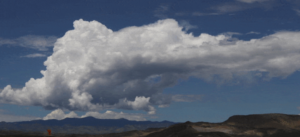
A deep convective cloud that we studied in New Mexico. Could insects have trigger ice formation?
Details
You will join the Atmospheric Ice Nucleation group in the Institute for Climate and Atmospheric Science. We are experts in how to quantify the ice nucleating ability on different materials in laboratory studies as well as field studies of ice-nucleating particles and their relation to clouds. You will adapt and apply the instruments and techniques we have developed for studying aerosol to insects.
Your CASE partner, Dr Ben Pickering of Wx Labs Ltd, is a drone expert who has been working with the University of Cambridge to collect insects from the atmosphere using nets deployed from an uncrewed aerial vehicle. You will work with Wx Labs and help deploy an insect sampling device and then test these insects back in the lab.
You will also benefit from the presence of Dr Chris Hassell, an Associate Prof of Animal Biology, in the School of Biology. He has been involved in the radar detection of insects and can supply insects for our experiments.
Further reading
Some background on why ice formation in clouds is important: Murray et al. Cloud-phase climate feedback and the importance of ice-nucleating particles. https://acp.copernicus.org/articles/21/665/2021/
Phys.org article titled ‘We now know how insects and bacteria control ice’. https://phys.org/news/2019-04-insects-bacteria-ice.html
An article about the instrument we’ll use in this project. Harrison et al. An instrument for quantifying heterogeneous ice nucleation in multiwell plates using infrared emissions to detect freezing. https://amt.copernicus.org/articles/11/5629/2018/