
YES-27-A-19: Improving the Representation of Subgrid-Scale Orography through a Physical Understanding of Terrain–Atmosphere Interactions
Understanding Atmospheric Flow Over Mountains
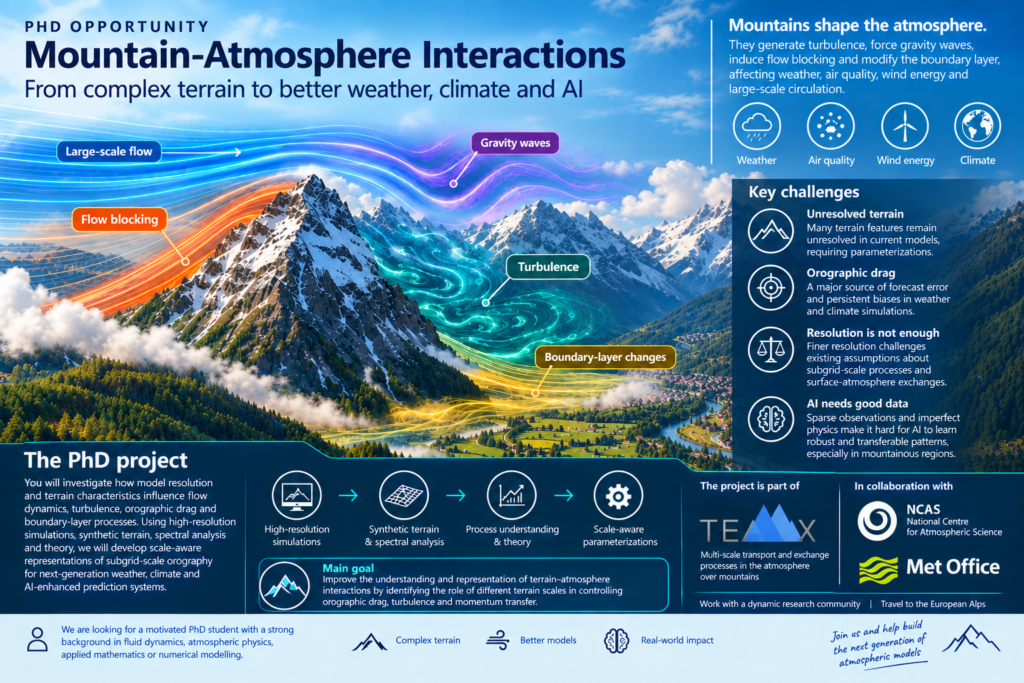
Mountains play a fundamental role in shaping atmospheric flow across a wide range of spatial and temporal scales. They generate turbulence, force gravity waves, induce flow blocking, and modify boundary-layer structure, thereby influencing local weather, air quality, wind energy resources, and large-scale atmospheric circulation.
Despite major advances in computing power, mountain meteorology remains one of the most challenging problems in numerical weather prediction and climate modelling. Many terrain features remain unresolved, even in current-generation kilometre-scale models, requiring their effects on the atmosphere to be represented through parameterisation schemes. Uncertainties in the representation of orographic drag continue to be a significant source of forecast error and contribute to persistent biases in weather and climate simulations. Recent studies have highlighted the sensitivity of atmospheric circulation to how unresolved terrain is represented and to the partitioning of momentum drag between resolved and parameterised processes. Moreover, increasing model resolution is not a complete solution. As finer-scale terrain features become explicitly resolved, long-standing assumptions regarding subgrid-scale processes and surface-atmosphere exchanges over complex terrain are increasingly challenged. This raises fundamental questions about which terrain scales control atmospheric drag and turbulence, and how their effects should be represented consistently across model resolutions.
These challenges are particularly relevant in the emerging area of Machine Learning (ML) and Artificial Intelligence (AI) applied to atmospheric science. While data-driven forecasting systems have shown considerable promise, their performance ultimately depends on the quality, representativeness, and physical realism of the data on which they are trained. In mountainous regions, observational datasets remain sparse and many key physical processes are still imperfectly represented in numerical models. As a result, approaches based on ML can struggle to learn robust and transferable relationships, especially for uncommon, highly localised, or poorly observed phenomena. Improving the physical understanding and modelling of mountain-atmosphere interactions is therefore essential not only for advancing traditional weather and climate models, but also for providing the reliable foundations upon which future AI-enhanced forecasting systems will depend.
The ultimate goal
The main goal of this project is to improve the understanding and modelling of terrain-atmosphere interactions by quantifying the role of different terrain scales in controlling orographic drag, turbulence, and momentum transfer.
The project will address questions such as:
- How do mountains generate drag through flow blocking, turbulence, and gravity waves?
- How do these processes change as model resolution increases?
-
How does atmospheric stability affect drag distribution?
- How can weather and climate models represent mountain effects more accurately?
Research approach
Through a combination of high-resolution numerical simulations, synthetic terrain generation, spectral analysis of orography, and theoretical approaches, the project will develop a process-based understanding and modelling of how unresolved and partially resolved orography affects atmospheric flow across scales. Particular attention will be devoted to understanding how drag is partitioned between low-level flow blocking, turbulent form drag, and gravity-wave drag as model resolution increases. The project will investigate how these contributions depend on terrain characteristics and atmospheric conditions, providing guidance for the development of scale-aware parameterization approaches in next-generation weather and climate models. In doing so, it will help improve both the physical fidelity of atmospheric simulations and the quality of the datasets that increasingly underpin emerging AI-based prediction systems.
Project Partners
The project is aligned with TEAMx (Multi-scale transport and exchange processes in the atmosphere over mountains – programme and experiment; http://teamx-programme.org), an ambitious international collaboration targeting the understanding of transport and exchange processes on all scales through modelling and intensive observation. There will be opportunities for travel to the European Alps as part of the TEAMx programme.
The project is also aligned with the National Centre for Atmospheric Science (NCAS)’s weather science programme. The student will be integrated within the NCAS research community.
The Met Office is a project partner. The successful applicant will be expected to work with and visit the Met Office partner.
Candidate profile
The project is ideally suited to a candidate with a strong background in fluid dynamics, atmospheric physics, applied mathematics, or numerical modelling, and an interest in developing physically based approaches to complex environmental flows.
Applicants will possess a degree in mathematical, physical or environmental science. For further information, please contact Dr Julian Quimbayo-Duarte ([email protected]). Details of the application process can be found at: https://yes-dtn.ac.uk/application-information/.