
YES-27-D-14: Transforming Volcanology Through Complex Systems Science
Project summary
Volcanic systems are complex (Annen et al. 2025). They contain many interacting parts and processes, from deep partial melting to shallow crustal storage and beyond (Fig. 1) (Magee et al. 2018). Crucially, it is the dynamic interactions between these parts, processes, and their external environments that controls how volcanoes behave (Fig. 1). We therefore cannot understand or forecast volcano behaviours, the major challenge in volcanology, by studying individual part or processes in isolation: we need to look at volcanic systems as a whole. Complex Systems Science offers a unique and exciting opportunity to tackle this problem.
Complex systems are common in Earth Sciences and throughout our everyday lives. From galaxies to Earth’s climate to financial markets to social situations, all can be described as complex systems. It is the connectivity and dynamic interaction between parts and processes within complex systems that drives their emergent behaviours. Complex Systems Science provides universal tools for describing and modelling complex systems, and has revolutionised understanding and prediction of phenomena across many disciplines. We think Complex Systems Science can similarly advance our understanding of and ability to forecast volcanic systems, but we need you to help us do this!
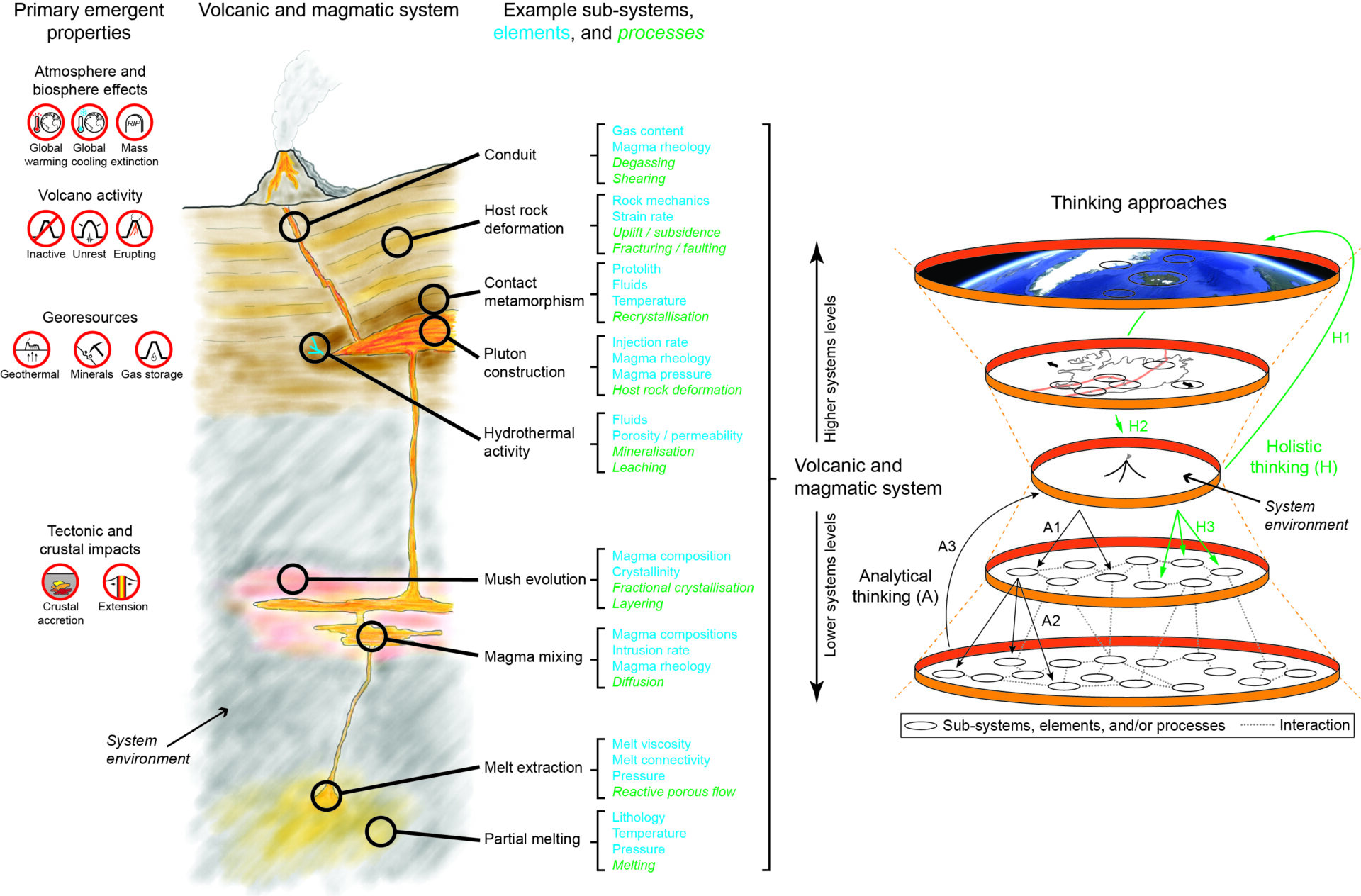
Figure 1: How volcanic and magmatic systems and their environment and can be broken down into sub-systems, parts, and processes that interact to produce emergent properties. Traditionally, Earth Scientists work to analytically examine volcanic systems (i.e. we move down system levels). However, systems thinking involves an holistic approach whereby the global and regional setting of the volcanic system is first considered (i.e. we move up system levels), before selection of sub-systems, parts, and processes to analyse.
Objectives and plan
This project will explore how Complex Systems Science can transform volcanology by developing holistic frameworks for understanding volcanic systems as dynamic, interconnected networks. In Year 1, you will undertake a comprehensive review of complex systems theory and volcanological literature, while engaging with an international network of researchers spanning volcanology, Complex Systems Science, mathematics, and data science. This work will establish systems-based frameworks for describing volcanic phenomena and identifying the key interactions that drive volcanic system evolution.
In Year 2, these frameworks will be used to construct knowledge graphs that represent volcanic systems through a common, interdisciplinary language. By mapping relationships between processes, parts, hazards and human systems, these graphs will reveal previously unrecognised connections, knowledge gaps, and emergent patterns. They will also lay the groundwork for integrating volcanic systems with broader environmental and societal contexts.
In Year 3, you will use the knowledge graphs as a dynamic source for updating the rules and states within the computational models. By leveraging modelling approaches such as network analysis (e.g., Cazabet et al., 2023), agent-based modelling, and cellular automata, you will start to simulate the evolution of coupled volcanic-human systems under different scenarios. Crucially, rather than relying on simple, static human-coding rules, your organised knowledge graphs will actively feed rule-sets and state transitions of cellular automata (and network-based analogues).
Overall, the project will evaluate whether concepts such as emergence, feedbacks, resilience, adaptation and critical transitions can provide new insights into volcanic behaviour, hazard development, and risk management. By establishing a Complex Systems Science framework for volcanology, this research aims to move beyond the study of isolated processes towards an integrated understanding of volcanoes as adaptive, interconnected systems, opening new avenues for prediction, hazard assessment and societal resilience.
Impact
Complex Systems Science has revolutionised disciplines from physics (e.g., see Nobel Prize winners, 2021) to economics to climate science: it thus offers an opportunity to similarly revolutionise volcanology. This PhD will adopt systems thinking approaches and complexity science modelling to simulate different aspects to volcanic and magmatic systems. This PhD will place you at the forefront of the volcanic and magmatic complex systems thinking revolution.
Your findings will be of interest to academics, industries (e.g., mining, geothermal), volcano observatories, and policy-makers worldwide. You will communicate findings through scientific papers, presenting at national and international conferences, and other avenues.
Training and opportunities
You will be based in the Institute for Geophysics and Tectonics at the University of Leeds but work closely with colleagues in the Sustainability Research Institute. You will receive training in complexity science and systems thinking (Magee, Cremades), and the workings of volcanic and magmatic systems (Magee, Ebmeier, Piazolo). Additional training in scientific writing, statistics and data analysis, problem-solving, time management, and developing independent research planning skills will also be provided by us and the YES DTN program. Through this training, you will become a confident and independent researcher with transferable skills applicable to both academic and non-academic jobs. Within Leeds, you will have the opportunity to interact with the Volcanology Research cluster, as well as many others depending on your interests.
Applicant Background
This project would suit candidates with a background in Earth Science, Complex Systems Science, or Systems Thinking. You should be curious and willing to work across disciplines. Some proficiency in coding would likely be beneficial but not essential. We encourage applicants from all backgrounds.
Fit to NERC Science
This project constitutes fundamental research into Earth processes and therefore fits well within the remit of NERC science. The project fits into the research areas of Volcanic Processes, Geohazards, and Earth Resources.