
YES-27-D-17: Geothermal seismology in Iceland
Summary
The Hengill region of Iceland is home to two of the largest geothermal power plants in the world, sitting atop a vast magmatic complex which ultimately supplies the heat which drives the geothermal system. However, it remains uncertain exactly how that heat is transferred to depths where it can be extracted as vapour and steam (about 2 km). Fractures and fluids play a key role, and in this project you will use seismic observations of the Hengill region to better understand where these fractures are, how they are oriented, and ultimately how they constrain the movements and distribution of subsurface heat. To do this, you will make use of data from a recently-deployed array of seismic ‘nodes’ (autonomous geophones which sense ground vibration) to the west of Hengill, alongside multiple existing datasets. You will use existing and new catalogues of microearthquakes and the ambient seismic noise recorded by the stations to create models of seismic velocity and anisotropy, as well as attenuation, and interpret these alongside other data. Depending on your experience and interest, you may build new inference schemes to combine multiple kinds of data, undertake fieldwork in Iceland to deploy new arrays, and develop machine learning-based approaches to handle data. The work will be in collaboration with researchers in Iceland and at Oxford, and involve travel to these locations.
Introduction and approach
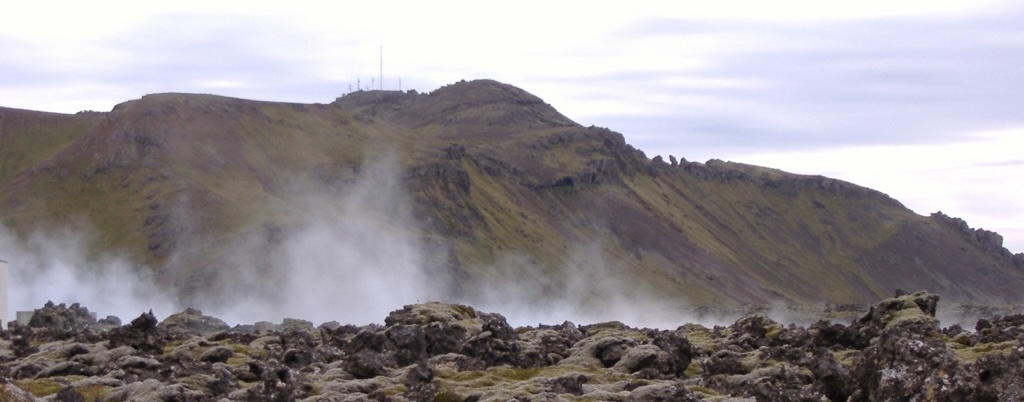
Geothermal power in Iceland is crucial to the country, providing 26% of electricity. In particular, the Hengill field (Figure 1) provides 56% of all geothermal electrical power. There is a constant need to manage geothermal fields, but seismology is not yet routine in exploring new or characterising existing fields, despite its proven usefulness elsewhere and promise to identify fluids and fracture, which are the primary requirement for power generation. This is because seismic instrumentation has typically been deployed too sparsely to see the complex geological structures which are important for hot fluids to be trapped or flow as needed. Moreover, traditional seismic methods provide only a ‘best-fit’ model of subsurface properties, whereas geothermal operators desire a risk-based approach to managing resources, and such models often ignore the crucial effect of fractures which carry geothermal fluids. What is needed is much denser seismic networks and seismic imaging with realistic uncertainties that accounts for fractures.

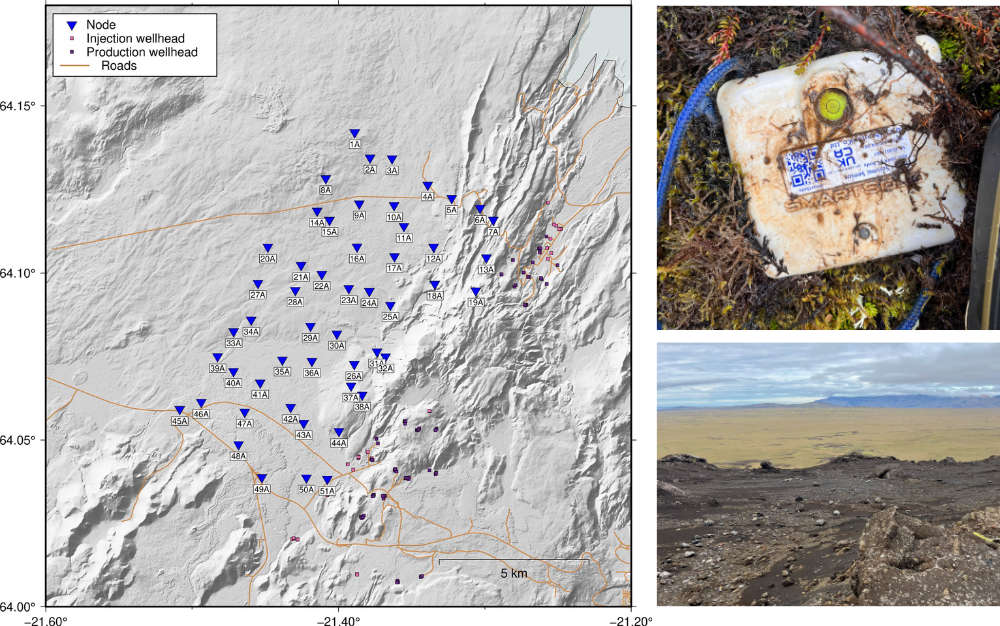
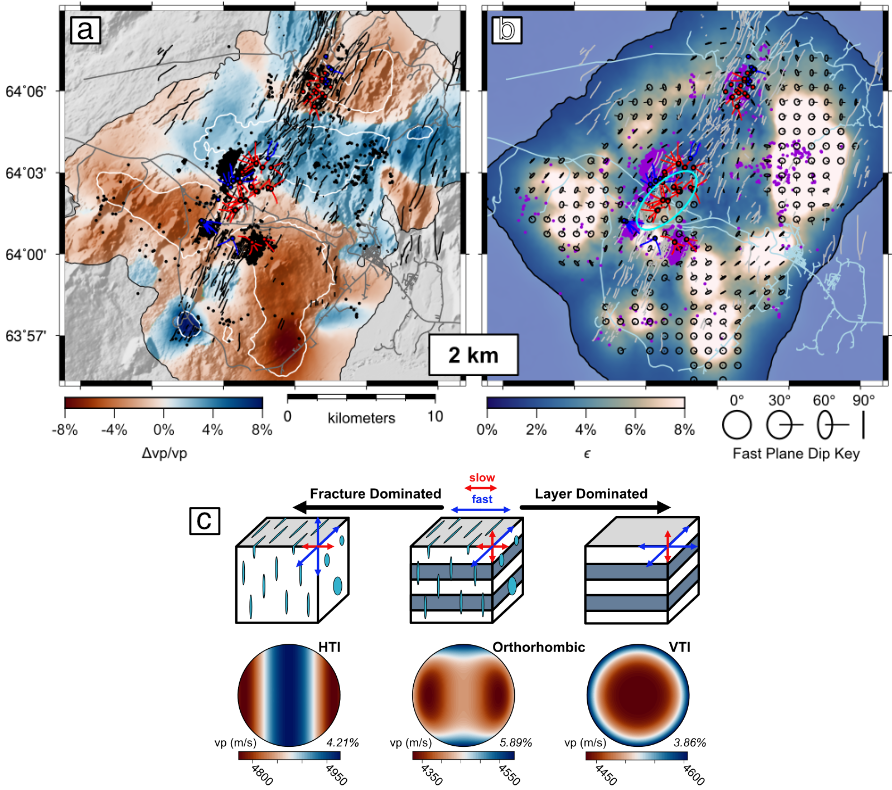
In this project, you will address these issues using a newly-deployed dense array of ‘nodes’, which are autonomous geophones, in the west of the Hengill geothermal field (Figure 2). This area is the target for future geothermal exploration by Reykjavik Energy, who operate the Nesjavellir and Hellisheiði power plants. During the deployment, many earthquakes within the array footprint occurred, which alongside ocean noise around Iceland, provides a natural, ‘passive’ source of energy to investigate the properties of the subsurface in this region. You will combine the nodal data alongside other existing datasets with Bayesian probabilistic imaging which incorporates the effects of fractures via seismic anisotropy (where wavespeed varies with direction), developed in Leeds and Oxford. This has been done with P waves for the wider region (Figure 3), but incorporating S waves will be important, as will using the finer scales within the nodal array.
The output of seismic imaging is therefore a set of probability distributions giving the seismic velocity at each point within the subsurface. During your PhD, you may look to update our methods to instead directly image rock physics parameters, such as fracture density, or to develop entirely new approaches to using Bayesian statistics to interpret the data. The exact plan of work will be developed with you as the project develops, based on your experience and interest.
Project structure
In this project, you will work with experts at Leeds and Oxford [and others] with backgrounds in seismology and geothermal development. The exact scope of the project will be developed with your own personal research interests and strengths in mind, but an initial plan could be:
- Use ambient noise (primarily from the oceans surrounding Iceland) to measure surface-wave dispersion by cross-correlating time periods to obtain empirical Green’s functions within the array.
- Combine these observations with existing earthquake catalogue data to obtain a 3D model of subsurface velocities (using the approaches of Zhang et al., 2020 and Roy et al., 2021), similarly to Wu et al. (2024), interpreting them in terms of heat, fluids and geothermal potential.
- Use existing catalogues of seismicity to use template-matching methods and machine learning-based detectors or migration (e.g., Shi et al., 2018) to discover more, tiny earthquakes and potentially reveal new structures or pathways for fluid migration.
- Incorporate shear-wave splitting data with P-wave travel times to infer fracture properties and relate these to other geophysical data, using the approach of Del Piccolo et al. (2026) (Figure 3).
Impact of this work
Monitoring the presence of subsurface fluids in geothermal power production is vital to ensure continued productivity, and this is nowhere more important to everyday life than in Iceland which relies on it greatly. The results of this project will inform decisions made by Reykjavik Energy (partners in the deployment of the nodal array described here) on future geothermal projects. Moreover, the results of this work will be applicable across similar geothermal prospects globally. Your results will help demonstrate the suitability of passive seismic acquisition in geothermal prospecting and management, and may lead to an expansion of seismology in this field. Because of the interest in the work and its applicability to a global geothermal audience, it is expected that your results will be publishable in respected journals and will allow you to present at international conferences.
Applicant suitability
This project would suit candidates with an interest in discovering new science which is useful in the real world, and a drive for interrogating datasets by using existing computational seismic techniques and possibly developing new ones. You will need to be able to collate seismic data, process it using available tools, develop new tools where appropriate, and model your data using existing workflows. Candidates will usually be armed with an undergraduate or masters training in an area such as geophysics, physics, geology, applied mathematics or similar branch of quantitative science. Programming experience is advantageous, as is a desire to undertake fieldwork.
Training environment
This project will involve working with collaborators in Iceland and Oxford. In Leeds, you will be a key member of a team of researchers across the School of Earth and Environment tackling fundamental problems in the study of the solid Earth. You will be part of the Geothermal and Seismology research groups in the Institute of Geophysics and Tectonics, interacting daily with not only your supervisors, but other senior colleagues, postdoctoral researchers and fellow PhD students. You will also have the opportunity to devise and co-supervise research projects for undergraduate and masters students. In this project, you will be trained in many transferrable scientific skills, including analysis of large datasets, high-performance computing, probabilistic inversion of geophysical data, and the dynamic communication of your ideas. Study for a PhD in the Geothermal and Seismic groups involves international travel to conferences and the possibility of seismic fieldwork. You will be supported in identifying a field site and obtaining the resources to deploy the group’s sensing equipment to gather new data, if appropriate. As a member of the YES Doctoral Training Network, you will receive tailored training alongside a cohort of other postgraduate researchers.
References and further reading
- Del Piccolo, G., Byrnes, J.S., Gaherty, J.B., VanderBeek, B.P., Faccenda, M., Morelli, A., 2026. Joint body- and surface-wave transdimensional Monte Carlo imaging of upper mantle anisotropy. Geophysical Journal International 247, ggag310. https://doi.org/10.1093/gji/ggag310
- Gasperikova, E., Rosenkjaer, G.K., Arnason, K., Newman, G.A., Lindsey, N.J., 2015. Resistivity characterization of the Krafla and Hengill geothermal fields through 3D MT inverse modeling. Geothermics 57, 246–257. https://doi.org/10.1016/j.geothermics.2015.06.015
- Mousavi, S.M., Ellsworth, W.L., Zhu, W., Chuang, L.Y., Beroza, G.C., 2020. Earthquake transformer—An attentive deep-learning model for simultaneous earthquake detection and phase picking. Nat Commun 11, 3952. https://doi.org/10.1038/s41467-020-17591-w
- Obermann, A., Sánchez‐Pastor, P., Wu, S., Wollin, C., Baird, A.F., Isken, M.P., Clinton, J., Goertz‐Allmann, B.P., Dahm, T., Wuestefeld, A., Shi, P., Lanza, F., Gyger, L., Wetter, S., Hjörleifsdóttir, V., Langet, N., Brynjarsson, B., Jousset, P., Wiemer, S., 2022a. Combined Large‐N Seismic Arrays and DAS Fiber Optic Cables across the Hengill Geothermal Field, Iceland. Seismological Research Letters 93, 2498–2514. https://doi.org/10.1785/0220220073
- Obermann, A., Wu, S.-M., Ágústsdóttir, T., Duran, A., Diehl, T., Sánchez-Pastor, P., Kristjansdóttir, S., Hjörleifsdóttir, V., Wiemer, S., Hersir, G.P., 2022b. Seismicity and 3-D body-wave velocity models across the Hengill geothermal area, SW Iceland. Front. Earth Sci. 10. https://doi.org/10.3389/feart.2022.969836
- Roy, C., Nowacki, A., Zhang, X., Curtis, A., Baptie, B., 2021. Accounting for natural uncertainty within monitoring systems for induced seismicity based on earthquake magnitudes. Front. Earth Sci. 9, 634688. https://doi.org/10.3389/feart.2021.634688
- Shi, P., Nowacki, A., Rost, S., Angus, D., 2018. Automated seismic waveform location using Multichannel Coherency Migration (MCM)–II. Application to induced and volcano-tectonic seismicity. Geophysical Journal International 216, 1608–1632. https://doi.org/10.1093/gji/ggy507
- Wu, S.-M., Sánchez-Pastor, P., Ágústsdóttir, T., Hersir, G.P., Mordret, A., Hjörleifsdóttir, V., Obermann, A., 2024. Crustal characterization of the Hengill geothermal fields: Insights from isotropic and anisotropic seismic noise imaging using a 500-node array. Journal of Geophysical Research: Solid Earth 129, e2024JB028915. https://doi.org/10.1029/2024JB028915
- Zhang, X., Roy, C., Curtis, A., Nowacki, A., Baptie, B., 2020. Imaging the subsurface using induced seismicity and ambient noise: 3D Tomographic Monte Carlo joint inversion of earthquake body wave travel times and surface wave dispersion. Geophysical Journal International 222, 1639–1655. https://doi.org/10.1093/gji/ggaa230