YES-27-D-22: Measuring Ice Sheet Velocity from Space Using Multi-Frequency Synthetic Aperture Radar
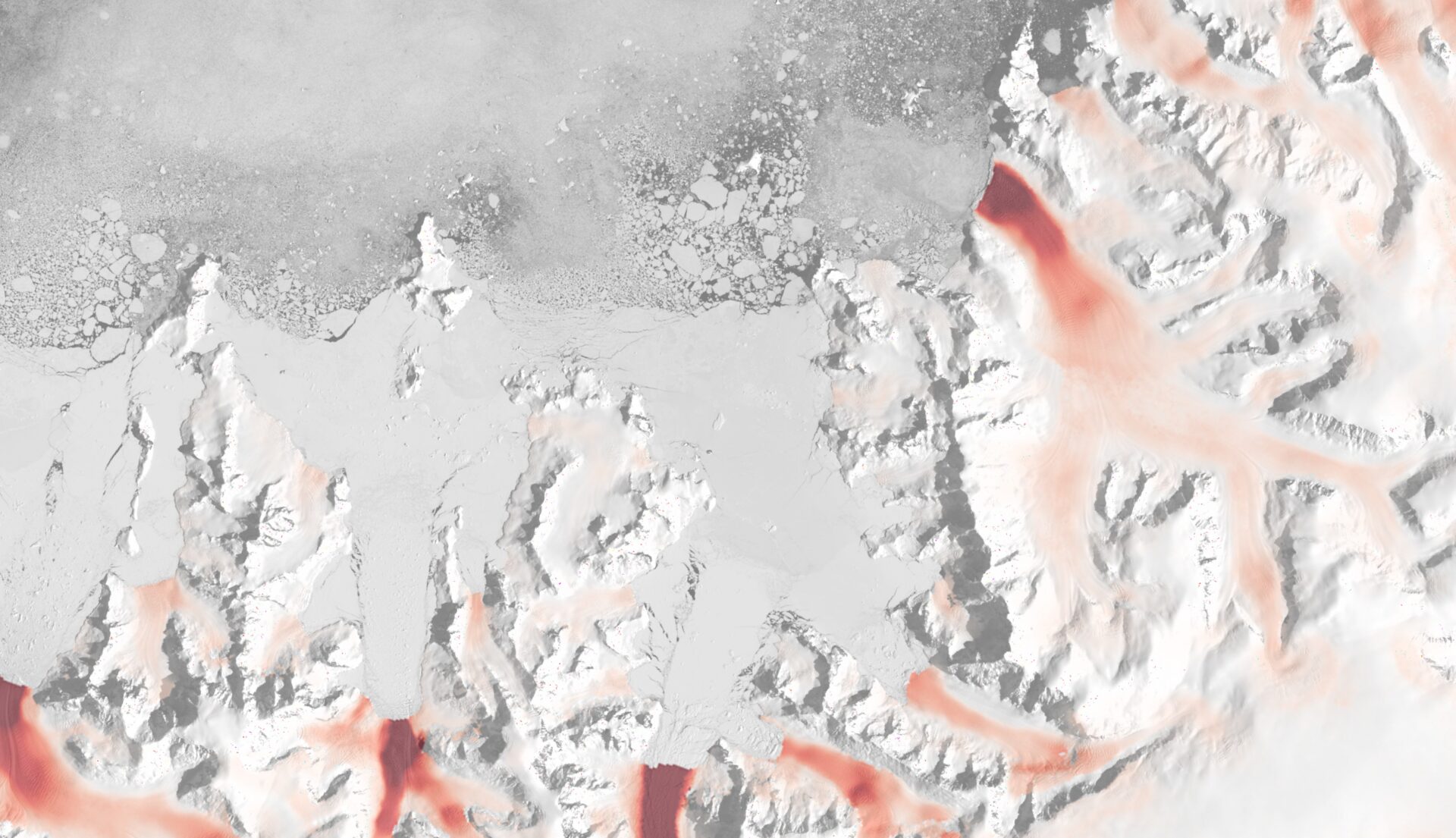
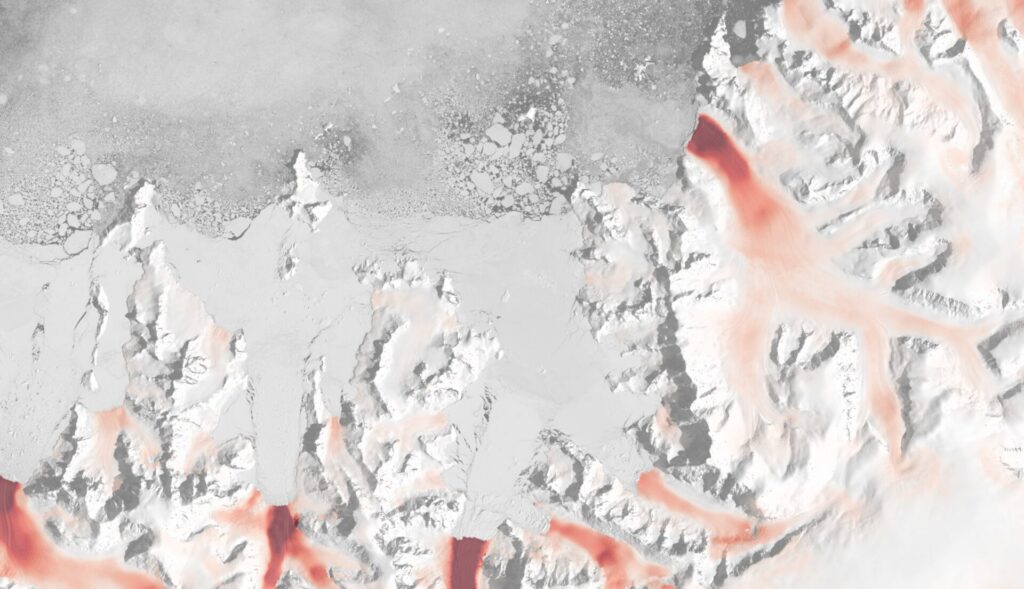
The flow velocity of ice sheets and glaciers is a key geophysical parameter that helps us understand and simulate the behaviour of ice within the Earth system. By observing ice velocity and measuring changes we can monitor the response of glaciers and ice sheets to the environment, including anthropogenic climate change, and track their contribution to global sea level rise. This is essential, because combined Antarctica, Greenland and global glaciers contain enough ice to raise global sea levels by 66 m, so even small percentage changes in total ice mass can have major impacts on communities around the world.
Since the 1990s, satellite data has revolutionised scientists’ ability to monitor the Earth’s glaciers and ice sheets, leading to major advances in our understanding of glacier and ice sheet behaviour. Most notably, these observations have shown that ice mass loss from Antarctica and Greenland has contributed 21 mm to global sea-levels since 1992. Synthetic aperture radar (SAR) satellite missions, such as the European Space Agency (ESA)’s Sentinel-1 constellation, have been particularly important in this satellite data revolution, because they image the surface of the Earth through cloudy conditions and the polar night, providing close to real-time monitoring all year round.
This project aims to leverage recent advances in the availability of new SAR satellite missions including NASA NISAR and the ESA BIOMASS (both launched in 2025), and commercial SAR providers made available through the European Space Agency’s Third Party Mission Programme. These data will be combined with over a decade of Sentinel-1 SAR acquisitions to form a virtual constellation across multiple radar frequencies that offers exciting opportunities to investigate ice dynamics with new levels of precision.
As a student on this project, you will learn how to process data from multiple SAR satellite missions to measure the ice velocity of glaciers and ice sheets. You will develop new methodologies and algorithms for combining measurements from these different sensors to improve the resolution, accuracy and error characterisation of ice velocity observations. You will also develop robust approaches for quantifying these uncertainties and their spatial covariance, producing velocity datasets with error estimates that are better suited to downstream modelling and data assimilation. You will use these improved measurements to investigate ice dynamic change in Antarctica, focussing on acceleration, increased ice discharge, seasonal ice dynamics and the ice sheet’s interaction with the climate. With the support of Beatriz Recinos Rivas at the University of Edinburgh, you will have the opportunity to work directly with the glacier modelling community to optimise your ice velocity measurements for use in modelling efforts.
During the PhD you will be part of the Satellite Ice Dynamics research group within the Institute for Climate and Atmospheric Science at the University of Leeds. You will have access to the YES-DTN’s training programme, as well as programming training and support through the department’s Centre for Environmental Modelling and Computation. Additionally, you will be supported and encouraged to apply for external summer schools within the field which can provide training in glaciology, Earth observation, machine learning, and fieldwork skills.
This project is suitable for students with an excellent undergraduate or Masters degree in physical sciences, Earth sciences, mathematics, or related disciplines. Experience with programming, including geospatial data is highly desirable. Students should have a keen interest in polar science, glaciology, and remote sensing, but prior experience of these is not a requirement.
We welcome applications from candidates of all backgrounds, including those that are underrepresented in the geosciences. Candidates with work experience outside of academia and non-traditional career paths are encouraged.
For further reading, you can find some examples of our research group’s work here: https://www.nature.com/articles/s41561-023-01131-4, https://doi.org/10.1002/2016GL072110, https://www.nature.com/articles/s41467-023-42970-4