
YES-27-E-02: The Rise of Vertebrate Apex Predators and the Ecological Origins of the Devonian Nekton Revolution
Project Summary
The Silurian and Devonian Periods witnessed one of the most significant ecological transitions in Earth’s history: the rise of active vertebrate predators and the apparent expansion of nektonic marine food webs (Figure 1; Klug et al. 2010). This interval saw the diversification of jawless vertebrates, the evolution of jaws and teeth, and the rapid radiation of groups including placoderms, chondrichthyans and early osteichthyans. Collectively, these innovations may have transformed marine ecosystems by introducing novel predatory strategies, increasing trophic complexity, and reshaping patterns of energy transfer throughout aquatic communities. However, it remains unclear whether these changes represent a discrete “Devonian Nekton Revolution” or a more protracted ecological reorganisation spanning much of the Palaeozoic and beyond (Whalen & Briggs 2018). Importantly, vertebrates did not enter ecosystems lacking large predators; apex predatory niches had long been occupied by groups such as orthocone cephalopods and eurypterids. Instead, the critical question is whether the rise of vertebrates simply replaced existing high-level consumers or introduced a broader array of predatory traits, feeding strategies, and trophic interactions that fundamentally altered marine ecosystem structure.
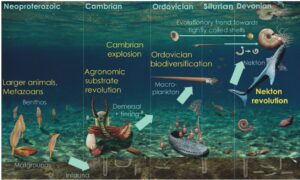
This project will investigate the origins and ecological impacts of the first vertebrate apex predators, examining how the evolution of vertebrate feeding innovations altered marine ecosystem structure and potentially triggered a major phase of ecological escalation (Klug et al. 2010). By integrating diversification analyses, network-based food web reconstruction, and functional morphological approaches, the project will evaluate the emergence of complex trophic interactions from the Silurian through the Late Palaeozoic and assess how these changes relate to broader Phanerozoic evolutionary events such as the Great Ordovician Biodiversification Event (GOBE) and the Mesozoic Marine Revolution (MMR).
Background and Rationale
The ecological expansion of vertebrates during the Silurian and Devonian represents one of the most important evolutionary innovations in the history of life (Janvier 1996). Prior to the appearance of large predatory vertebrates, marine ecosystems were largely dominated by invertebrate consumers and opportunists (Figure 1). The diversification of jawless vertebrates, followed by the evolution of jaws, mineralised teeth, and enhanced locomotory capabilities, may have created entirely new trophic roles within marine ecosystems (Long 2011).
The concept of a Devonian Nekton Revolution proposes that swimming animals rapidly occupied the free water column during this interval, resulting in greater vertical coupling of food webs, increasing trophic complexity, and the emergence of large vertebrate predators (Figure 1; Klug et al. 2010). Nevertheless, evidence for the timing, magnitude, and ecological consequences of this event remains fragmented. Most studies have focused on taxonomic diversification, whereas relatively little attention has been paid to ecosystem-level processes.
A key unresolved question is whether the appearance of increasingly active vertebrate predators fundamentally altered marine community structure through ecological escalation (Klug et al. 2010). Did the rise of vertebrate predation drive increasing prey specialisation, defensive adaptations, and niche partitioning, both in the water column and within benthic communities? Did food webs become more complex or more stable throughout the Palaeozoic? More fundamentally, do these patterns support the existence of a distinct Devonian Nekton Revolution, driven by the ecological expansion of vertebrates (Klug et al. 2010), or do they instead reflect a more prolonged restructuring of marine ecosystems characterised by the gradual diversification of nektonic organisms, predators, and marine life more generally from the Ordovician through the Mesozoic (Whalen & Briggs 2018)?
Research Questions
The project will address three overarching questions:
- Did the rise and diversification of vertebrate apex predators drive ecological escalation within marine ecosystems, as evidenced by the diversification of benthic and pelagic prey groups exhibiting defensive adaptations, alongside the restructuring or decline of incumbent invertebrate predator and prey guilds?
- How did trophic network properties change through the rise of major vertebrate groups such as osteostracans, placoderms, chondrichthyans and osteichthyans?
- Did the diversification of vertebrate feeding traits and functional morphologies associated with jaws and teeth result in the expansion of trophic roles and the evolution of defensive adaptations among benthic and pelagic prey communities?
Objectives
Objective 1: Diversification Dynamics of Vertebrate Predators and Marine Ecosystem Turnover
Compile a comprehensive occurrence database of Silurian-Carboniferous vertebrates from published literature and the Paleobiology Database, alongside datasets for major marine predator and prey guilds, including pelagic and benthic invertebrate groups.
Analyses will include:
- Diversity trajectories
- Origination and extinction rates
- Sampling standardisation approaches
- Diversification dynamics of major prey groups and benthic communities
- Temporal turnover among vertebrate and invertebrate predator guilds
This framework will test whether the diversification of vertebrate predators coincided with broader ecological restructuring of marine ecosystems. Specifically, it will evaluate whether increases in vertebrate predatory diversity were associated with: (i) diversification of benthic and pelagic prey groups exhibiting potential anti-predator adaptations; (ii) declines or replacement of incumbent invertebrate apex predators such as cephalopods and eurypterids; and (iii) changes in the diversity and composition of vulnerable benthic communities. These analyses will allow explicit testing of hypotheses that the rise of vertebrate predation intensified ecological escalation, altered selective pressures across marine food webs, and contributed to long-term turnover in both predator and prey guilds.
Objective 2: Reconstruction of Palaeozoic Food Webs
Marine food webs will be reconstructed at a series of time slices spanning the Late Ordovician to Carboniferous. Using approaches derived from ecological network analysis and recent palaeo-food web studies (Shaw et al. 2024; Dunhill et al. 2024), trophic interactions will be inferred from:
- Functional traits
- Body size distributions
- Feeding morphology
- Phylogenetic constraints
- Sedimentological and palaeoenvironmental data
Key metrics will include:
- Connectance
- Generality
- Vulnerability
- Motif distributions
- Mean trophic level
- Food chain length
This framework will test whether the diversification of vertebrate predators was associated with fundamental changes in marine food-web structure and ecosystem organisation. Specifically, it will evaluate whether the rise of jawed vertebrates coincided with: (i) increases in trophic complexity and food-chain length; (ii) shifts in network structure resulting from the emergence of new predatory guilds and feeding strategies; (iii) increasing ecological integration between pelagic and benthic communities; and (iv) evidence for ecological escalation through changing patterns of predator-prey interactions.
Temporal patterns in food-web structure will be used to assess whether marine ecosystems underwent a discrete reorganisation during the Devonian, consistent with a Devonian Nekton Revolution, or whether observed changes instead reflect a more gradual expansion of trophic complexity and predator-driven ecosystem restructuring throughout the Palaeozoic. Particular attention will be paid to identifying whether increasing vertebrate dominance altered the organisation and stability of marine ecosystems, and whether periods of predator diversification are associated with corresponding changes in prey guild structure, trophic architecture, and network resilience.
Objective 3: Functional Evolution of Vertebrate Predation
Ecological functional diversity will be assessed for vertebrate predator assemblages spanning the Late Ordovician to Carboniferous. Building on recent approaches in functional palaeoecology (e.g. Blanco et al., 2025), this objective will quantify how innovations in feeding and locomotory systems altered vertebrate ecological roles and expanded the functional breadth of marine ecosystems through time.
Morphological datasets will be assembled for:
- Jaw architecture
- Tooth morphology
- Cranial mechanics
- Body size
- Locomotory characteristics
- Limb morphology
- Dental microwear
Methods could include:
- Functional disparity analyses
- Morphospace occupation
- Ecological guild reconstruction
- Dental microwear texture analysis (DMTA)
- Functional trait analyses
- Geometric morphometrics
This framework will test whether the evolution of jaws, teeth, and associated feeding adaptations resulted in a significant expansion of vertebrate functional diversity and trophic role occupation. Specifically, it will evaluate whether the diversification of feeding strategies was associated with: (i) the appearance of novel ecological guilds and feeding modes; (ii) increased partitioning of trophic resources among vertebrate predators; (iii) occupation of previously inaccessible trophic niches; and (iv) the emergence of apex predatory roles distinct from those occupied by incumbent invertebrate predators.
By integrating functional trait data with the diversification and food-web analyses developed in Objectives 1 and 2, this objective will test whether increases in vertebrate functional diversity correspond with evidence for ecological escalation within marine ecosystems. In particular, it will assess whether the appearance of novel predatory adaptations and feeding strategies coincided with the diversification of prey taxa exhibiting defensive morphologies, changes in body-size structure, shifts in habitat utilisation, or other indicators of increased predation pressure within both benthic and pelagic communities. These analyses will determine whether the evolution of vertebrate feeding innovations simply increased taxonomic diversity or instead generated fundamentally new ecosystem functions that reshaped marine trophic structure throughout the Palaeozoic.
Big Picture
This project will integrate vertebrate evolution, food-web ecology, and macroevolutionary theory into a single framework spanning the Palaeozoic. By combining diversification analyses, quantitative network modelling, and functional morphology, it will move beyond taxonomic analyses to investigate how innovations in feeding and predation reshaped marine ecosystems across multiple levels of biological organisation.
More broadly, the project seeks to determine whether the rise of vertebrate predators represents a discrete ecological transition or part of a longer-term pattern of ecosystem restructuring spanning the Ordovician to Mesozoic. By examining the links between predator diversification, functional innovation, food-web complexity, and ecological escalation, it will provide new insights into how evolutionary novelties drive the reorganisation of marine ecosystems and contribute to major Phanerozoic transitions.
An excellent training and research environment
This interdisciplinary project will provide the successful PhD candidate with highly valued and sought-after tools for investigating macroecological and macroevolutionary processes. The student will gain experience and expertise in database construction, fossil specimen taxonomy, trait quantification, functional morphology, and ecological modelling, and macroevolutionary modelling. This will equip the student with the necessary expertise to become the next generation of palaeontological and ecological scientist, ready to carry out their own programme of innovative scientific research. The student will be based within the nurturing and supportive environment of the DeepBio@Leeds group where student development and wellbeing comes before all else and will benefit from working within and collaborating with dynamic scientists within the CASCaDE team, the multidisciplinary Palaeo@Leeds Research Cluster as well as the quantitative evolutionary ecology group at Sheffield. There will be opportunities to present results at major, international conferences, e.g. BES, GSA, PalAss, and attend residential summer-schools (e.g. in USA, UK) and in-house workshops and courses.
Student profile
A good first degree (1 or high 2i), or a good Master’s degree in physical or biological sciences or mathematics with a focus towards ecology, palaeobiology, or evolutionary biology, experience in programming (e.g. R) is an advantage but not essential.
References
Blanco, F., Lazagabaster, I.A., Sanisidro, Ó., Bibi, F., Heckeberg, N.S., Ríos, M., Mennecart, B., Alberdi, M.T., Prado, J.L., Saarinen, J., Silvestro, D., Müller, J., Calatayud, J., & Cantalapiedra, J. L. (2025). Two major ecological shifts shaped 60 million years of ungulate faunal evolution. Nature Communications, 16(1), 4648.
Dunhill, A. M., Zarzyczny, K., Shaw, J. O., Atkinson, J. W., Little, C. T., & Beckerman, A. P. (2024). Extinction cascades, community collapse, and recovery across a Mesozoic hyperthermal event. Nature Communications, 15(1), 8599.
Janvier, P. (1996). Early Vertebrates. Oxford University Press.
Long, J. A. (2011). The Rise of Fishes: 500 Million Years of Evolution (2nd ed.). Johns Hopkins University Press.
Shaw, J.O., Dunhill, A.M., Beckerman, A.P., Dunne, J.A., Hull, P.M. A framework for reconstructing ancient food webs using functional trait data, BioRxiv, doi:https://doi.org/10.1101/2024.01.30.578036
Whalen C.D. and Briggs D.E.G. (2018). The Palaeozoic colonization of the water column and the rise of global nekton. Proc R Soc B Biol Sci. 285(1883):20180883. doi:10.1098/rspb.2018.0883