
YES-27-G-05 – Mechanisms of Soil Organic Carbon Stabilisation Following Woodland Creation: Impact of tree species and soil type
Introduction
Woodland creation and soil carbon sequestration are increasingly promoted as a nature-based solution to climate change because it can increase carbon sequestration in both biomass and soils. To support net-zero targets, the UK Climate Change Committee recommends increasing woodland cover from 13% to 17%, requiring the establishment of 30,000 ha of new woodland annually until 2050. While aboveground carbon accumulation following tree establishment is relatively well understood, the response of soil organic carbon (SOC) remains uncertain.
In principle, woodland creation can increase SOC through greater litter inputs, larger root systems, enhanced microbial activity, and reduced soil disturbance. However, SOC responses vary considerably among sites. Previous land use, soil properties, climate, woodland age, tree species, and management practices can all influence outcomes. Moreover, most studies focus on changes in total SOC stocks. As a result, our understanding of the mechanisms that govern long-term carbon storage and stabilisation remains limited.
Recent advances in soil biogeochemistry show that SOC consists of pools with contrasting turnover rates and stabilisation mechanisms. Specifically, researchers often separate SOC into particulate organic matter (POM) and mineral-associated organic matter (MAOM). POM mainly contains partially decomposed plant residues, whereas MAOM forms when organic compounds bind to mineral surfaces. Importantly, these fractions differ in persistence, with MAOM generally representing the more stable long-term carbon pool.
Understanding where woodland-derived carbon accumulates is therefore critical to woodland creation and soil organic carbon sequestration. Indeed, long-term SOC stabilisation depends not only on plant carbon inputs but also on microbial processing and subsequent interactions with mineral surfaces. Consequently, increases in total SOC may overestimate the climate mitigation benefits of woodland creation if carbon accumulates primarily within relatively labile POM pools.
This uncertainty is particularly important because woodland expansion increasingly underpins climate mitigation strategies. Furthermore, soil texture, mineralogy, drainage, tree species and previous land use may strongly influence MAOM formation and, therefore, the permanence of stored carbon. Taken together, these factors highlight the need for a stronger mechanistic understanding of SOC stabilisation following woodland creation. Such knowledge will improve carbon accounting frameworks, reduce uncertainty in greenhouse gas inventories, and help identify where woodland creation and soil carbon sequestration can deliver the greatest and most durable soil carbon benefits.
Aim
This PhD will determine how woodland creation influences SOC storage in temperate soils. It will also identify the mechanisms that stabilise newly sequestered carbon within POM and MAOM pools.
Objectives
1. Quantify how woodland creation affects total SOC stocks in temperate soils.
2. Determine how woodland-derived carbon is distributed between POM and MAOM fractions.
3. Assess how soil texture, mineralogy, depth, and previous land use influence carbon stabilisation.
4. Evaluate how SOC storage and stabilisation mechanisms change as woodlands age.
5. Investigate how tree species affect SOC accumulation and partitioning between POM and MAOM.
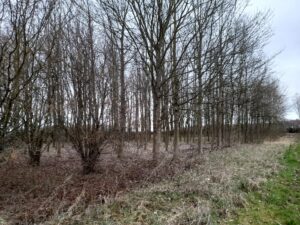
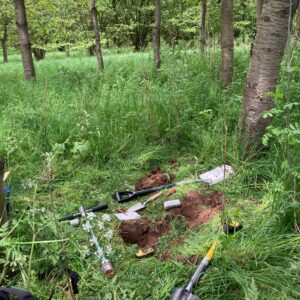
Figure 1. Trees planted on agricultural land at the University of Leeds farm in 1988
Potential for High-Impact Outcomes
This project will provide one of the first mechanistic assessments of SOC stabilisation following woodland creation in temperate agricultural landscapes. Specifically, it will identify the conditions that promote long-term carbon storage in MAOM. The findings will improve carbon accounting and help guide woodland creation policy. They will also support more effective climate mitigation strategies.
The project will work closely with the Woodland Trust. This partnership will help communicate findings directly to woodland practitioners, land managers, and policymakers. It will also ensure that new woodland is established where it can deliver the greatest and most durable soil carbon benefits.
Supervision
The student will be supervised by Professor Pippa Chapman (School of Geography), Dr Cat Scott, and Professor Dominick Spracklen (School of Earth and Environment) at the University of Leeds. In addition, the Woodland Trust will provide additional support. It will offer access to woodland creation sites, long-term monitoring locations, and a three-month placement within the organisation.
The supervisory team provides expertise in soil biogeochemistry, ecosystem science, carbon cycling, and woodland ecology. Regular meetings will support the student’s development throughout the project. In addition, the student will also join several interdisciplinary research communities at the University of Leeds, including the Priestley Centre for Climate Futures. Together, these networks will provide opportunities for collaboration and professional development.
Training
The project will provide training in a wide range of interdisciplinary research skills. These include experimental design, soil sampling, soil fractionation, laboratory analysis, statistics, modelling, data interpretation, scientific writing, and oral presentation. In addition, the student will also receive training in field safety, laboratory risk assessment, research integrity, and data management. Together, these activities will build an advanced understanding of soil carbon cycling, stabilisation, and storage.
Collaboration with the Woodland Trust will provide valuable experience at the science-policy-practice interface. During the placement, the student will learn about woodland creation delivery, stakeholder engagement, and policy development. At the same time, they will also gain experience translating scientific evidence into practical guidance for land managers and decision-makers. This partnership will help maximise research impact by connecting findings directly with practitioners, landowners, and policymakers.
The studentship includes a comprehensive postgraduate researcher training programme. Supervisors will assess training needs at the start of the project and review them regularly. Furthermore, there will be many opportunities to access training, including via the YES Doctoral Training Network and the University of Leeds. Available training includes statistics, programming, academic writing, grant writing, public engagement, science communication, and impact development.
Student Profile
Applicants should have a strong interest in environmental science and climate change mitigation. They should also have a background in physical geography, environmental science, ecology, biology, soil science, forestry, or a related discipline. Experience in fieldwork, laboratory methods, or statistical analysis would be beneficial but is not essential. The project provides full training.
The successful candidate should enjoy working across disciplinary boundaries. They should also be motivated to conduct research with real-world impact. An interest in engaging with external partners, including the Woodland Trust and other environmental stakeholders, is highly desirable.
References
Cotrufo, M.F., Ranalli, M.G., Haddix, M.L., Six, J. & Lugato, E. (2019). Soil carbon storage informed by particulate and mineral-associated organic matter. Nature Geoscience, 12, 989-994. https://doi.org/10.1038/s41561-019-0484-6
Cotrufo, M.F., Wallenstein, M.D., Boot, C.M., Denef, K. & Paul, E. (2013). The Microbial Efficiency-Matrix Stabilization (MEMS) framework integrates plant litter decomposition with soil organic matter stabilisation. Global Change Biology, 19, 988-995. https://doi.org/10.1111/gcb.12113
(2026) Woodland creation scheme in the Yorkshire Dales successfully focuses tree planting on soils with lower soil organic carbon stocks. Ecological Solutions and Evidence, 7, (1) https://doi.org/10.1002/2688-8319,70201
Laganière, J., Angers, D.A. & Paré, D. (2010). Carbon accumulation in agricultural soils after afforestation: a meta-analysis. Global Change Biology, 16, 439-453. https://doi.org/10.1111/j.1365-2486.2009.01930.x
Lavallee, J.M., Soong, J.L. & Cotrufo, M.F. (2020). Conceptualizing soil organic matter into particulate and mineral-associated forms to address global change in the 21st century. Global Change Biology, 26, 261-273. https://doi.org/10.1111/gcb.14859
Six, J., Conant, R.T., Paul, E.A. & Paustian, K. (2002). Stabilization mechanisms of soil organic matter: implications for C-saturation of soils. Plant and Soil, 241, 155-176. https://doi.org/10.1023/A:1016125726789