
YES-27-G-06: Integrating Remote Sensing and Field Measurements to Monitor Amazon Forest Climate Risk
Context: Climate Change in Southern Amazonia
The Southern Amazon faces the greatest climatic threat of all Amazon regions. This region is drier and warmer than ‘core’ areas of the Amazon and has been subject to the most pronounced drying and warming trends. Furthermore, it is also the region of the Amazon where tree species exhibit the most water stress (Tavares et al. 2023) and where atmospheric measurements suggest forests are no longer acting as carbon sinks but as net sources of carbon to the atmosphere (Gatti et al. 2021). Given that Southern Amazon is at the front line of the Amazon’s battle against climate change, we urgently need to understand how drought and high temperatures impact the functioning of these forests.
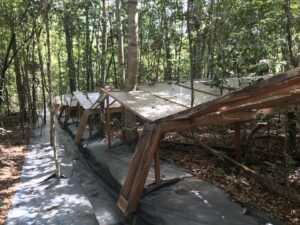
Integration with Ecosystem-scale drought Experiment in Southern Amazonia
This PhD will build directly upon an ecosystem-scale rainfall exclusion experiment established through a NERC grant to better understand the physiological survival limits of southern Amazon trees (https://secalimite.org/). The experiment is now fully functional and began excluding rainfall in October 2024. This PhD will integrate data currently collected at the drought experiment site and nearby control (undroughted) site with new in-situ data collection and satellite observations to develop approaches to detect Amazon tree water stress from space that can be scaled up across the broader southern Amazon. Data currently collected at the site includes soil water content, stem water content, sap flow, leaf water potential, and core carbon fluxes (tree growth and mortality). The student will have access to these datasets as well as drone-mounted camera data on canopy temperatures and canopy greenness collected monthly over each of the focal monitoring plots.
Aims, Objectives and Methodological Approach
The overall aim of the PhD is to link field observation of Amazon tree water stress and it consequences on Amazon forest vegetation to remote sensing measurements at different resolutions to better understand climate-associated tree mortality risk in tropical forests. As well as the locally collected plant ecophysiology and leaf reflectance datasets, the student will have access to high-resolution multispectral (Axel Space) and hyperspectral imagery (Pixxel) as well as readily available satellite products (e.g. Sentinel-2).
The integration of field and remote sensing approaches can be used to address a number of questions, depending on the interests of the student, including:
- What are the impacts of sustained drought on leaf reflectance?
- How well can ground observations of leaf water content and leaf water potential under drought be predicted by reflectance signatures?
- Which remote sensing bands and indices best predict drought-associated tree mortality risk?
- How does drought-induced mortality risk vary across Amazon forests?
A considerable focus of the studentship will be on the analysis of field spectra datasets, UAV-based imagery and multiple streams of satellite data (multispectral and hyperspectral). However, there will also be scope for new data collection at the experimental site in Mato Grosso, Brazil when this is relevant for addressing core project questions.
Research Opportunities
The student will interact with a number of scientists at different career stages involved in the project in different capacities – this includes not only the student’s direct supervisors but also PhD researchers from Brazilian institutes, postdoctoral researchers and project partners from across an array of institutes. The student would be co-supervised by Prof. David Galbraith and Prof. Emanuel Gloor in Leeds and Dr. Marcos Adami at the Brazilian Space Institute and will be based in the Ecology and Global Change (EGC) research cluster in the School of Geography, University of Leeds. EGC is a dynamic, world-leading research cluster with a strong focus on understanding the ecological and biogeochemical functioning of tropical forests.