
YES-27-Y-01: Investigating sources of iodine to the Arctic atmosphere
Investigating sources of iodine to the Arctic atmosphere
The Arctic is warming 2-4 times faster than the global average, driving rapid environmental change. The Arctic climate and its future evolution is particularly sensitive to aerosol-cloud interactions, which strongly influence radiative forcing. Atmospheric iodine has recently been discovered to be a key driver of Arctic new particle formation and a contributor to enhanced cloud condensation nuclei (CCN) formation. However, the sources of iodine to the Arctic atmosphere are unknown. A number of active polar sources are possible, from marine biological activity in and under sea ice, to oceanic emissions from the marginal ice zone (MIZ), to photochemical snowpack release. Within this project, you will investigate, compare and make progress towards quantifying these various production mechanisms, measuring both inorganic and organic emissions using a Vocus Chemical Ionisation Time-of-Flight Mass Spectrometer and by GC-MS. Soluble inorganic iodine ions, which are precursors for gaseous iodine formation, will be measured in snow and aqueous samples.
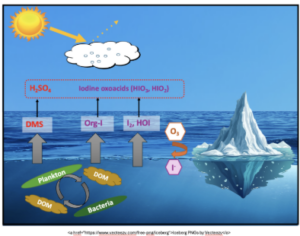
Observational platforms for field work are to be determined, but possibilities include an Arctic cruise around the coast of Greenland in spring/summer 2028, giving access to MIZ and open ocean waters, and the UK Arctic Research Station in Ny-Ålesund, Svalbard, allowing access to snow and sea-ice samples. Iodine emissions will be quantified from aqueous samples using flow tube technologies developed in our laboratory and from interstitial snowpack air, at various depths, using custom-built probes. Controlled laboratory studies designed, as far as possible, to mimic environmental conditions will also be undertaken in order to investigate the drivers of these emissions. Outputs of the project will be improved parameterisations of sea-air and snow-air emissions of gaseous iodine molecules as a function of variables including concentrations of gaseous ozone (O3), dissolved inorganic iodine ions, and the intensity of solar irradiation. The results, alongside complementary measurements of aerosols and aerosol precursors, will be used in a global model to improve understanding of how Arctic halogen chemistry drives the formation and growth of particles and their contribution to CCN. In particular, the project will lead to a better understanding of the factors which control the release of iodine from the Arctic ocean and cryosphere, and therefore whether iodine-related NPF has the potential to be part of an active climate feedback loop in the Arctic.
The student will work under the supervision of Professor Lucy Carpenter, Dr Rosie Chance and Dr Marvin Shaw in the Wolfson Atmospheric Chemistry Laboratories (WACL). Training specific to the project will include in gas handling and sampling, in high resolution chemical-ionisation time-of-flight mass spectrometry, instrument design and characterisation, analytical measurements, and atmospheric chemistry. WACL has significant technical support and you will also be supported in your project by postdoctoral research associates working on related studies.