
YES-27-Y-03: What’s cooking? Understanding air pollutant emissions from cooking indoors
What’s cooking? Understanding air pollutant emissions from cooking indoors
Outdoor air quality has improved significantly in the UK in recent years, and increasing attention is now being paid to indoor air quality. Air pollutants also have numerous sources indoors and can be emitted from building, and furnishing materials, as well as from occupant activities like cooking and cleaning. Once emitted indoors, some of these air pollutants leave buildings via ventilation, through open windows or doors, and can also react with each other to form secondary pollutants indoors. From our recent work in occupied homes in Bradford, we have seen that cooking indoors is a major source of air pollution (figure 1).
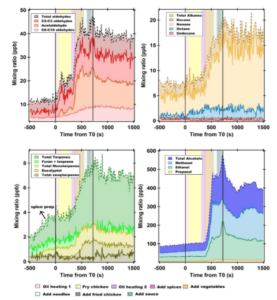
Figure 1: Concentrations of different groups of VOCs released when cooking a chicken stir-fry.
The aim of this studentship is to study air pollutant emissions from indoor cooking activities in detail. It will explore gaseous and particulate phase pollutant emissions from a range of cooking activities, their transformation indoors, and their impacts on both indoor and outdoor air quality, as well as exposure of people to air pollutants in their homes.
This project will use the new, globally unique INTERIORS (Interdisciplinary Facility for Indoor Air Quality Research) facility at the University of York. INTERIORS comprises a standard build home and a modern highly insulated house, separated by a state-of-the-art air sampling laboratory. The isolated but integrated laboratory allows us to measure air pollutants (volatile organic compounds, ammonia, formaldehyde, ozone, nitrogen oxides, carbon monoxide, carbon dioxide, methane and particulate matter) in any room in either house, as well as outdoors. We will use INTERIORS to make simultaneous indoor and outdoor measurements to investigate how pollutant concentrations vary with different cooking activities. This information will be vital to inform the National Atmospheric Emissions Inventory, in which air pollutant emissions from cooking are currently highly uncertain. Without a more accurate understanding of the composition and size of these emissions, policy makers are unable to develop effective policies to reduce population exposure to air pollution.
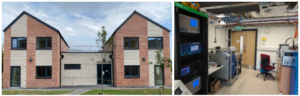
Figure 2: External view of the new INTERIORS facility (left) and inside the integrated lab (right)
The student will work under the supervision of Prof Nic Carslaw, Dr. Darpan Das and Dr. Terry Dillon and will be based in the Department of Environment and Geography at the University of York. They will spend much of their time in the INTERIORS facility, working with a world-class team of indoor air quality researchers.
The student will develop transferrable skills in making gas-phase and particle-phase measurements using a variety of experimental techniques, and also develop key numerical and data skills associated with air pollution data analysis and source apportionment, through a variety of modelling and statistical techniques. They will also have the opportunity to develop their communication skills through presenting their work at national and international conferences and through the production of scientific publications.