
YES-27-Y-05: Understanding Sulfur Chemistry over the Remote Ocean
Project summary
The oxidation of atmospheric sulfur dioxide (SO₂) is central to the formation of atmospheric aerosols, making the sulfur cycle an important component of the climate system. Sulfate aerosols influence climate both directly, by scattering incoming solar radiation, and indirectly, through their effects on clouds. Together, these processes produce a net cooling effect that offsets some of the warming caused by greenhouse gases. Quantifying the magnitude of this aerosol cooling remains one of the largest sources of uncertainty in our understanding of present-day anthropogenic radiative forcing (IPCC AR6, Forster et al., 2021).
Sulfur dioxide is also involved in a range of important atmospheric chemical processes, including reactions with the hydroxyl radical and halogen species, and processes that influence aerosol acidity. Accurately representing atmospheric SO₂ concentrations are therefore essential for understanding both atmospheric chemistry and climate. This is particularly challenging over the remote oceans, where SO₂ concentrations are typically very low (<200 ppt) and where observations are extremely limited.
This PhD project will address this knowledge gap through a combination of cutting-edge measurements and atmospheric modelling. New observations will be generated using a recently developed, highly sensitive instrument for measuring SO₂ (Temple et. al., 2025), deployed at the Cabo Verde Atmospheric Observatory. These observations, together with measurements from several recent research cruises, will be used to evaluate and improve a state-of-the-science representation of sulfur chemistry in the global chemical transport model GEOS-Chem.
By combining observations with modelling, the project will investigate the sources, variability and atmospheric processing of sulfur over the remote ocean, and determine how well current models represent these processes. The results will improve our understanding of atmospheric sulfur chemistry and help establish a stronger scientific basis for assessing the atmospheric and climate impacts of future changes in emissions and environmental policy.
Introduction
Atmospheric aerosols influence climate by scattering and absorbing incoming solar radiation and by affecting the formation, properties and lifetime of clouds. Although the magnitude of their overall cooling effect remains uncertain (Fig. 1), aerosols and their precursors emitted by human activities are understood to have offset a substantial fraction of the warming caused by increased concentrations of CO₂ and other greenhouse gases.
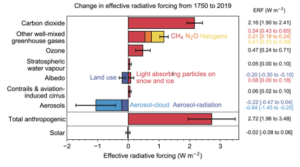
Figure 1: Change in effective radiative forcing (ERF) from 1750 to 2019 by contributing forcing agents (Figure 7.6 in IPCC AR6, Forster et al., 2021). Solid bars represent best estimates, and very likely (5–95%) ranges are given by error bars. Aerosols are broken down into contributions from aerosol–cloud interactions (ERFaci) and aerosol–radiation interactions (ERFari).
Air-quality policies have led to major reductions in emissions of aerosols and their precursors, including SO₂ (Fig. 2). These reductions have delivered substantial benefits for human health, but they can also alter the balance of atmospheric warming and cooling. A notable example is the International Maritime Organization’s 2020 reduction in the sulfur content of shipping fuel. Several studies have linked the resulting reduction in marine SO₂ emissions to additional warming through changes in aerosol concentrations and cloud properties (e.g. Yoshioka, M., et al., 2024).
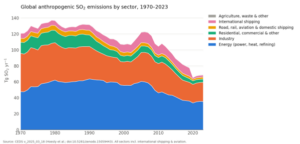 Figure 2: Global anthropogenic SO2 emissions by sector from 1970 – 2023.
Assessing the climate consequences of such policies requires atmospheric models to accurately represent the emissions, chemistry and transport that control SO₂ concentrations and the subsequent formation of atmospheric particles. However, our understanding of sulfur emissions and chemistry over the world’s oceans remains incomplete. New sources and chemical processes have been identified in recent years, but their importance—and whether other processes are missing from current models—can only be established through detailed comparison between observations and state-of-the-science simulations.
Observational constraints are particularly limited for SO₂. Concentrations over the remote ocean are often extremely low, making accurate measurements technically challenging. As a result, there are few datasets capable of testing whether models reproduce the daily, seasonal and spatial variability in marine SO₂ arising from the combined effects of emissions, atmospheric chemistry and transport.
This project will directly address this gap by generating one of the most comprehensive datasets of remote marine SO₂ measurements to date and using these observations to evaluate and improve the GEOS-Chem chemical transport model.
Project description
The University of York’s LIF-SO₂ instrument uses laser-induced fluorescence to make highly sensitive measurements of atmospheric SO₂. During the first year of the PhD, the successful applicant will contribute to the deployment and operation of this instrument at the Cabo Verde Atmospheric Observatory as part of a large, multi-institutional collaborative project.
The resulting measurements will provide a unique opportunity to investigate the sources and atmospheric processing of marine sulfur, as well as the variability of SO₂ over timescales ranging from minutes to seasons. Following the observational phase, the student will compare the measurements with simulations from the GEOS-Chem global chemical transport model. GEOS-Chem incorporates a recently updated representation of marine sulfur chemistry, providing a state-of-the-science framework in which the observations can be used to test current understanding and identify opportunities for improvement.
The project combines experimental atmospheric chemistry, field measurements, data analysis and computational modelling. It therefore offers an exciting opportunity to develop a broad range of research skills, including:
- operating sophisticated atmospheric measurement instrumentation;
- participating in field-based atmospheric research;
- analysing and interpreting large environmental datasets;
- developing and applying atmospheric chemistry models;
- using high-performance computing (HPC) facilities; and
- communicating research findings to scientific and non-specialist audiences.
The successful applicant will join the Wolfson Atmospheric Chemistry Laboratories at the University of York, one of the UK’s largest atmospheric chemistry research groups. The group has extensive expertise in atmospheric measurements, instrument development, data analysis and modelling, alongside strong links with the UK National Centre for Atmospheric Science (NCAS).
Skills and experience
The interdisciplinary nature of this project makes it particularly suitable for an enthusiastic candidate who is interested in combining experimental and computational research. Practical or physical laboratory skills, computational experience, and a background in the physical or chemical sciences would all be advantageous.
However, applicants are not expected to have experience in all of the techniques involved in the project. The project brings together several different areas of atmospheric science, instrumentation and computational modelling, and the student will receive training and support to develop the necessary skills during the PhD.
The Wolfson Atmospheric Chemistry Laboratories provide extensive technical expertise and research infrastructure to support instrument development, field measurements, data analysis and atmospheric modelling.
Training and development
The student will be supervised by Prof. Pete Edwards and Prof. Mat Evans within the Department of Chemistry’s Wolfson Atmospheric Chemistry Laboratory at the University of York.
Project-specific training will be provided in both the experimental and computational aspects of the research. This will include training in atmospheric measurement techniques, data analysis, atmospheric chemistry and the use of GEOS-Chem and high-performance computing facilities.
In addition, the University of York and the wider YES-DTN provide comprehensive training programmes for PhD researchers, covering both technical skills (such as data carpentry and scientific computing) and transferable skills (such as scientific communication and presentation). Students also have access to an individual training allowance that can be used to undertake relevant external courses.
The student will also have opportunities to access specialist training provided by the UK National Centre for Atmospheric Science, including courses in atmospheric science and scientific computing.
Throughout the PhD, the student will be encouraged to present their research at national and international conferences and meetings, develop collaborations within the atmospheric science community, and contribute to outreach activities. These activities will provide opportunities to communicate the significance of the research to audiences beyond the immediate scientific community, including policymakers and the general public.
References
Forster, P., et al.: The Earth’s Energy Budget, Climate Feedbacks, and Climate Sensitivity. In Climate Change 2021: The Physical Science Basis. Contribution of Working Group I to the Sixth Assessment Report of the Intergovernmental Panel on Climate Change. Cambridge University Press, Cambridge, United Kingdom and New York, NY, USA, pp. 923–1054, doi:10.1017/9781009157896.009, 2021.
Temple, L. G., et al.: An intercomparison of aircraft sulfur dioxide measurements in clean and polluted marine environments, Atmos. Meas. Tech., 19, 1165–1178, https://doi.org/10.5194/amt-19-1165-2026, 2026.
Yoshioka, M., et. al.: Warming effects of reduced sulfur emissions from shipping, Atmos. Chem. Phys., 24, 13681–13692, https://doi.org/10.5194/acp-24-13681-2024, 2024.