
YES-27-Y-08: Urban VOCs: the effect of indoor emissions.
Urban VOCs: the effect of indoor emissions.
Outdoor air quality in the UK has undergone a major improvement in recent years, particularly through reductions in emissions from vehicle exhausts. For instance, concentrations of nitrogen oxides (NOX) and volatile organic compounds (VOCs), both released through exhaust emissions, have decreased markedly in urban areas. VOCs and NOX react in the presence of sunlight to form harmful pollutants such as ozone (O3) and secondary organic aerosol. However, air pollutants also have sources indoors and can be emitted from building, and furnishing materials, as well as from occupant activities like cooking and cleaning.Once emitted indoors, some of these air pollutants can leave buildings via ventilation, usually through open windows or doors. As outdoor sources of air pollution continue to decrease in importance, we need to quantify the role of buildings and their occupants as outdoor pollutant sources in urban areas, and how pollutants that are emitted or generated indoors affect outdoor air quality.
This project will use two new state of the art facilities at the University of York. Firstly, the globally unique INTERIORS (Interdisciplinary Facility forIndoor Air Quality Research) facility (https://www.york.ac.uk/environment-geography/research/interiors-facility/) comprises a standard build home and a modern highly insulated house, separated by a state-of-the-art air sampling laboratory. This allows us to measure air pollutants (VOCs, NH3, HCHO, HONO, O3, NO2, NO, CO, CO2, CH4, N2O and particulate matter) in any room in either house, as well as outdoors. We will use INTERIORS to make simultaneous indoor and outdoor measurements and thus investigate how these vary with indoor activities (e.g. cooking, cleaning), the type of housing, and over time.
Secondly, a brand new fully electric mobile laboratory containing an almost identical set of measurements to those in INTERIORS, will be used to track emissions from the houses and assess their effect on the wider area, including on secondary pollutant formation. The mobile laboratory will also be used to assess the effect of other indoor emission sources on the ambient atmosphere in York.
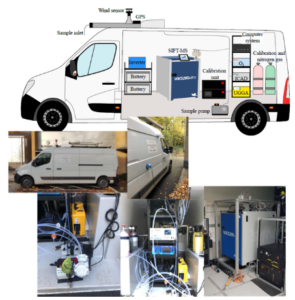 Figure 1: Diagram and photos of the York mobile laboratory.
We will use the methodology developed in a previous project (https://doi.org/10.1021/acsestair.5c00290), looking at sources such as restaurants, beauty salons, automobile repair shops and domestic housing. These will all be compared and contrasted to outdoor emissions such as those from road vehicles, industry and petrol stations. Ultimately, the project will address important knowledge gaps in our understanding of VOC sources in an urban environment.
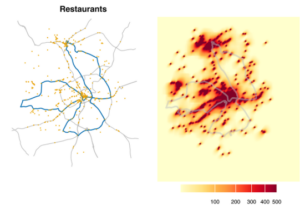
Figure 2: Spatial distribution of restaurant sources in Bradford, England. Left panel: Discrete point-source locations for restaurants (n = 576) used as model input. Right panels: Modeled source factor intensity at 10 m resolution grid averaged across all measurements.
The student will work under the supervision of Prof. James Lee, Dr Marvin Shaw and Prof Nic Carslaw and will be based at the Wolfson Atmospheric Chemistry Laboratories, part of the Department of Chemistry, University of York. Here, the student will develop skills in making atmospheric measurements using a variety of techniques (e.g. PTR-MS, GC-MS, standard air quality instrumentation), air pollution dispersion modelling, numerical and data analysis skills associated with source apportionment and chemical reactivity using a variety of statistical techniques. All of these skills are highly transferable and are relevant to work in a variety of industries (e.g. academic research, government policy, instrument development).