
YES-27-Y-09: Impact of future fuels on UK airports and ports air quality
Impact of future fuels on UK airports and ports air quality
Ruth Purvis, James Lee, David Carslaw
Introduction
UK has set an ambition for ports and airports to decarbonise in the next 10 -15 years to become net zero. Whilst operations at these transport hubs can be decarbonised though electrification and use of on site renewable energy generation, fuels involve a transition to cleaner energy sources. The move to “cleaner” future fuels will mean a difference in emissions at both ports and airports, leading to potential changes in air quality through new emissions and chemistry.
Airports are more advanced for decarbonisation than most other sectors, with large hubs like Gatwick planning on net zero operations by 2030 and in 2026 sustainable aviation fuel needing to be 2% of national supply, rising to 3.6% in 2027. Ports are lagging slightly behind with transitions to future fuels just beginning and more being planned over the next few years.
For aviation the future fuels are a range of sustainable aviation fuels (SAF) which are produced through several routes; HEFA (Hydroprocessed Esters and Fatty Acids); Alcohol-to-Jet (AtJ); FT-SPK (Fischer-Tropsch Synthetic Paraffinic Kerosene); e-Fuels (Power-to-Liquid / PtL). A small percentage of ships have transitioned to liquid natural gas which can produce methane and other hydrocarbons through “slippage” and potential future fuels include ammonia and methanol.
The project
This project will establish baselines for airports and ports from existing datasets over 2026 and 2027 and then use these and new measurements to establish the impact of future fuels on the local air quality. As well as measurements in the urban areas around these transport hubs, specific measurements which can be linked directly to ships and jet engines will also be taken.
Science questions this project will address;
- What is the 2026/2027 air quality baseline for several UK ports and airports?
- Can new source apportionment approaches be developed to quantity impact on air pollutants from net zero technologies in complex environments?
- How well do current inventories estimate emissions from UK ports and airports?
- Can emissions be linked to specific ships and aircraft?
- What is the potential impact of decarbonisation and future fuels on emissions?
- How will the current and future emissions affect local air quality?
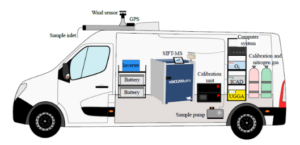
Measurements around a series of ports and airports will be made during the PhD using the electrified WACL mobile laboratory, that has the ability to measure a range of aerosol and gas species (e.g. NOx, CO2, CO, O3, PM2.5), as well as host larger instruments for measurements such as VOCs (Budisulistiorini et al., 2026; https://doi.org/10.1021/acsestair.5c00290) . Particle Matter (PM) is a known tracer for airport pollution and will be used as a tracer and then other gas phase measurements compared. The van can be deployed to measure levels of air pollutants around the port or airport, which can then be linked to activity data of ship and aircraft movements. In addition, measurements will be made of individual ships and aircraft, with the emission factors (calculated by taking a ratio of the species in question to CO2), compared to those used by the inventories. High time resolution mobile measurements, such as those available from the WACL mobile laboratory, provide new opportunities to better understand the influence of different sources on ambient concentrations.
These spot measurements will be combined with long data from the DEFRA AURN network (Automatic Urban and Rural Network). We will use sites that are close to major ports and airports (e.g. Southampton and Gatwick, see maps below) and then make assessments of how much those facilities affect the local air quality.

The student will be based in the Wolfson Atmospheric Chemistry Laboratories (WACL), in the Department of Chemistry at the University of York. Within the project there will be a mix of fieldwork, which the student will help plan and take part in, and then subsequent data analysis. WACL is the largest atmospheric chemistry facility in the UK, providing access to state-of-the-art facilities and a wide range of interdisciplinary expertise. The supervisors are part of the National Centre for Atmospheric Science (NCAS), therefore the student will benefit from research training and events tailored for atmospheric chemistry students, including training courses that NCAS provides.