
YES-27-Y-10: Balancing Net Zero Goals and Air Quality: Atmospheric Transformations of Carbon Capture Solvent Emissions
Balancing Net Zero Goals and Air Quality: Atmospheric Transformations of Carbon Capture Solvent Emissions
Dr Andrew Rickard, Dr Sarah Moller, Professor Jacqui Hamilton
Introduction
Climate change and air pollution are the two greatest environmental threats to human health, both worldwide and in the UK (EA, State of the Environment Report, 2023, and WHO, Ten threats to global health, 2019). To address the former, the UK government has committed to achieve net zero greenhouse gas emissions by 2050. The UK Climate Change Committee estimates that in order to reach this target the UK will need to capture 50 to 100 million tonnes of carbon dioxide per year from activities in sectors that are hard to decarbonise (CCC, seventh Carbon Budget, 2025). To progress towards this the UK Government has recently committed ~£21B to develop two carbon capture utilisation and storage (CCUS) clusters as part of their mission to make Britain a green energy superpower. These will employ amine-based carbon capture processes that use chemical absorption of carbon dioxide by an amine-based solvent.
Amines have been implicated in poor air quality and particle formation in urban, agricultural and marine settings, and they can form highly carcinogenic, mutagenic and toxic compounds during degradation or atmospheric processing. Amines and the nitrogen-containing by-products will also contribute to nitrogen deposition to ecosystems, many of which already suffer damage from excess nitrogen.
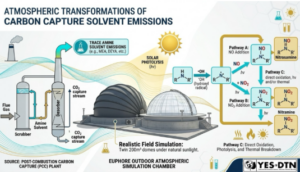
As industrial carbon capture deployment accelerates, future assessments of environmental and health impact will depend upon our understanding of how amines break down in the atmosphere and how these processes can be appropriately represented in atmospheric models. At present, there is only a limited chemical reaction mechanism available for amine degradation, which is used in modelling to assess the impact of new CCUS facilities on surrounding communities and ecosystems.
The Project
This PhD will address key questions around the air pollution impacts of the use of amines for CCUS including:
- What happens to amines in the atmosphere once they are emitted?
- What secondary pollutants do they form, and in what proportions?
- How are the lifetimes, atmospheric fate and distribution of secondary products affected by the chemical structures of the amines being used?
- How can this chemistry be represented in the models used for regulatory assessments?
These questions are absolutely central to our ability to assess the potential impact of amine use on pollutant concentrations, the number of people who are exposed to that pollution, how toxic that pollution mix may be, and what that means for the risks to human and ecosystems health.
This PhD will require you to carry out activities such as:
- Experimental design and analysis of experiments performed at the European PhotoReactor (EUPHORE) in Valencia, Spain, a highly-instrumented, atmospheric simulation chamber.
- Compiling a comprehensive database of relevant chemical metrics from existing laboratory, theoretical, and chamber studies.
- Developing chemical mechanisms for the reactions of amines for inclusion in the internationally recognised Master Chemical Mechanism.
- Using chemical process box modelling to evaluate the developed mechanisms against experimental data.
- Modelling the geographical extent of impact from CCUS installations under different future deployment scenarios.
- Producing policy briefings to communicate the state of the science and insights emerging from your research and progress in the wider field.
As this is an active and developing area, you will work closely with the Environment Agency and Department for the Environment, Food and Rural Affairs to understand their priority evidence needs, to enable the research to respond to changes in the sector or emerging issues, to allow research to be used rapidly, and to ensure continued relevance of the work to the CCUS sector in the UK. You will be supported in this by your supervisors who have extensive experience working at the science/policy interface.
Researcher development
During your PhD you will collaborate with a broad range of atmospheric chemists and policy scientists, involving some european travel opportunities. You will work with researchers at European Photo-reactor (EUPHORE) in Valencia on data analysis from photochemical experiments carried out on a range of amine precursors. You will also collaborate with Professor Claus Neilsen at the University of Oslo on developing atmospheric chemical mechanisms of amine photochemistry.
You will liaise with officials from the Environment Agency and the Department for the Environment, Food and Rural Affairs to ensure the relevance of this study in improving understanding of the potential impacts of CCUS deployment and our ability to risk assess and appropriately permit forthcoming installations. You will also interact with experts from Cambridge Environmental Research Consultants (CERC) to create representations of the complex mechanisms you have developed that are simple enough to be included in the models they use in regulatory assessments. Working with external collaborators will give the student experience of working at the science-policy interface, engaging with policy makers and consultants to produce research with real-world impact. There may also be opportunities for work-shadowing or a short placement to experience working in these organisations.
You will be based in the Wolfson Atmospheric Chemistry Laboratories (WACL), in the Department of Chemistry at the University of York. Training on all methods and techniques required to carry out your PhD will be provided by skilled experts working in WACL, which is the largest integrated atmospheric chemistry facility in the UK, providing access to state-of-the-art facilities and expertise across a range of different disciplines. You will benefit from research training and events tailored for atmospheric chemistry students, including access to training courses provided by the National Centre for Atmospheric Science. The University of York and the NERC YES-DTN provide comprehensive training programmes for PhD students with a range of courses on both hard (e.g. data carpentry) and soft (e.g. presentation) skills.
You will have the opportunity to present your work to the scientific community at national and international meetings and conferences, as well as regularly discussing your work with policy makers, regulators and research end users.