
YES-27-Y-11: Developing real-time detection methods for amine emissions from industrial carbon capture technologies
Developing real-time detection methods for amine emissions from industrial carbon capture technologies
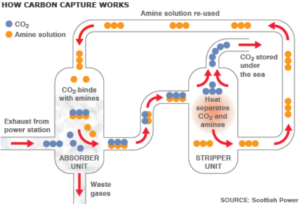
The global warming potential of carbon dioxide in the Earth’s atmosphere has accelerated international efforts to develop industrial mitigation strategies to reduce emissions. Amine-based carbon capture is expected to be one of the most widely deployed technologies for mitigating industrial CO2 emissions via post combustion carbon capture (PCCC). PCCC uses an amine solvent (a weak base) to selectively strip CO2 (a weak acid) from post-combustion flue gases. Although this removal is designed as a closed system, atmospheric releases of unreacted amines and amine degradation products carried in the flue gas can occur – a process called solvent slip. A typical PCCC plant using monoethanolamine to remove ~1 Mt CO2 per year is predicted to emit 40-160 tonnes of amines to the atmosphere per year.
The amines can undergo atmospheric oxidation, uptake to aerosol and cloud droplets, and wet and dry deposition to the planetary surface. Atmospheric oxidation of amines forms secondary organic nitrogen compounds including toxic nitrosamines and nitramines, however the yields, chemical speciation and toxicology of these products remain poorly understood. There is very little quantitative data on the transport, aerosol interactions, and environmental fate of the amine emissions, which prevents accurate assessments of PCCC safety. This is compounded by analytical limitations: standard atmospheric measurement methods fail due to amine chemical instability and severe surface adsorption effects within traditional sampling lines.

York mobile air quality laboratory. WACL Atmospheric Sampling Platform (WASP)
This project will develop and validate real-time mass spectrometric measurement techniques to detect trace levels of amines originating from PCCC facilities in the UK. The objectives of the PhD are to:
- Develop Chemical Ionisation Mass Spectrometry technique to detect PCCC relevant amines. The work will specifically focus on Proton-Transfer-Reaction Mass Spectrometry (PTR-MS) and Ethanol Chemical Ionisation Mass Spectrometry (Ethanol-CIMS), which provide fast, direct, high sensitivity detection with minimal sample introduction lines and no pre-treatment requirements.
- Integrate the CIMS instrumentation into the York mobile laboratory (WASP). This is the most comprehensive mobile laboratory in the UK and measures multiple pollutants at high resolution (≥ 1Hz).
- Deploy the mobile laboratory at UK PCCC facilities to quantify ambient background concentrations and emission rates of primary amines and degradation products.
- Use the novel datasets to evaluate the impacts of amine-based PCCC on air quality and human health.
The student will work under the supervision of Dr Marvin Shaw, Professor Jacqui Hamilton, and Dr Naomi Farren. The studentship will be based in the Wolfson Atmospheric Chemistry Laboratories (WACL) at the University of York. WACL hosts over 75 researchers with interests in all aspects of atmospheric chemistry, from stratospheric ozone through to urban air pollution, personal exposure and health. This collaborative interdisciplinary environment offers access to state of the art facilities and the support required to develop innovative approaches to produce high impact publications. The PhD student will acquire skills that are highly sought after in academia and the public and private sectors. Past students have successfully attained exciting positions for a range of employers using the skills developed during their PhDs. Training and guidance will be provided in scientific writing, data analysis, and presenting at national and international conferences. The student will have regular opportunities to disseminate their research at symposiums organised with Defra and the National Centre for Atmospheric Science (NCAS), as well as UK and international conferences.