
YES-27-D-08: Measuring Morocco’s Earthquake Cycle from Space: Satellite Radar, Active Faults and Seismic Hazard
The devastating Mw 6.8 Marrakech earthquake of September 2023 exposed major gaps in our understanding of where damaging earthquakes can occur in Morocco. Most historical and instrumental earthquakes have occurred in northern Morocco, particularly around the Rif, yet the 2023 event ruptured deep within the High Atlas. Recent geological work has identified evidence for active faults much more widely across the country, raising a fundamental question: is present-day tectonic deformation concentrated on a small number of known structures, or distributed across a much broader network of faults?
This PhD will use satellite radar interferometry (InSAR) to measure how Morocco is deforming today and to investigate the full earthquake deformation cycle. The student will construct a country-scale, high-resolution velocity field from Sentinel-1 radar observations, tied to available GNSS measurements, to quantify interseismic strain accumulation across the Rif, Atlas Mountains and surrounding regions. The project will build directly on methods developed at Leeds to produce the first trans-continental three-component velocity and strain-rate field for the Alpine-Himalayan Belt, demonstrating how dense satellite measurements can reveal both deformation concentrated on major faults and more diffuse strain that is poorly resolved by sparse ground-based geodesy.
The project will then focus on individual earthquakes, including the 2023 Marrakech event, using InSAR observations to map coseismic surface displacement and constrain the geometry and slip of the faults that ruptured. Continued satellite observations will be used to search for and quantify postseismic deformation, providing insight into how the crust responds after major earthquakes and how stress is redistributed onto neighbouring faults. By combining these three components — interseismic strain accumulation, coseismic rupture and postseismic relaxation — the project will develop an integrated picture of the earthquake cycle across Morocco.
A major strength of the PhD is its close connection to the complementary Morocco earthquake-hazard programme led by Professor Richard Walker at Oxford (co-supervisor) and Professor Afaf Amine at Mohammed V University in Rabat. That programme is mapping active faults, reconstructing prehistoric earthquakes and measuring long-term fault slip rates from geomorphology, palaeoseismology and Quaternary dating. The Leeds PhD will provide the present-day geodetic counterpart to those geological observations and may have the opportunity to participate in a field programme if desired. Comparing deformation measured over years by InSAR with fault behaviour recorded over thousands to tens of thousands of years will allow us to test whether the faults identified in the landscape are accumulating measurable strain today, and whether important deformation is occurring away from currently recognised active structures.
The final aim is to translate these new observations into improved estimates of seismic hazard. Working with collaborators at the Global Earthquake Model (GEM) Foundation, the student will investigate how geodetic strain rates, earthquake source models and geological fault constraints can be incorporated into regional seismic-hazard models. The project therefore spans fundamental earthquake science through to applications with direct societal relevance.
The student will receive training in InSAR time-series analysis, satellite geodesy, GNSS integration, tectonic strain analysis, earthquake source modelling and seismic-hazard assessment. The project is ideal for a student interested in the physical sciences, data analysis, geophysics, remote sensing, tectonics and earthquakes, and in using large satellite datasets to address questions that matter both scientifically and societally.
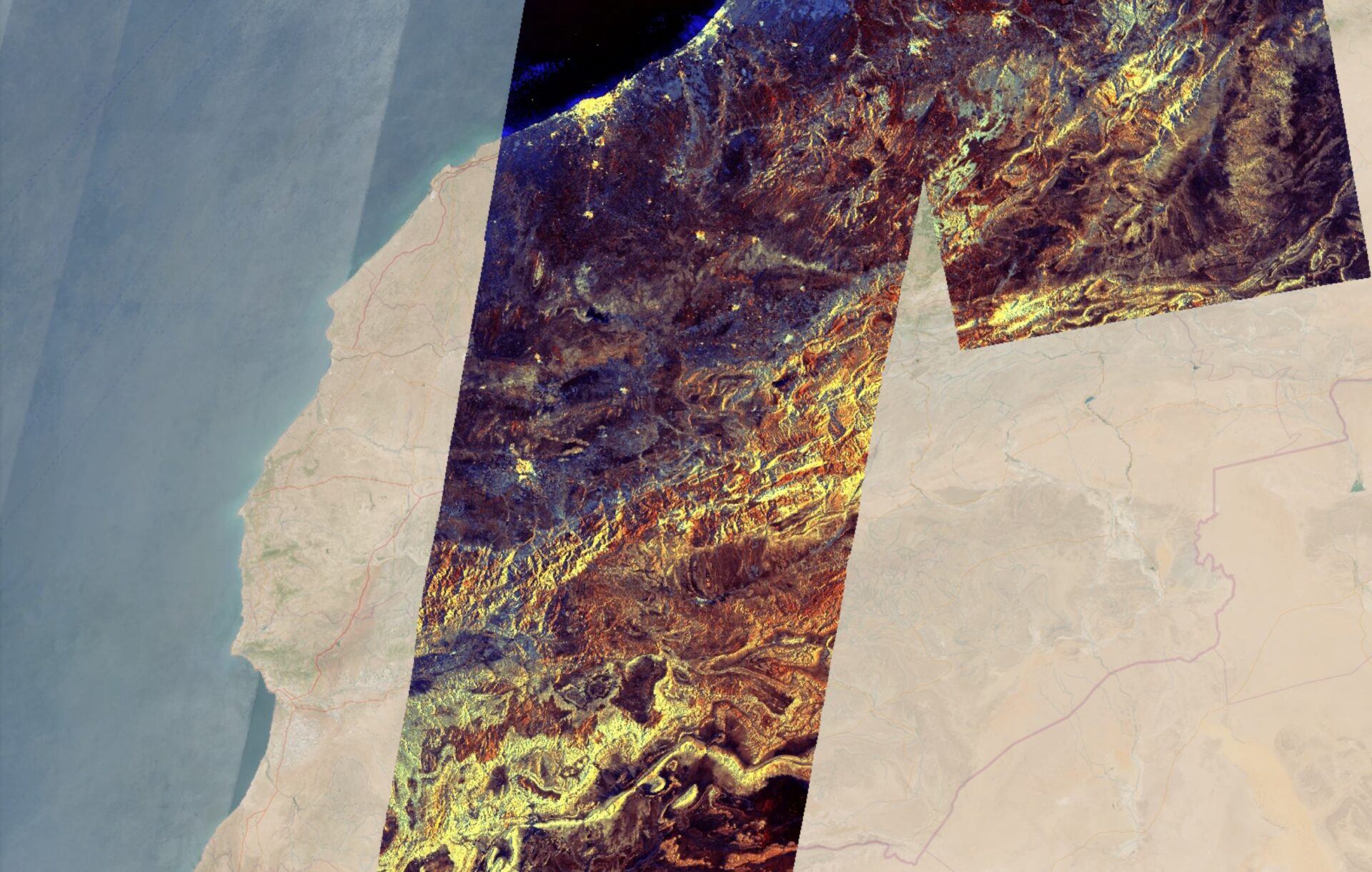
Satellite Radar across the Atlas Mountains of Morocco (source: ESA)
References:
Cheloni, D., Famiglietti, N.A., Tolomei, C., Caputo, R. and Vicari, A., 2024. The 8 September 2023, MW 6.8, Morocco earthquake: A deep transpressive faulting along the active high Atlas mountain belt. Geophysical Research Letters, 51(2), https://doi.org/10.1029/2023GL106992.
Elliott, J.R., Fang, J., Lazecký, M., Maghsoudi, Y., Ou, Q., Payne, J.A., Rollins, C., Wang, D., Hooper, A. and Wright, T.J., 2026. Deformation, strains and velocities for the Alpine Himalayan Belt from trans-continental Sentinel-1 InSAR & GNSS. Remote Sensing of Environment, 338, https://doi.org/10.1016/j.rse.2026.115320
Pagani, M., Bayliss, K., Brooks, C., Johnson, K., Styron, R., Villani, M. and Rong, Y., 2026. The OpenQuake Model Building Toolkit: A suite of tools for building components of a seismic hazard model. Seismica, 5(1), https://doi.org/10.26443/seismica.v5i1.1677