
Applications for 2026 for October 2026 entry are now closed.
Recruitment for October 2027 will reopen at the end of 2026.
Please read the ‘How to Apply‘ information carefully, as not supplying the correct information may mean we cannot consider your application.
Please note: there is no option for you to provide your own project.
If you have any questions about applications please contact us at [email protected].
Studentships
We offer 25 – 26 fully funded studentships each year, to be based at either the University of York or the University of Leeds.
The studentships cover:
- a personal stipend (tax-free allowance that you don’t have to pay back) at Research Council UK (RCUK) rates for 3.5 years
- university fees
- generous support for research costs, fieldwork, training and conference travel.
We can offer up to 7 funded studentships each year to international applicants
- We cover all your university fees as well (regardless of home-international fee difference), and you will receive the standard UKRI rate stipend.
- However, we are unable to cover costs associated with relocation to the UK, e.g. accommodation, travel, student visa, international health surcharge.
- See the UK Govt. website for more information on student visas (including costs) and the health surcharge. You can also get in touch with the Student Visa Advice service at the University of Leeds.
Application process
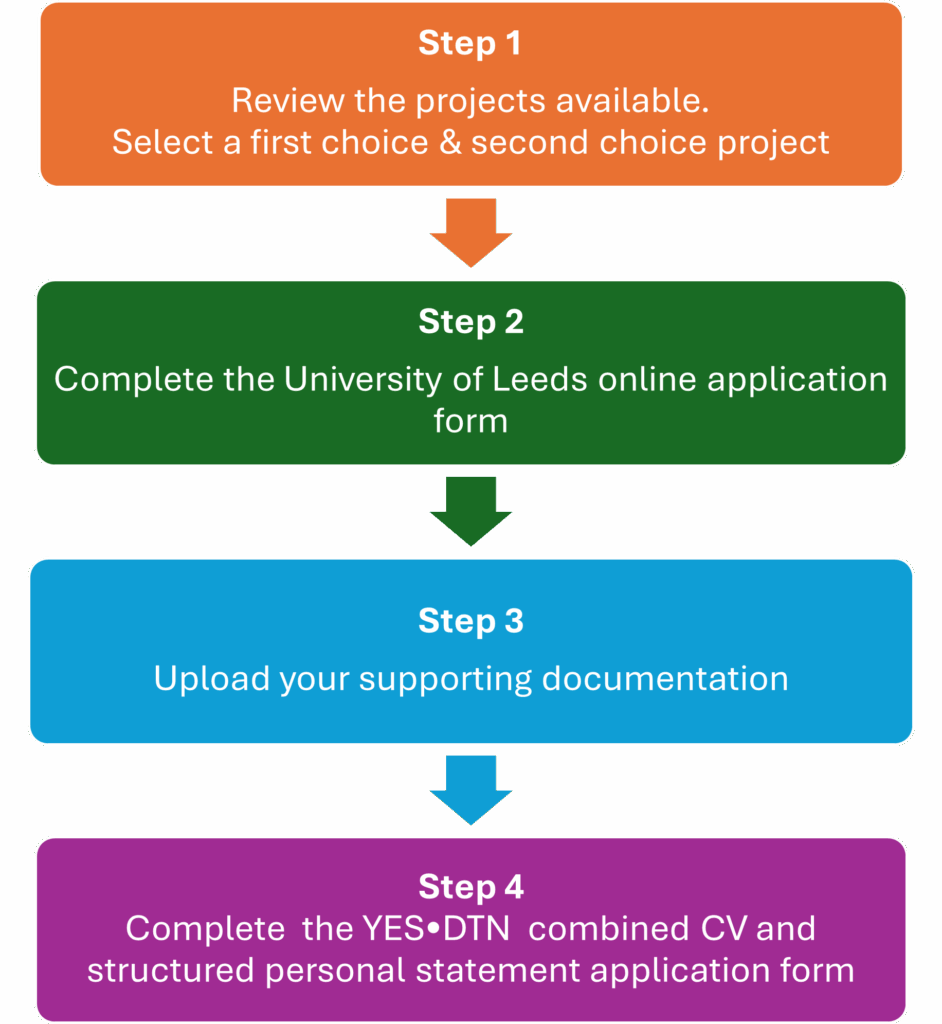
You must complete the YES•DTN application form AND the University of Leeds Online Application form.
We will not be able to consider applicants who do not submit both forms.
The YES•DTN application form is a combined CV and structured personal statement.
The structured personal statement asks you to respond to 5 questions, within a word limit of about 250 words per question.
- What motivates you to do a PhD?
- What excites you about your chosen project? Why is it important to work on this topic?
- How does your professional and academic background prepare you to do a PhD?
- How do your existing skills match with the required skills and which skills do you hope to acquire during the PhD?
- Why is a YES•DTN studentship the right way for you to get a PhD?
More information on the required information for the CV component can be found here.
Please do not email your personal CV and personal statement to us as we cannot accept them.
Before you apply
Carefully draft your email to the supervisor. Make sure it is project specific: include detail that shows that you are genuinely interested in the project and that you have done some background reading. Academics are very busy at that time of year so may not reply immediately. They are more likely to take your interest seriously if you draft a meaningful email rather than a general request. More information can be found in our FAQs.
This discussion is a two-way opportunity: you want to learn more about the project and the skills/interests required, and it allows the supervisor to get a feeling for your motivation and interests.
Our process aims to reduce bias at all stages and we recruit candidates from all backgrounds and with a diversity of experiences.