
Does El Niño-Southern Oscillation (ENSO) have a tipping point?

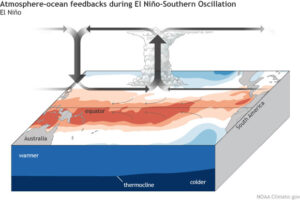
Could rapid changes in ENSO reshape global climate systems within our lifetime? This project will investigate how quickly ENSO—the main source of climate variability—can change and affect global systems.
1. Background
The geological record indicates that many of the transitions between climate states occurred abruptly. These abrupt changes are triggered by small perturbations that are amplified by Earth System feedbacks. Abrupt Climate Change occurs when the climate system is forced to cross some threshold, triggering a transition to a new state. The threshold is known as tipping point. Similarly, tipping elements are features in the climate system that have the potential to potential to quickly amplify the climate triggers.
The fact that large changes can occur quickly has gained attention not only of the scientific community but also policymakers. Recent research has identified a few key elements that have been recognised as extremely important to climate change (i.e., Ice-sheets, sea-ice, AMOC). Change associated with these elements will very likely have global impacts and may accelerate a possible transition between climate states. However, there is still a lack of understanding of the tipping dynamics of most tipping elements.
In particular, a possible tipping point in the most important driver of year-to-year variability in the Earth System, the El Nino-Southern Oscillation (ENSO), has not yet been identified. Nevertheless, recent scientific advancements have shown that ENSO has a nonlinear sensitivity across different background states. This finding opens an avenue to investigating the possible tipping behaviour of ENSO.
ENSO is the phenomena responsible for causing surface temperatures in the equatorial Pacific to be cooler (La Nina) or warmer (El Nino) than normal. As ENSO is located right at the middle of the world’s largest ocean, it causes large atmospheric perturbations that have global impacts, making it a central element in the Earth System. Therefore, if ENSO has a tipping point, it is reasonable to think that a shift in ENSO properties can modulate climate change.
2. Objectives
The central objective of this project is to identify whether ENSO oscillates between two or more stages of stability and what is the role of ENSO in accelerating or slowing down global warming.
To achieve this, the candidate will:
- evaluate ENSO dynamics across a wide range of climate states, from palaeo periods (i.e. the early Pliocene [~5 million years ago]) to future projections.
- apply theoretical analyses of bifurcation dynamics (dynamical systems) to ENSO.
- perform idealized climate model experiments using the UK suit of Climate and Earth system models to further investigate possible ENSO states.
- use proxy-data (palaeo data) for ENSO to investigate whether there is observational evidence of the possible theoretical states ENSO states
- evaluate the impact of ENSO regime shifts in the Earth System dynamics and their associated teleconnection patterns
3. Data and Methods
The candidate will gain skills in data analysis through analyses of data generated by models of diverse complexities, from simplified ENSO models to fully coupled state-of-the-art Earth System Models.
Additionally, the candidate will have the opportunity to perform their own climate model simulations to address specific questions and possibly developing their own ENSO model!
Finally, the candidate will gain experience in analysing proxy-data and in performing data-model comparison analyses.
4. Expected ‘high-impact’ results
We expect to define a safe warming range in which ENSO shows higher stability. This will assist decision makers for policy development in next decades and contribute to reducing uncertainties in future projections in ENSO-related processes and teleconnections.
5. International Network opportunities
- The Project will involve collaboration with researchers from world-class international Institutions. Prof. Andrea Taschetto (University of New South Wales – Australia) is a world-leader in ENSO research. Prof. Niklas Boers (Technical University of Munich – Germany) is an expert in the study of tipping points and machine learning. The student will have the opportunity to spend some time abroad in both institutions.
- Present work in and attend major scientific conferences of the field, as well as attend summer schools.
6. Entry requirements
- First degree 1 (first-class honours) or high 2i (upper second-class honours)
- Graduate degree or master’s degree or equivalent in Physics, Mathematics, Oceanography, Meteorology, Marine Sciences, Engineering, Computer Sciences or similar.
- Experience in computer programming (i.e., Python, MATLAB, R…) and/or numerical modelling is highly desirable.
7. Contact
For further information, please get in touch with Dr. Gabriel Pontes ([email protected]) or Professor Alan Haywood ([email protected])
8. Additional reading
Tipping point dynamics: Lenton2011-NCC
ENSO dynamics: Pontes2022-NGEO, Pontes2025-CP, Vialard2025-RevGeo