
Why was the Earth so warm during the time of the dinosaurs?
Project summary
The Cretaceous period, some 100 million years ago, was a time of extreme global warmth that lasted for millions of years. Indeed, this may have been the hottest sustained climate the Earth has even seen. The global average surface temperature was around 10-15 C hotter than present, which is far in excess of predicted scenarios for future global warming. But we are not sure how this happened: High levels of atmospheric CO2 were a key contributing factor, but what caused CO2 levels to rise? and what other warming mechanisms existed? There are many factors that could be important here, from the different distribution of the continents to the types and locations of vegetation, and the chemical makeup of the oceans. Understanding how our planet became so hot in the past, and why it cooled so significantly towards the present day, is very important for understanding what will happen to our future climate and local environments.
This project will use a new state of the art ‘Earth Evolution’ computer model to investigate the potential climate warming mechanisms and feedbacks during the Cretaceous, and how these changed as the Earth cooled towards the present day. This type of holistic modelling tool – which simulates the Earth in 3D over many millions of years – has only recently been developed by our group, and will give the researcher an early opportunity to address important questions and paradoxes by devising different scenarios in the model and comparing the outputs to rich spatially-resolved datasets. Comparisons of this type have not been done before, and we hope that this project will result in real scientific breakthroughs that will help us better understand not just the ancient Earth, but the planet we inhabit today and must manage into the future.
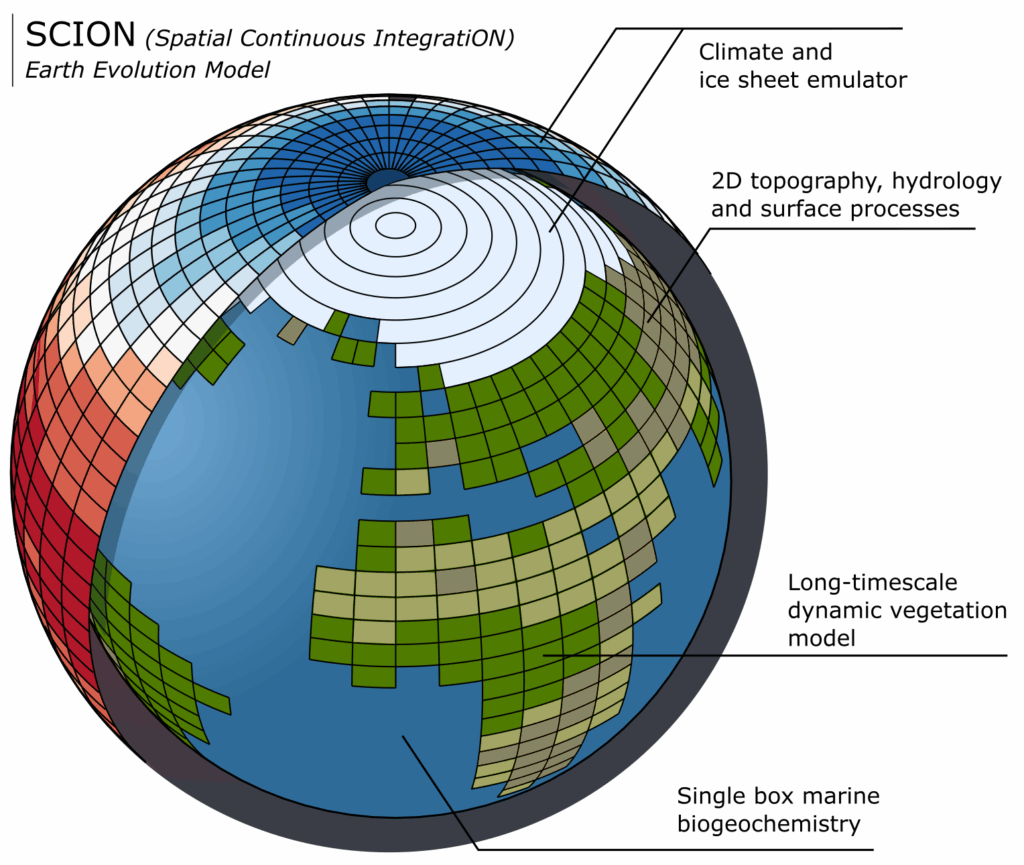
Figure | The SCION Earth Evolution Model – see EarthEvolutionModelling.com for more information
The research group
The research will be based in the Earth Evolution Modelling Group, which is a large, well-funded and productive research group within the Earth Surface Science Institute (ESSI), of the School of Earth and Environment at the University of Leeds. A short video about the group’s work can be seen at our Blavatnik Awards profile. The wider ESSI institute includes analytical geochemists, biogeochemists, sedimentologists, palaeontologists and modellers of climate and biogeochemistry. It holds several annual science and social events and weekly informal get-togethers. Project supervisor Professor Mills has received multiple ESSI ‘Star Supervisor’ awards.
Entry requirements
This project would suit somebody with a degree in one of the natural sciences, mathematics or computing, and the candidate should have a strong interest in Earth history and planetary surface environments. Formal training in numerical techniques is not essential, but enthusiasm for computing is advisable. All necessary training will be provided as part of the project. The group writes mostly in MATLAB and occasionally in python, but the researcher would be supported to apply a programming language of their choice.
Further information
Professor Mills can be reached at [email protected] or [email protected] for any questions about this project.