
YES-27-A-01 Risks and storylines of extreme air quality episodes under future climate change
Motivation
Exposure to ambient air pollution is one of the major environmental health challenges of our time, responsible for more than 4 million premature deaths globally each year, imposing global economic costs of trillions of $US. Short-lived extreme air pollution episodes often coincide with extreme meteorological events, including heatwaves and severe cold winter events, so shifts in regional climate may be linked to changes in their occurrence. Our previous work has shown how extreme weather can drive severe air pollution episodes with substantial health impacts. During Australia’s 2019–20 “Black Summer” megafires, we found that smoke exposed hundreds of thousands of people to poor air quality and brought forward an estimated ~170 deaths, around 30% of all deaths linked to short-term particulate exposure over that period (Graham et al., 2021). We have also shown that meteorology was the main driver of widespread ozone pollution across Europe during the 2018 summer heatwave (Pope et al., 2023). More recently, the record-breaking July 2022 UK heatwave, saw substantial elevation of ozone pollution at some UK sites.The IPCC concludes that climate change will make conditions that enable air quality degradation more frequent, with heatwaves, wildfires, and stagnant conditions favouring extreme pollution episodes affecting populated regions. This “climate penalty” could partially offset benefits of emissions controls, affecting air pollution exposure for millions of people. Despite these effects, how the frequency, severity and health burden of these rare but extreme events will change remains poorly understood.
Novel approach
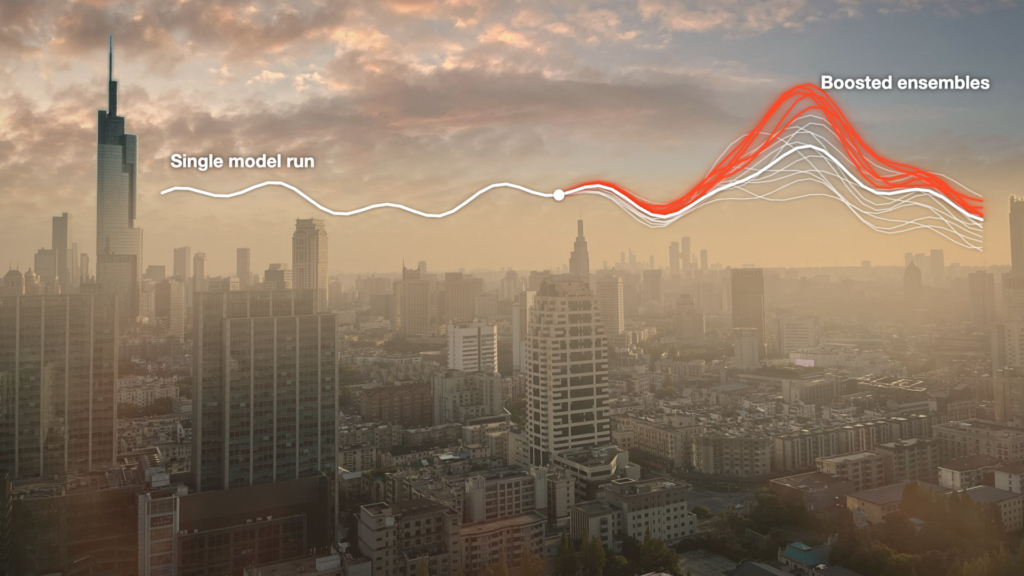
Recently new climate modelling methods have allowed efficient investigation of rare but extreme climate events, but these have so far not been applied to extreme air pollution episodes. In this project, you will use cutting-edge climate modelling and data science techniques to generate new understanding of extreme air pollution events and associated future health risks. This will provide an exciting opportunity to inform how we prepare for and respond to extreme climate-driven air pollution events in order to mitigate their potential health impacts. The project will combine observations, novel climate modelling, and data science methods to explore rare but plausible extreme air pollution episodes. A method known as “ensemble boosting” will be applied to events of extreme air pollution identified from an initial set of simulations of the UK Earth System Model (UKESM) undertaken for the forthcoming CMIP7 climate modelling exercise in support of the next IPCC Climate Change Assessment. This will produce a large set of plausible extreme events, consistent with the rare but extreme events sampled from a given climate scenario, but without the need for 100s years of extra model simulation. The project’s aim is to use this novel methodology to explore extreme events of differing severity and likelihood under a range of possible future climate scenarios.
Objectives
Specifically, the student will:
- investigate relationships between occurrence of rare but extreme air quality events and specific developments in the state of the atmosphere and land surface;
- determine the potential health impacts of rare but extreme air quality events in the context of long-term changes air quality;
- examine and understand storylines of rare extreme air quality events in different world regions, how these impact the expected time evolution of their health impacts and how these storylines can be used to inform decision makers.
Candidate profile
We seek an enthusiastic student with a background in a numerate or science-based subject who has an interest in data science or computer modelling, and is keen to apply novel methods to helping tackle one of the most pressing societally-relevant challenges at the intersection of climate change and health.
The project will be co-supervised by Prof. Steve Arnold and Dr. Carly Reddington, who bring expertise in air pollution science and air quality health impacts, and Dr. Steven Turnock from the UK Met Office, who has expertise in Earth system modelling and the UKESM model.
You will join a vibrant research team at Leeds focussing on air quality and Earth system interactions, with extensive active collaborations with observational scientists and international partners.
Further Reading
- Graham et al. (2021), Impact of the 2019/2020 Australian megafires on air quality and health, GeoHealth
- Pope et al. (2023), Atmospheric Chemistry and Physics, 23, 13235–13253
- IPCC AR6 WG1 Chapter 6 (Szopa et al., 2021): extract
- Description of UKESM model: https://ukesm.ac.uk
- Ensemble boosting method applied to heatwaves: https://www.nature.com/articles/s41467-023-40112-4#Sec11