
YES-27-A-20: The role of contrails in current and future aviation climate impact mitigation

Background and context
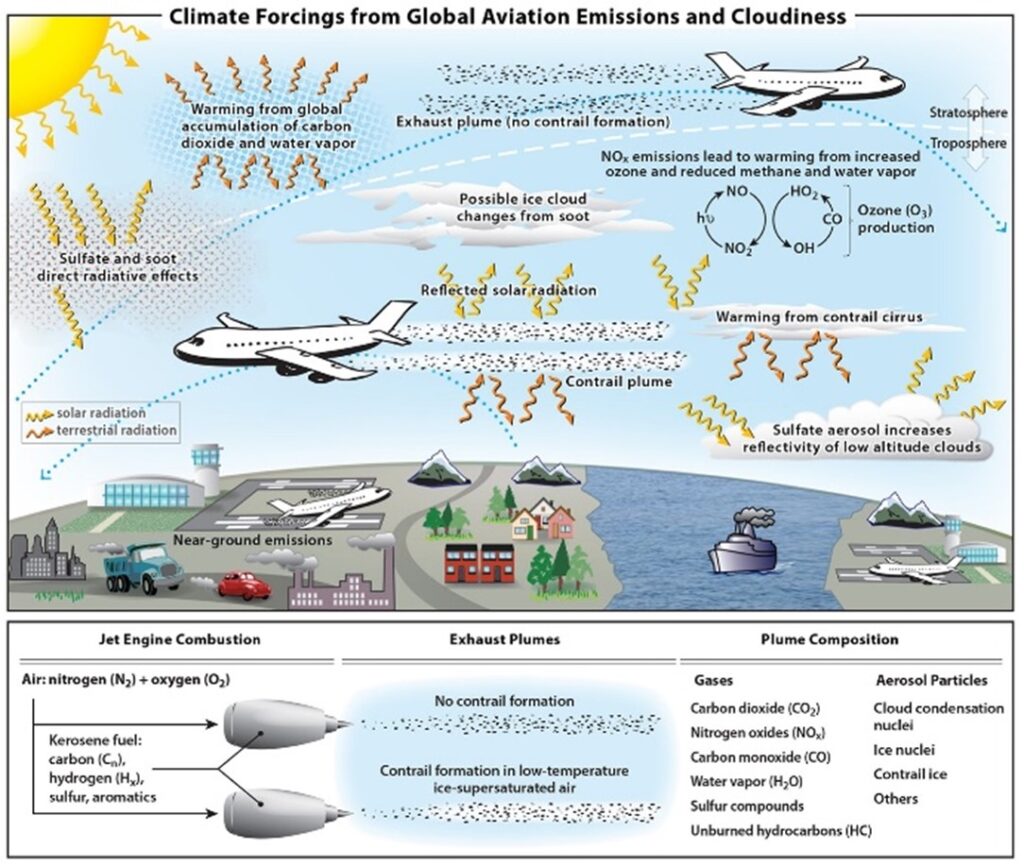
The aviation sector faces increasing pressure to reduce its climate impact, with ambitious national and international net-zero targets driving efforts to decarbonise air transport. While reducing CO₂ emissions remains a priority, non-CO₂ effects are now recognised as a major contributor to aviation-induced climate change, accounting for around two-thirds of aviation’s total effective radiative forcing (Lee et al., 2021). However, substantial uncertainties remain regarding the magnitude of these effects and how they may evolve under future technologies, fuels and operational practices.
Several proposed pathways to net-zero aviation involve transitions to sustainable aviation fuels (SAF) and hydrogen, alongside targeted mitigation of non-CO₂ effects (Rap et al., 2021; Dray et al., 2022). Particular attention has focused on aviation contrails, which form when aircraft exhaust mixes with cold upper-tropospheric air. Under ice-supersaturated conditions, contrails can persist and spread into contrail cirrus, widely regarded as the largest contributor to aviation’s present-day warming effect (Kärcher, 2018).
Recent contrail avoidance trials have demonstrated the growing maturity of climate-optimised flight operations. These include the DLR-EUROCONTROL-MUAC operational trials over north-west Europe (Sausen et al., 2024), AI-assisted contrail avoidance trials led by Google and American Airlines (Google, 2024), and the recently launched UK-led Operation Blue Skies programme over the North Atlantic. While these initiatives focus primarily on reducing contrail warming, their overall climate benefit depends on potential fuel penalties and interactions with other aviation climate effects. Robust assessments of contrail mitigation strategies therefore require a comprehensive understanding of contrail impacts under both present-day and future climates.
Project objectives:
The aim of this project is to improve understanding of how aviation contrails influence climate under present-day and future atmospheric conditions, and to assess the effectiveness of emerging technological and operational strategies for reducing their climate impact.
Using the Community Earth System Model CESM2 with its latest contrail cirrus parameterisations (Zhang et al., 2025; Zhang et al., 2026), the project will:
- Evaluate present-day simulations of contrail cirrus against observations;
- Quantify the evolution of contrail climate impacts under future climate and aviation scenarios;
- Assess the influence of aviation technology transitions, including the use of ultra-low-soot combustion technologies, SAF, or hydrogen-powered aircraft;
- Evaluate the climate effectiveness and potential trade-offs of emerging contrail mitigation strategies, including flight rerouting, schedule optimisation and other operational measures.
Potential for high impact outcome
Large uncertainties remain in our understanding of aviation’s non-CO₂ climate impacts and how they may evolve over the coming decades. By combining state-of-the-art Earth system modelling with emerging contrail parameterisations, this project will provide new insights into one of the most important and uncertain components of aviation-induced climate change. The results will be relevant to climate scientists, policymakers and the aviation sector, helping to inform future mitigation strategies and assessments of sustainable aviation pathways. Findings are expected to generate publications in leading international journals and presentations at major scientific conferences.
Training
The student will work under the supervision of Dr Alex Rap, Dr Wuhu Feng and Prof Piers Forster and will be a member of the Physical Climate Change research group in SEES. The project provides an exciting opportunity to be trained in and exploit state-of-the-art Earth system modelling. The student will also be part of the Priestley Centre for Climate Futures that brings together world leading expertise in all the key strands of climate change research at the University of Leeds. Through the high level specialist scientific training associated with this project, the student will develop a comprehensive understanding of aviation impacts on climate. In addition, the student will learn how to communicate science and how to write high impact journal publications.
The successful PhD student will also have access to a broad spectrum of training workshops put on by the Faculty that includes an extensive range of training workshops in numerical modelling, through to managing your degree, to preparing for your viva. A full list of training opportunities is available here.
Eligibility requirements
A good first degree, Masters degree or equivalent in a quantitative science discipline (e.g. Physics, Mathematics, Chemistry, Atmospheric Science, Engineering) and a keen interest in global environmental problems. While a substantial part of this project involves computer modelling, prior experience is not essential – we provide high level specialist scientific training during the PhD.
References
- Dray et al., 2022. Cost and Emissions Pathways towards Net-zero climate impacts in aviation. Nature Climate Change 12(10), 956-962.
- Google, 2024. Project Contrails. [Online]. Available from: https://sites.research.google/contrails/
- Karcher, 2018. Formation and radiative forcing of contrail cirrus, Nature Comm., 9, 1824.
- Lee et al., 2021. The contribution of global aviation to anthropogenic climate forcing for 2000 to 2018, Atmospheric Environment, 244, 117834.
- Rap et al., 2021, The impact of contrails and NOx emissions for FlyZero aircraft concepts with alternative fuel and energy systems, Fly Zero Report FZ_RB_001, ATI.
- Sausen et al., 2024. Can we successfully avoid persistent contrails by small altitude adjustments of flights in the real world?, Meteorol. Z., 33(1), 83-98.
- Zhang et al. (2025) Impact of host climate model on contrail cirrus effective radiative forcing estimates, ACP, 25, 473–489.
- Zhang et al. (2026) Strong simulated reductions in contrail cirrus effective radiative forcing from alternative fuels. (preprint).