
YES-27-A-28: Hydrologic Whiplash in a Changing Climate: Evaluating Earth System Models for Decision-Relevant Climate Risk
Hydrologic whiplash events, that is sequences of extreme rainfall and extreme drought, or vice versa, are a growing risk under climate change. Such events cause a range of societal challenges, especially for the water, ecology and agricultural sectors. This PhD aims to develop a better understanding of such events, and assess which modelling tools are required to understand and assess their changing risk.
The first part will explore the drivers and mechanisms that lead to these events. This will involve identifying the large-scale atmospheric and oceanic conditions associated with hydrologic whiplash, examining the role of different climatic modes, and assessing how these processes interact across different spatial and temporal scales. Understanding the physical mechanisms that trigger rapid transitions between extreme wet and dry conditions is key for assessing model representation of such events, and exploring future projections. This will include considering different definitions; definitions of whiplash events vary across disciplines and decision types, and can lead to conflicting assessments of future risks and the anticipated actions that need to be taken. Establishing usability of Earth system models in decision making requires clear definitions of whiplash events, both from the perspective of model developers and users.
This new understanding will then be used to assess the representation of hydrologic whiplash events across a hierarchy of climate models, including high-resolution convection-permitting models, and lower-resolution Earth system models. Particular attention will be given to evaluating the added value of convection-permitting models in capturing the processes and extremes associated with rapid transitions between drought and excessive rainfall. Alongside evaluating the model representation of such events, the use of such models to support decision making will also be explored; it is an oversimplification to assume that, if models underperform in reproducing extreme events, model output is not valuable for decision making.
Model evaluation will be considered from both a model-developer and user-centred lens. Useful and usable information requires a concerted effort to engage both users and a diverse range of climate science specialists in co-developing the information and communicating model limitations and gaps in capabilities. This two-way information pipeline involves building relationships to help decision makers understand the model development process, explore where models are credible, and direct model output toward user-oriented decisions. It also involves identifying weaknesses in the model responses, experimental design to better understand causes, and exploring the potential science questions to improve the underpinning model.
Overall, this PhD will aim to:
– Establish metrics that define hydrological whiplash events and can be applied to Earth system model output
– Identify the large-scale atmospheric and oceanic conditions associated with hydrologic whiplash
– Explore the complexity and resolution of Earth system models that can provide some insight into this type of phenomenon
– Identify where model weaknesses may prevent the effective use of model output, and the science questions that might inform model development and lead to improved outputs to support decision-making.
The project involves collaboration with world-class researchers from the NSF National Center for Atmospheric Research (NCAR) in Boulder, Colorado. Subject to available funding, the student will have the opportunity to spend at least one summer working at NCAR, with the opportunity to engage with NCAR’s summer internship activities.
This project would be suitable for a student with a background in physics or atmospheric science (e.g. meteorology, hydrology, physics, mathematics, computer science, statistics).
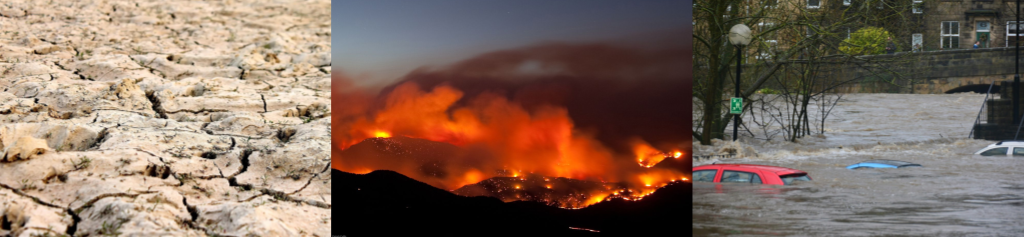
Hydrologic whiplash: drought, fire and flood. Left: Cracked thirst! Drought in India. (Image credit: NOAA Weather in Focus Photo Contest 2015 | Ritun Prachur). Middle: Fourmile fire. (Image credit: Patrick Cullis 2010. NCAR/UCAR Image and Multimedia Gallery). Right: Bingley Floods 2015 Boxing Day – Brown Cow Bingley (Image credit: Chris Gallagher 2019, Unsplash License).
Additional reading
Swain et al. 2025 https://doi.org/10.1038/s43017-024-00624-z
Francis et al. 2023 https://doi.org/10.1038/s41612-023-00542-9
Peek et al. 2020 https://www.frontiersin.org/article/10.3389/fbuil.2020.00110/full