
YES-27-A-30: Wildfire Aerosol Retrievals and Air‑Quality Applications from Polar and Geostationary Satellites
This PhD project will develop and apply advanced satellite aerosol retrievals to improve understanding of wildfire smoke pollution, its diurnal behaviour, and its representation in regional/global air quality (AQ) models. Intense wildfire regions such as Indonesia, boreal North America, and Australia (e.g. the 2019/2020 Black Summer bushfires – see Figure 1) generate extreme aerosol loadings that challenge current retrieval algorithms and modelling frameworks. By integrating Earth observation (EO) datasets, from multiple platforms, regional AQ modelling, and novel machine learning (ML) approaches, the project will deliver new capability for monitoring and evaluating fire driven AQ impacts.
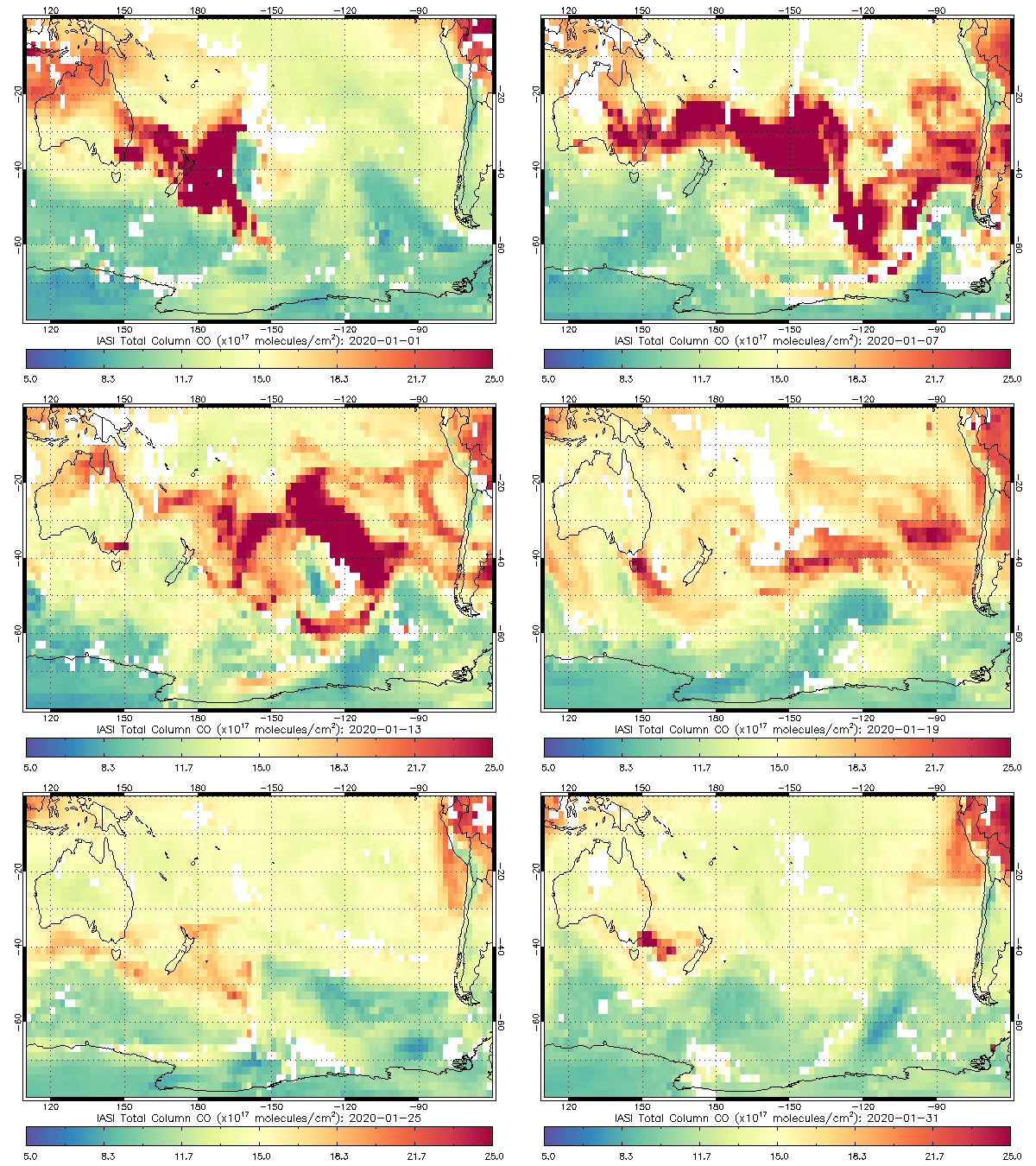 Figure 1: Satellite-retrieved carbon monoxide plumes from the Australian Black Summer bushfires in December 2019 and January 2020 (Pope et al., 2021).
The first research aim investigates aerosol pollution enhancements in intense wildfire regions using polar orbiting satellite observations. The student would work with project partners at the Rutherford Appleton Laboratory (RAL) Space, to optimise their satellite aerosol retrieval scheme to improve aerosol optical depth (AOD) retrieval performance under heavy smoke conditions. These enhanced retrievals will be evaluated against regional WRF CMAQ simulations (i.e. regional AQ model), and observations from the surface AErosol RObotic NETwork (AERONET) network to quantify how the new scheme works.
The second aim examines how diurnal fire activity influences emitted PM₂.₅ concentrations and associated health impacts. Using geostationary observations (e.g. Himawari), you will apply the optimised AOD scheme to derive high frequency aerosol fields over fire prone regions. ML methods (e.g. XGBoost) will then be used to estimate surface PM₂.₅ concentrations, guided by WRF Chem output (see Figure 2) and surface monitoring networks. This will enable assessment of how daytime fire variability shapes population exposure and short term health risks, providing new insight into the temporal dynamics of smoke pollution.
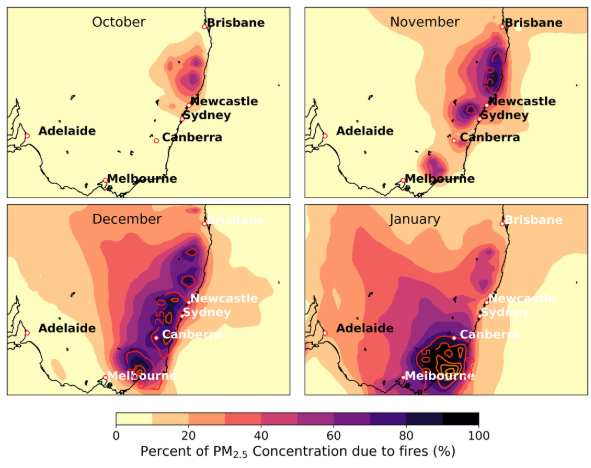 Figure 2: Contribution of the Australian Black Summer bushfires to PM2.5 pollution levels simulated by the WRF-Chem regional air quality model (Graham et al., 2021).
The third aim evaluates whether satellite retrievals of AOD and PM₂.₅ can improve assessment of operational AQ forecasts, particularly those from European Centre for Medium-range Weather Forecasts (ECMWF)’s Copernicus Atmosphere Monitoring Service (CAMS). Pollution from fire events in operation forecasts are generally poorly constrained due to sparse surface observational coverage. Therefore, by integrating near real time satellite retrievals of AOD and PM2.5, the project will identify systematic model limitations (e.g. such as emission timing, plume injection height, or aerosol processes) and demonstrate how EO data can strengthen operational AQ services. This forms a strong impact case study for the value of satellite observations in environmental forecasting.
Overall, the project will deliver a framework, exploiting multiple satellite sensors, novel retrieval schemes and regional modelling, to characterise wildfire smoke and quantify its AQ impacts, while improving the evaluation of operation forecasting systems. It aligns closely with national and international priorities on wildfire risk, atmospheric composition, and provides opportunities for collaboration with RAL Space, modelling groups at Leeds, and operational centres such as CAMS.
References:
, , , , , , et al. (2021). Impact of the 2019/2020 Australian megafires on air quality and health. GeoHealth, 5, e2021GH000454. https://doi.org/10.1029/2021GH000454
, , , , , , et al. (2021). Large enhancements in Southern Hemisphere satellite-observed trace gases due to the 2019/2020 Australian wildfires. Journal of Geophysical Research: Atmospheres, 126, e2021JD034892. https://doi.org/10.1029/2021JD034892