
YES-27-D-16: Unravelling Earth’s Magnetic Reversals
Earth’s core has generated a magnetic field for billions of years; however, the nature of that field has varied considerably through time for reasons that are still not fully understood. Both the average strength of the field and the average frequency of geomagnetic reversals have changed over timescales of 100s of millions of years. These changes relate to fundamental questions about the evolution of Earth’s deep interior, such as the influence of the mantle on core convection and the age of the inner core.
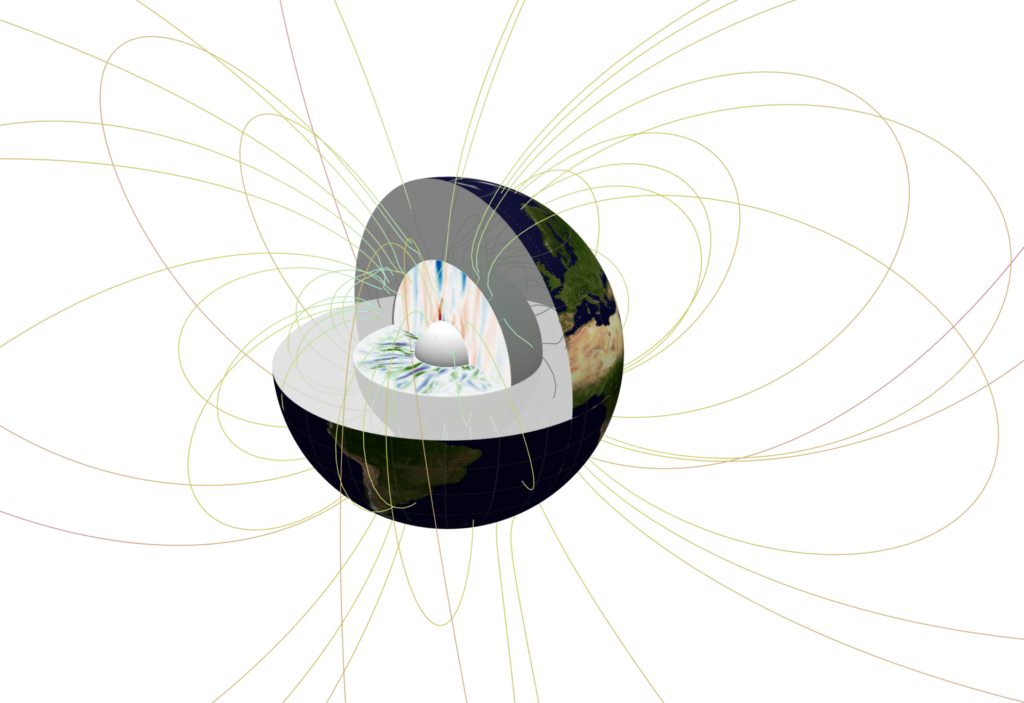
Magnetic polarity reversals are one of the most dramatic and well-known features of the geodynamo process; however, the mechanism by which the field reverses remains poorly understood. Previous attempts to study reversals in numerical simulations have failed to match the balance of magnetic to kinetic energy in Earth’s core, suggesting that the mechanisms at play in those simulations over-estimate the importance of inertia in the reversal process. We have made recent theoretical and numerical improvements that allow simulations to reach a more realistic energetic balance, opening up a new avenue for studying the details of Earth-like magnetic reversals. These simulations point to specific changes within the flow of Earth’s outer core that correlate with weakening of the global dipole field and, ultimately, magnetic excursions and reversals.
Not only does the Earth’s magnetic field sporadically reverse, but the average frequency of reversals has varied greatly over geological time. The recent field has reversed about 5 times per million years, whereas during the Cretaceous normal superchron there were either no, or very few, reversals for nearly 40 million years. The timescales over which the reversal frequency has changed is much longer than any timescales associated with the internal dynamics of the convecting liquid iron outer core and thus is likely related to external factors arising from the thermochemical evolution of the planet. Simulations have shown that changes in the distribution of heat extracted from the core can alter the frequency of reversals. Although we know that these heat flux patterns should change through time due to the evolution of mantle convection and plate tectonics, previous attempts to reconcile mantle circulation models with simulations of reversal frequency generally suggest that the Cretaceous would be a time of high reversal frequency – the opposite of what is observed! This previous work has not made use of the new simulation approach that generates low inertia reversals.
A combination of increased computing power and faster numerical implementations (enabling simulation of more Earth-like conditions) and better theoretical understanding (allowing more robust extrapolations of those simulations) means that we are now well placed to investigate fundamental questions around Earth’s magnetic reversals. You will analyse an extensive suite of existing simulations to characterise and understand the flows that have been identified as a potential trigger for magnetic reversals. You will run new simulations of the core to investigate both individual magnetic reversals and the long-term evolution of reversal frequency as mantle convection patterns change. You will compare the simulated reversals to paleomagnetic observations, building on established collaborations between Leeds and colleagues at the University of Liverpool and the Scripps Institute of Oceanography.
Overall, through this project you will shed new light on fundamental questions in deep Earth geophysics concerning the influence of the mantle on core convection, the nature of magnetic reversals, and why their characteristics change through time.
Related reading:
Terra-Nova, F. and Amit, H. Regionally-triggered geomagnetic reversals. Sci. Rep. 14, 9639 (2024).