
YES-27-G-03: Are European Trees at a Tipping Point? Assessing the impact of recent European heatwaves and droughts on tree growth and mortality
Are European Trees at a Tipping Point? Assessing the impact of recent European heatwaves and droughts on tree growth and mortality
Forests provide vital ecosystem services by regulating the hydrological cycle (Spracklen et al. 2012), cooling the land surface (Bonan 2008), and storing large amounts of carbon (Pan et al. 2011). However, the climatic conditions under which forests across the globe have developed are changing rapidly. Europe in particular has experienced several unprecedented heatwaves and droughts during the last decade, including the severe events of 2018, 2022, 2023 and the exceptionally hot and dry summer of 2026. These climate extremes have caused widespread reductions in tree growth, increased tree mortality and altered forest functioning across large parts of the continent. Yet it remains unclear whether the impacts observed in recent years are truly unprecedented, how they compare to historical droughts, and which species and populations are most vulnerable to future climate extremes,
The response of trees to drought and heat stress varies considerably among species and populations. While some species suffer strong growth declines and elevated mortality during drought, others remain relatively resilient. These differences are thought to reflect variation in hydraulic traits, carbon storage strategies and other functional characteristics. Understanding why some species and populations are more resilient than others is essential for predicting the future of European forests under continued climate warming and intensifying drought.
The aim of this project is to place recent European heatwaves and droughts, including the extreme summer of 2026, into a long-term context and identify the traits and environmental conditions that determine tree vulnerability and resilience to climate extremes.
This project will combine large international tree-ring databases, forest inventory data, climate records and trait databases to provide a unique assessment of how trees across Europe have responded to historical and recent droughts. Particular emphasis will be placed on understanding how recent extreme events compare with past droughts and whether forests are approaching critical thresholds of climate vulnerability. In addition to analysing existing datasets, you will conduct new tree-ring sampling campaigns focusing on key European tree species occurring at the warmest and driest margins of their geographic distributions, where vulnerability to climate extremes is expected to be greatest.
Using these datasets, you will address several significant questions, including:
- How does the impact of the extreme European heatwaves and droughts of the past decade, particularly the summer of 2026, compare with earlier drought events in terms of tree growth decline and mortality risk?
- Are tree populations occurring at the warm and dry edges of their climatic distributions more vulnerable to heat and drought stress than populations growing in the centre or cooler parts of their range?
- How do drought sensitivity, resilience and recovery differ among major European tree species, such as oak, beech, pine and birch?
- Can we predict species’ vulnerability to drought and heat extremes from functional traits and phylogenetic relatedness?
- How well does climate sensitivity derived from tree rings predict long-term mortality risk and forest resilience under future climate change?
The insights generated will improve our ability to predict how European forests will respond to increasing climatic extremes and inform both ecosystem models and forest adaptation strategies.
Material & Methods
You will compile and analyse large datasets of tree rings, climate, forest inventories and functional traits to assess the sensitivity of European tree species to drought and heat stress. Tree Ring Database (ITRDB) contains more than 100,000 tree-ring series from over 4,000 sites worldwide, providing an unparalleled opportunity to place recent climate extremes within a long-term perspective. While the primary focus of this PhD will be on Europe and its recent droughts, you can explore also the full potential of all global tree ring records in this database for the purpose of this study. These tree ring data will be complemented with records from National Forest Inventories, collaborators and published studies and new tree ring collections.
By linking tree-ring records with historical climate data, you will quantify species-specific growth responses to drought and temperature variability across multiple decades and determine whether recent events, including the 2026 drought in Europe, resulted in exceptional growth reductions relative to past extremes. Species’ climate sensitivities will subsequently be linked to functional traits derived from large databases such as TRY and DRYAD to assess whether hydraulic, anatomical and life-history characteristics influence vulnerability and resilience.
A distinctive component of the PhD will be the collection of new tree-ring data from selected European species at the warm and dry limits of their distributions. These populations are expected to experience some of the strongest impacts of climate warming and therefore provide valuable natural laboratories for studying adaptation and climate vulnerability. The new field data will complement existing databases, provide training in dendrochronological methods and help fill important geographic and taxonomic data gaps. Additional components of this PhD project may include the use of remote sensing products to assess the large-scale effects of drought across space and time.
Potential for High-Impact Outcome
The recent sequence of European droughts presents a unique opportunity to understand how forests respond to unprecedented climatic stress. By combining long-term tree-ring records with contemporary observations of drought impacts, this project will bridge the gap between historical climate sensitivity and current forest decline. The integration of large-scale databases, functional trait information and new field data from climate-range margins will provide novel insights into the mechanisms that determine forest resilience.
The results will directly inform predictions of future forest vulnerability, improve vegetation and Earth system models, and help identify species and populations most at risk under continued warming and increasing drought frequency. Given the growing concern regarding forest health across Europe, this research has strong potential for impactful scientific publications and policy relevance.
Student profile
You are expected to have strong interests in environmental and earth system science and global change. You also should have some background in disciplines such as mathematics, physics, geography, biology, or environmental science. Strong analytical skills are required.
Training
You will work under the supervision of a strong team of earth system dynamics experts within the Ecology and Global Change research group of the School of Geography. Direct daily supervision will be by Profs. Roel Brienen and Emanuel Gloor. You will also benefit from working within a highly active and multidisciplinary group of scientists in the Leeds Ecosystem, Atmosphere & Forest (LEAF). The school of geography has excellent and state-of-the-art laboratory facilities including a full equipped tree ring lab. You will have access to a broad spectrum of training workshops put on by the Faculty that include an extensive range of training workshops in numerical modelling, through to managing your degree, to preparing for your viva.
Contact e-mail: [email protected]
Research Keywords : Forests, Ecology, climate change, Resilience, sensitivity, dendrochronology
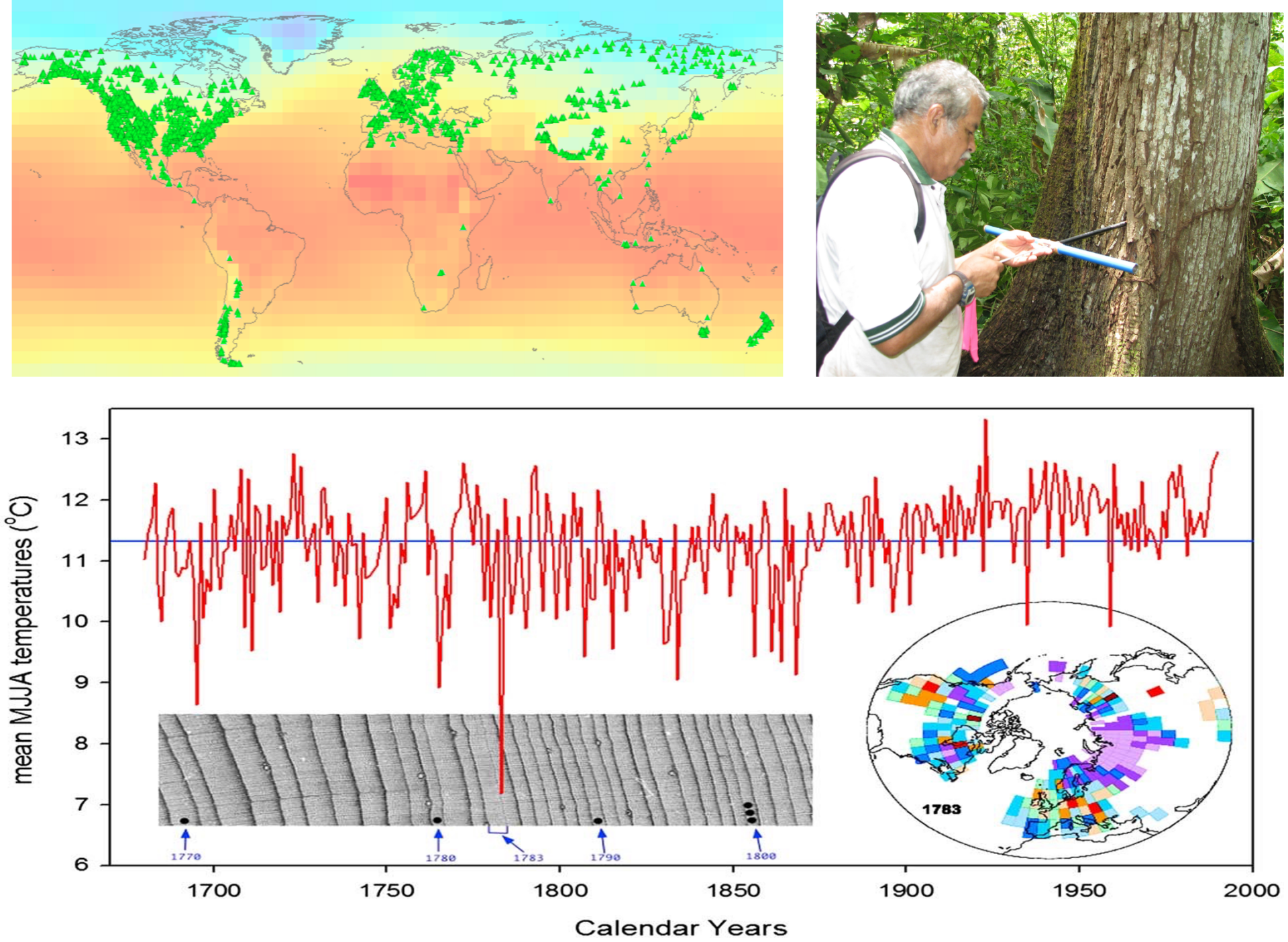
Fig. 1 Approaches used in this study consist of sampling and analysing tree ring data from new sites and use the extensive dataset of the International Tree Ring DataBase (ITRDB) (see map) available online (see http://www.ncdc.noaa.gov/data-access/paleoclimatology-data/datasets/tree-ring). This dataset contains tree ring data from over 4000 sites, and hundreds of species.
References
Anderegg, W. R., Konings, A. G., Trugman, A. T., Yu, K., Bowling, D. R., Gabbitas, R., … & Zenes, N. (2018). Hydraulic diversity of forests regulates ecosystem resilience during drought. Nature, 561, 538–541.
Bonan, Gordon B. “Forests and climate change: forcings, feedbacks, and the climate benefits of forests.” science 320, no. 5882 (2008): 1444-1449.
Chapin III, F. S., Schulze, E. D., & Mooney, H. A. (1990). The ecology and economics of storage in plants. Annual review of ecology and systematics, 21(1), 423-447.
McDowell, N.G. (2011) Mechanisms Linking Drought, Hydraulics, Carbon Metabolism, and Vegetation Mortality. Plant Physiology, 155, 1051-1059.
Pan, Y., Birdsey, R.A., Fang, J., Houghton, R., Kauppi, P.E., Kurz, W.A., Phillips, O.L., Shvidenko, A., Lewis, S.L., Canadell, J.G., Ciais, P., Jackson, R.B., Pacala, S.W., McGuire, A.D., Piao, S., Rautiainen, A., Sitch, S. & Hayes, D. (2011) A Large and Persistent Carbon Sink in the World’s Forests. Science, 333, 988-993.
Ryan, M. G., & Yoder, B. J. (1997). Hydraulic limits to tree height and tree growth. Bioscience, 47(4), 235-242.
Sperry, John S., Frederick C. Meinzer, and KA. McCulloh. “Safety and efficiency conflicts in hydraulic architecture: scaling from tissues to trees.” Plant, Cell & Environment 31.5 (2008): 632-645.
Spracklen, D.V., Arnold, S.R. and Taylor, C.M. (2012) Observations of increased tropical rainfall preceded by air passage over forests. Nature, 489(7415), 282.