
YES-27-G-10: Source and fate of microfibres in river catchments
Source and fate of microfibres in river catchments
Introduction
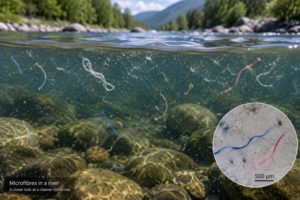
Plastic pollution is arguably the hottest topic in water quality science at the moment and developing strategies to use plastics sustainably is a key aim of research. Policy interventions have not previously been based on good scientific evidence though and little has been done to target the most prevalent types of plastic pollution. We now know that microfibres are by far the most numerous type of plastic found in the environment (Bayo et al., 2019; Suaria et al., 2020) but that most of these fibres are not actually plastic but cellulosic (Stanton et al., 2019; Muns-Pujadas et al., 2023) (Figure 1). Cellulosic fibres such as cotton have been hailed as the solution to microfibre pollution but recent work has shown that they may not degrade as fast as previously thought due to the various chemical pretreatments, dyes and finishes used in textile production (Kim et al., 2022; Zambrano et al., 2021). Currently, very little is known about where cellulosic fibres enter the environment and what their fate is, which is crucial information for the sustainable management of microfibre production and pollution.
Aim and objectives
The aim of this project is to examine the source of microfibres in river catchments and their subsequent environmental fate. Specific objectives will be agreed with the successful candidate but are likely to include:
• Measure microfibres present in rivers up and downstream of potential source locations, including textile manufacturing facilities, wastewater treatment plants and urban runoff discharges.
• Quantify the distribution of microfibres between the water column and river sediments.
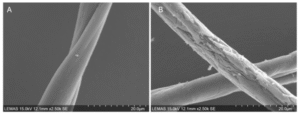
• Examine the characteristics of microfibres sampled from different locations using techniques such as electron microscopy (Figure 2) and FTIR.
Supervision
You will be supervised by Prof Paul Kay (School of Geography) and Prof Richard Blackburn (School of Design), providing expertise across water science and sustainable materials. You will be part of research groups in both of these schools and also receive training as a member of the doctoral network.
References
Bayo, J., Rojo, D. and Olmos, S. 2019. Abundance, morphology and chemical composition of microplastics in sand and sediments from a protected coastal area: The Mar Menor lagoon (SE Spain). Environmental Pollution. 252, pp.1357–1366.
Kim, S., Cho, Y. and Park, C.H. 2022. Effect of cotton fabric properties on fiber release and marine biodegradation. Textile Research Journal. 92(11–12), pp.2121–2137.
Muns-Pujadas, L., Dallarés, S., Constenla, M., Padrós, F., Carreras-Colom, E., Grelaud, M., Carrassón, M. and Soler-Membrives, A. 2023. Revealing the capability of the European hake to cope with micro-litter environmental exposure and its inferred potential health impact in the NW Mediterranean Sea. Marine Environmental Research. 186, p.105921.
Skilbeck, O. (2026). The effect of preparation, dyeing and finishing treatments on the biodegradation of cellulosic microfibres. PhD thesis, University of Leeds.
Stanton, T., Johnson, M., Nathanail, P., MacNaughtan, W. and Gomes, R.L. 2019. Freshwater and airborne textile fibre populations are dominated by ‘natural’, not microplastic, fibres. Science of The Total Environment. 666, pp.377–389.
Suaria, G., Achtypi, A., Perold, V., Lee, J.R., Pierucci, A., Bornman, T.G., Aliani, S. and Ryan, P.G. 2020. Microfibers in oceanic surface waters: A global characterization. Science Advances. 6(23), pp.8493–8498.
Zambrano, M.C., Pawlak, J.J., Daystar, J., Ankeny, M. and Venditti, R.A. 2021. Impact of dyes and finishes on the aquatic biodegradability of cotton textile fibers and microfibers released on laundering clothes: Correlations between enzyme adsorption and activity and biodegradation rates. Marine Pollution Bulletin. 165, p.112030.