
YES-27-G-13: Peatland restoration and water budgets under climate change
Background
Peatland restoration strategies aim to raise water tables, to support peat-forming plant species and slow decomposition, ultimately increasing long-term carbon storage. However, restoration fundamentally alters the movement and storage of water within peatland catchments.
Restoration schemes aim to improve ecosystem functioning and services by increasing water retention, but there is limited understanding of how much water is required to sustain restored peatlands under future climate change scenarios. This is increasingly important as climate change is expected to alter rainfall patterns, increasing drought frequency, altering evapotranspiration rates and water availability. Related to this, during periods of low rainfall peatland streams and downstream rivers and reservoirs experience very low flow. There is limited evidence for the role of peatland restoration in changing low flow conditions. Some organisations, such as water companies, are concerned that restoration, including creation of pool systems on peatlands, may reduce riverflow during dry weather.
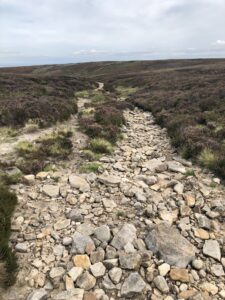
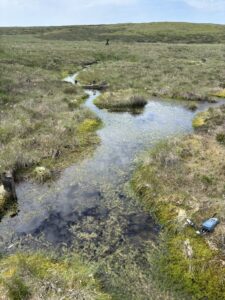
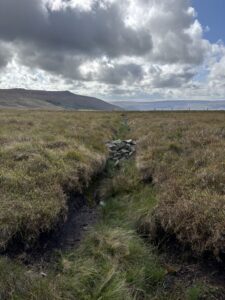
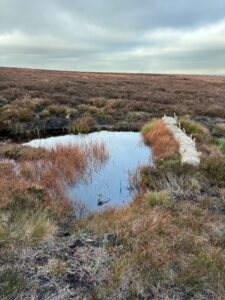
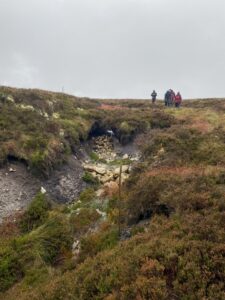
Figure 1. Photographs of: A dry river bed on a peatland, a restored site where water has pooled behind wooden gully blocks, a stone dam in a dry gully where vegetation has re-established, recently installed gully blocks holding back water to raise water tables, and a actively eroding gully in a peatland.
Headwater streams and rivers in peatland catchments are also hotspots of aquatic carbon processing. Dissolved and particulate carbon in streams flowing out of peatlands acts as a large flux of carbon that is processed in situ and either lost as gases to the atmosphere or flocculates in lower flow water, such as reservoirs, lakes and estuaries. Restoration aims to reduce carbon export, but the long-term interactions between restoration, water and carbon budgets under future climate scenarios remains a critical knowledge gap.
Aim/Methods
This project will investigate i) the water inputs needed to restore or maintain peatlands under present and future climate conditions, ii) the impact of restoration on low flows and evapotranspiration rates and iii) the impact of these hydrological changes on aquatic carbon budgets.
The project will likely involve a combination of some of the below:
Fieldwork to measure water table, stream flow, peat physical properties
Lab work to measure water/peat properties
Measurement of key peat hydraulic properties controlling water movement
Modelling of catchment water budgets
Sensitivity analysis for extremes of rainfall and drought
Links to carbon processing – DOC export
The project may involve local sites such as Bridestones Moor, and areas in the North Pennines, or other sites/international analysis as deemed suitable as the project concept is developed by the successful applicant.
Outputs/Impact
We anticipate the PhD thesis resulting in at least three journal papers. The project will aid organisations concerned about impacts of changing peatland management on low flows during drought conditions (e.g. water companies, restoration agencies) and also support evaluations of climate change impacts on aquatic carbon export.
Example reading:
IUCA (International Universities Climate Alliance), 2024. Water for Climate Mitigation: Estimating the Water Requirements of Climate Mitigation Measures. IUCA. http://hdl.handle.net/1959.4/102824
Xu, J., Morris, P.J., Liu, J., Ledesma, J.L.J., Holden, J. (2020) Increased dissolved organic carbon concentrations in peat-fed UK water supplies under future climate and sulfate deposition scenarios. Water Resources Research 56, e2019WR025592, DOI: 10.1029/2019WR025592
Howson, T., Holden, J., Chapman, P.J., Shah, N., Anderson, R. (2021) The effect of forest-to-bog restoration on the hydrological functioning of raised and blanket bogs. Ecohydrology, 14, e2334, DOI: 10.1002/eco.2334
Putra, S.S., Baird, A.J., and Holden, J. (2022) Modelling the performance of bunds and ditch dams in the hydrological restoration of tropical peatlands. Hydrological Processes, 36, https://doi.org/10.1002/hyp.14470.